SAMUEL PEPYS

Rose early and off to my office
After playing the fool with young Nell
And thinking a while in my study
Of mon plaisir I had had avec elle.

I do see my nature’s unconquered,
Music and women I cannot refuse
Esteeming these pleasures above all else,
‘Tho my business I most surely abuse.

The Duke of York hath got with child
My Lord Chancellor’s daughter Sally
Who claims there be, on oath of blood,
An agreement that they shall marry.

Whoever do get a wench with child
Then promise that they’ll be wed
Is as if a man should piss in his hat
And then clap it upon his head.

To church and there saw a wedding,
Young people in merry delight;
What pleasure we married people have
To see others decoyed in a similar plight.

So apt is my nature to evil
Once set upon pleasure again
That I’m down to Deptford by boat
For a bout with the wife of a friend.

Strange how a brave, bucksome woman,
Professing great pretence to adore
Her husband, her family, her religion,
May behave like a Drury Lane whore.

And so to my home and to dinner,
A most handsomely served meal
Of a dozen plump larks, all in a pie,
Some prawns and a shoulder of veal.

The claret has left me quite fuddled,
The brandy has gone straight to my head:
I played awhile with the breasts of our Nell
And being sated therewith, so to bed.

EEYORE GOES FRENCH – Special Gourmet Edition

Back in the air and bound for Paris via Bangkok and Dubai. The plane is enormous; I’m not sure whether I’m sitting upstairs or downstairs. I’m reminded of the words of actress Talulah Bankhead when she boarded the Queen Mary in 1931 and asked ‘What time does this place get to New York?’ Aboard are lots of young, scantily clad passengers travelling to tattoo parlours in Bangkok, some old duffers like myself on their way to poke around European museums and a few bound for vacation in Dubai. With so many holiday possibilities in this suddenly shrunken world, why anyone would be interested in spending free time in Dubai defeats me, unless you are a worshipper of the Golden Calf and enjoy window shopping for Rolex watches, playing tennis on the roof of a skyscraper or wafting through air-conditioned, marble-clad hotel lobbies. Like Babylon, I suppose Dubai will end up under the sand, only the tip of a broken ski-lift marking its tomb. Unlike Babylon there will be nothing among the ruins that will interest the Louvre or the antiquities department of the British Museum.

I feel a strong sense of home when I come to Paris; after all we were married for close on fourteen years. I loved her then although I’m not sure she loved me in return, certainly not in the beginning, for she had many lovers. But little by little, in her coquettish way, she revealed herself, from her medieval rat holes in the rue Quincompoix to her glassy slopes of La Defense, until she finally came to me completely, nue, toute nue et sans culottes. Now she is an old mistress I like to visit occasionally with no thoughts of marriage for we have both changed. Of course, those that fall in love with her now love her for what she is, for she renews herself continually while we merely age. In years to come her new lovers too will mourn the loss of the Paris they loved.

It was certainly a less busy and less regulated city in 1970. No one paid parking fines in the knowledge that the city had no means of enforcing collection, which it acknowledged by announcing annual amnesties. With considerably less traffic than present and no rules against driving after a couple of bottles of Beaujolais Nouveau, it was quite possible, as I well know, to drive the wrong way around the Etoile at four in the morning. Then, there were only six other founding states in the European Union and our office challenge, to sleep with a girl from each member country, was not unachievable; today even George Clooney would have trouble completing the course. Gone too is the afternoon thé dansant in the café under the Theatre du Champs Elysees where we would light up our elderly dancing partners with a Coca Cola bottle down the front of our trousers. Ah oui, ah oui.

One secret the city yielded up concerns the world’s oldest profession; no, not accountants. While conducting an inventory at one of my audit clients, the minor haute-couture house of Jean-Louis Scherrer, I asked why a rack of expensive dresses had been excluded. These, said the elegant manageress, making me feel like a cockroach about to be speared by her haut-talons, ‘are partly-paid dresses awaiting the final installments.’ In fact, to put it politely, they were the accumulated earnings of demi-mondaines. The scam operated as follows: The lady, declining cash for her services as too vulgar, suggests a little dress instead. The dress, which costs 3,000 francs, is sold, with the connivance of the assistant for, say 500 francs, but left at the shop by the lady for “alterations”. After five more ‘tricks’ the dress is hers. Quelle finesse!!

Even blindfolded I believe I could identify my whereabouts from Paris’ particular smell, a mixture of perfume, disinfectant, beeswax and praline. I’m surprised someone hasn’t bottled it and marketed it as Eau de Clichy. I love it here; shall I seek asylum?

I’m staying with my old friend P-J. We are anciens combattants and have fought our way together through feijoadas in Brazil, raclettes in Switzerland and Chili Crab Cakes in New Orleans. We will spend a few days in Versailles and Paris and then we are off to Touraine and Anjou to see if classic, French provincial cuisine is alive and well after the deprivations of fast food and the excesses of nouvelle cuisine. P-J, a supremely peaceful man, has some very comfortable digs in Louis XIV’s old Ministry of War, a stone’s throw from the Palace. The building, appropriately in the quartier St Louis, is next to the Conservatoire du Musique and on sunny mornings one may wake to the sound of piccolo and violin.

Dinner in one of my favourite restaurants, Le Limousin in Versailles, an old fashioned, no nonsense establishment where the speciality is gigot. While P-J modestly picks at some foie gras frais for starters, I tuck into one and a half legs (or rather three half shinbones) of grilled bone marrow, leaving my finished plate looking like a prehistoric ossuary. For mains P-J takes the gigot with pommes dauphinoises while I choose an andouillette, a sausage of what appears to be compressed, highly seasoned rubber bands but in fact are chitterlings, the small intestines of the pig. The menu informs me that my andouillette is a 5A model, that is to say the top of the range according to the Association Amicale des Amateurs d’Andouillette Authentique, the governing body of this particular species of sausage.

Saint Louis Blues

France is a very saintly country; even the cheeses are canonized; in fact I’m nibbling on a tasty Saint Marcellin as I write. We have a Saint Paris railway station (St Lazare), a saint writer cum aviator (St Exupery) and thousands of sanctified cities, towns, villages and hamlets, from St-Agnan to St-Zacharie. Each day is named for one saint or another, and of these a select few have been chosen as France’s patron saints. One of these, Saint Denis (the first Bishop of Paris), has lent his name both to the Abbey of St Denis, last resting place of French Kings and to the rue St Denis, notorious nesting place for those seeking solace in the arms of a fille de joie.

It is the 800th anniversary of the birth of Saint Louis, aka Louis IX, France’s only King to be honored with sainthood, the medieval equivalent of the Nobel Prize, and, after an unseasonal navarin and a glass of Saumur in the Café des Deux Palais, we pay our respects with a visit to Sainte-Chapelle. On the way P-J shoos away small packs of Romany children who, he claims, under guise of asking us to sign a petition or complete a meaningless questionnaire, will strip us of our purses like a school of hungry piranhas.

I can never understand why the French, and the Parisians in particular, are so often accused of rudeness. They are a serious people and may occasionally tire of the less mannered peoples that invade their country, intent only on enjoyment and expecting everyone to love them for buying a croque monsieur and a café au lait. I understand certain sections of the Inuit people are almost as well mannered as the French, but I would need to see that for myself.

It is Sunday, market day and autumn and the plane trees lining the broad avenues that fan out from the Palace are beginning to litter the sidewalks. Recent rain makes it seem that we are walking through a dish of sodden cornflakes. Past the statue of Louis Lazare Hoche, a General at 23 and mort pour La Patrie at 29. Rain or sun, nothing beats a visit to a French market on a Sunday morning. The market is packed and the same Peruvian pipe band I saw last week in Pitt Street is playing El Condor Pasa. I’m surrounded by yellow, corn fed chickens from Bresse, puck-sized goat cheeses with exquisite labels, resembling a hoard of precious medals, pates en croutes, polished, purple aubergines, punnets of raspberries and stalls sagging under mountains of charcuterie. My taste buds, long dormant, begin to flower again. I hate to be pessimistic but I think it will be a thousand years before Australia can produce a saucisson of the quality one finds in the weekly food markets of France.

We buy oursins sur lit de varech (sea urchins on seaweed bed), crab claws, bulots (whelks) and crevettes grises, the tiny, sweet North Sea shrimp that are eaten whole. In England, peeled and encased in seasoned butter they are potted shrimps and served on toast, one of the country’s finer dishes. That evening we bookend our seafood with foie gras frais sur pain d’epices and fromage blanc a la crème and sink a bottle of Domaine Bel Air 2013, Gros Plant du Pays Nantais sur Lie. After dinner P-J opens a superb 15 year old Armagnac. Poured into glasses that could accommodate several goldfish in comfort, the aroma mixes into the general atmosphere of smouldering Monte Cristo No 3s, leather-bound works of Jules Verne and 17th Century furniture.

For reading matter I have brought ‘Agincourt’ by soldier/explorer Sir Ranulph Fiennes, not to upset the French but because the author, interestingly, had notable ancestors fighting on both sides in the conflict. One ancestor, William the Conqueror’s general commanding the 1066 invasion of England, was rewarded with estates and titles in that country. Among his descendants were a queen of England and Henry V’s captains at Agincourt. Members of the Fiennes family who remained in France also prospered, one ending up as Connetable de France, one dying at Agincourt. Finsbury Circus in London was land donated by the family as a last resting place for the heart of a son killed in the 2nd Crusade. Actors Ralph and Joseph Fiennes are cousins.

On the 20th June 1789 Louis XVI, in an effort to halt the liberalizing program of the Estates General, barred its members from entry into the Hotel des Menus-Plaisirs, their normal meeting place in Versailles. A deputé from Paris, Joseph-Ignace Guillotin, led his frustrated colleagues to the tennis court in the rue du Jeu de Paume. There, 641 deputés, that is to say the Third Estate joined by a few deputés from the Clergy and Nobility, swore ‘never to separate until the Constitution of the Kingdom is established and built on solid foundations’. If you stand in the Jeu de Paume now, you are standing at the birthplace of French democracy. Later that year Monsieur Guillotin, a physician by profession, proposed that all persons guilty of crimes demanding capital punishment should suffer the same clean and efficient method of execution. It was a German engineer, Tobias Schmidt, who actually designed and built the instrument. Obviously, it sounded wrong to be ‘Schmidted’ or to be ‘sent to the Schmidt’ and so it became known as the Guillotine. Personified during the Terror as Madame Guillotine when she operated in the Place de La Concorde, she had a long and busy life. The last public guillotining was in June 1939 outside the Saint-Pierre Prison (another Saint) in Versailles (now the Palais de Justice). The last person to be executed by guillotine was Hamida Djandoubi in September 1977.

Monuments Men

We are off to Touraine and Anjou or Indre et Loire and Maine et Loire, two of the departements established by Napoleon whose size was determined by the distance a horseman could cover in a day. We stay mainly on the left bank of the Loire avoiding the better-known tourist attractions. We are in early autumn and follow the curling road alongside the river, which in the morning is invisible until the sun disperses the damp mist hovering over the surface. The trees are in various stages of advancement into their autumn colours; there are balls of mistletoe in the tops of poplars; crows peck among the corn stubble. It’s like having a preview of heaven, a sort of visitors day, except that I suspect that the real heaven, if it existed, would be rather boring, full of politically correct people strumming harps, while all the interesting people will be in the other place (if it existed).

Our first stop is the village of Meung because it was here, on a spring morning, standing on the banks of the Loire, some 45 years ago, that I had an epiphany – a natural not religious epiphany; I have never believed in the supernatural. Similar feelings of intense happiness have returned now and again, sometimes interspersed with occasional glum periods of leaden depression and debilitating fatigue. I once checked out these symptoms with a psychiatrist, who, after looking at the results of a question and answer test, pronounced me to be mildly bi-polar. ‘Tell me’ I said, ‘how does this make me different from a normal, uni-polar, person, for we all have mood swings’. ‘The difference’ said the Doc, ‘is that you do not know how you will feel tomorrow, whether you will be sad or happy, whereas I, on the other hand know that I will always be the same’. This information convinced me to reject the Doc’s offer of medication and leave his consultancy content with the knowledge that the road ahead was at least unknown. Peaks and valleys have always made for a more interesting landscape then endless plains.

After standing in that same spot by the river, waiting to see if enlightenment would strike a second time, it was time for lunch and the Café du Commerce looked, and proved to be, promising. We both chose le plat du jour, a parmentier du coq au vin, mine with a pichet of cabernet franc, P-J’s with a Perrier because he was driving, although I suspect he drives better after a glass of Jaja. Afterwards we visited the Chateau where we descended into the damp bowels of its prisons or ‘oubliettes’ where poet Francois Villon languished for several months in 1461. From his ‘Ballade des Dames du Temps Jadis’ comes one of the world’s most quoted lines of poetry ‘Mais ou sont les neiges d’antan?’ (‘Where are the snows of yester-year?’). Jehan de Meung, another famous inhabitant, was the co-writer, with Guillaume de Lorris, of Le Roman de La Rose, the bible of courtly love.

Then, in short order, the Chateau of Usse, which inspired a previous visitor, Charles Perrault, to write Sleeping Beauty; the Chateau of Langais, where Anne de Bretagne married Charles VIII, so adding Brittany to the Kingdom of France and Clos Lucé, where Leonardo da Vinci designed helicopters for Francois I. I’m completely Chateau’d out. I’m so worn out with climbing medieval staircases that I have barely the strength to tear apart my bread roll as we sit down to dine at Le Colombien in the village of Villandry. After popping open a bottle of Domaine des Varinelles Saumur Champigny 2010, P-J chooses a Rable de lapin au foie gras de canard extra compote de pruneau de Tours a l’Hypocras. Sheer music isn’t it? P-J is eating so much foie gras the geese and ducks in Perigord have been put on overtime. I’m easing up with a salade de gambas and the fillet de Saint Pierre and finishing with a sorbet. Every restaurant should have a refreshing sorbet on its dessert menu. Le Procope, which opened its doors in 1686 and is still operating in la rue de l’Ancienne Comedie, once offered 80 varieties for the delectation of its clientele.

Our rooms, bearing the scars of multiple reconfigurations since the 14th Century, are perfectly clean and comfortable. When I turn on the taps in the bathroom I hear the reverberating engines of the lost Titanic.

A whizz around the Chateau de Villandry with its Italianate vegetable gardens. A compulsive acquirer of rubbish, I am spending more time in the museum shops than studying examples of Gothic architecture and Gobelin tapestries. A Joan of Arc bookmark, a medieval cooking calendar, a cushion with the embroidered coat of arms of Anne de Bretagne, a fridge magnet with a picture of the Chateau de Chambord, all will be exported to Australia only to end up on sale in one of Sydney’s charity shops. I hesitate over a pair of earrings bearing the heraldic insignia of the Duke of Anjou, trying to picture them hanging from my Honeybee’s lobes. A plastic bassinet and a replica Genoese crossbow secure my interest. But Allo! Allo! What’s this? A plumed musketeer’s hat! A chapeau from the chateau! Alas, lack of luggage space means this tasteful piece of headgear will be unavailable at my local Salvation Army shop.

For lunch, P-J’s intelligence network has fingered Au Chapeau Rouge in the centre of Chinon, where Murielle greets us and we settle in to peruse the menu. I settle for an entrée of Veloute de Topinambour (pumpkin soup), a main of ‘Joue de Roi Rose confite a la Turone Ambreu de Cormery et aux pommes (pig’s cheek with apple) and a dessert of Poire pochée coulee a la feve de cacao (poached pear with chocolate sauce). We tell Christophe, Murielle’s tocque-hatted husband, that we enjoyed the meal.

Worked some of the lunch off with a hike around the Chateau, but must give the liver a rest, it’s been working overtime on all those rich sauces and creams and cheeses, not to mention the wine and the Armagnac. Forty years ago I returned from a trip to Egypt with a violent dose of hepatitis, which kept me bedridden for nearly six months, able only to digest dried bread and peeled and pipped grapes. ‘M’sieur’, said the French Doc when I was finally able to rise from my couch, ‘I regret to inform you that your liver has suffered considerably and therefore you will never be able to drink alcohol again’. Totally wrong of course; I’ve never had much confidence in French doctors since.

Chevaliers de la Table Ronde
Goutons voir si le vin est bon

Last night P-J, a Chevalier de la Tastevin no less, fell in love with an impertinent little Chenin Blanc at dinner, which he felt made a perfect marriage with his Feuilleté de St Jacques à la crème de Cognac and so we are making a detour to the village of Varrains and to the winery of the Daheuiller family. The wines of Touraine are unfashionable and therefore relatively cheap, in fact the most expensive Bourgueil I could find in Nicolas was 8.50 euros. The principal grape varieties of Touraine are Chenin Blanc, present in Vouvray, Saumur and Chinon wines and Cabernet Franc, better known as the minor partner in some Bordeaux blends while Folle Blanche is used in the making of Gros Plant. They all taste of France.

P-J tells me of a grape variety that, distilled, can invoke delirium tremens, a state my mother felt sure would overtake her after a second glass of Dubonnet.

Afterwards, a visit to La Divinière, home of the rumbustious, hard drinking Francois Rabelais, author of the satirical and lewd Gargantua and Pantagruel. Presumably an ancestor of Gerard Depardieu.

Manger à Angers

We’re in the charming town of Angers to visit the Saint Louis exhibition being held in the Chateau. Louis was a manic collector of reliquaries, ornate receptacles of macabre religious ephemera – bits of canonized fingers, splinters from the true cross. Sainte-Chapelle itself was built on Louis’ orders as a giant reliquary to hold the Crown of Thorns. On Sainthood, Louis turned from collector to collected and sure enough, just visible in an elaborate, jeweled container is a minute piece of one of his kingly garments. A coffin-sized reliquary holds the entire body of one nameless, forgotten saint. Missing, of course, is the Holy Grail.

Afterwards, at the highly recommended Creperie du Chateau – a galette of reblochon, pommes de terre et jambon de Bayonne, a crèpe jus de citron et sucre and a bowl of Breton cider. Pas mal du tout.

The royal Abbey of Fontevreauld once held the mortal remains of Henry II, Eleanor of Aquitaine and their son, Richard, although the abbey was ransacked during the French Revolution and only the stone effigies remain. Richard, although King of England spent most of his life in France and travelling to the Holy Land on Crusades, which is why he is referred to as Richard Gare de Lyon in the charming book ‘1066 and all That’. Revolutionaries turned the abbey into a prison which has only been opened to the public since 1985.

Nantes is not a particularly charming town, too little planning and too much grey slate; mind you we are seeing it at its worst in the midst of a rain-storm. Our hotel is basic, which is all one would expect for 51 euros, and P-J has trouble squeezing into the perspex coffin of a shower, especially after what was possibly the best meal of the trip at the apartment of Jean-Michel and Gerard.

A whizz around the Chateau of the Dukes of Brittany and then a visit to the Jules Verne museum overlooking Feydeau island where he was born. Along with HG Wells, a father of science fiction, Jules Verne wrote 62 adventure stories. I suppose his modern day equivalent would be George RR Martin and his Songs of Ice and Fire novels, except that the Frenchman wrote literature, although the stuffy old Academie Francaise refused to recognize this. His yacht was, of course, named after a Saint (Michael).

Back in Versailles it’s time to find some gifts for those left behind and where better than Guerlain, which is strategically located near the point where the tourists exit the Palace and deux pas from chez P-J. Forget Armani, Christian Dior and Old Spice, there are only two real perfumiers, Guerlain, founded in 1824 and Penhaligon, established in 1860, both apparently used by Queen Victoria to keep Prince Albert interested. They both produce unmistakable fragrances but are quite dissimilar. Penhaligon’s Bluebell is an après-tennis kiss in the summerhouse that leaves you throwing your racquet in the air; Guerlain’s Shalimar is the tongue down the throat after dinner at Maxim’s. It is the fragrance that M’Lady de Winter dabs in her ivory cleavage before folding you in her fatal embrace. Habit Rouge was once my eau de choix and brought me considerable success in my salad days. I buy Habit Rouge for my son and Mitsouko for my Honeybee. I decline the assistant’s offer to perfume me; my Honeybee would be upset if I was trampled to death in a sudden stampede by a busload of Polish lady tourists.

One last outing to the antiquarian book market held each Sunday at the old Abbatoirs de Vaugirard (now the Parc Georges Brassens) near the Porte de Vanves. I am fortunate that not many sellers take credit cards and that the market is on the other side of the world. Nevertheless, I exit with several weighty tomes including a Nicolas wine catalogue from 1931 and a charming 1965 cookbook by Michel Oliver, an early exponent of nouvelle cuisine and son of Raymond, owner of the Grand Vefour in the Palais Royal.

Time to leave and give the ducks and geese a rest. Merci P-J. I leave you, (my hand-luggage bursting with unsent post-cards), with a quote from the real Eeyore:

‘This writing business. Pens and pencils and what-not. Over-rated, if you ask me. Silly stuff. Nothing in it.”

DEATH IS JUST AN (IRREGULAR) HEARTBEAT AWAY

Sonnet for an ageing hypochondriac

I’m concerned about my prostate and the colour of my pee,
It’s not that pale straw or light Sauterne I’m sure it’s meant to be.
My knees are giving trouble, my anatomy is grey
And my skin is hanging on me like a dank and dismal day.
I wake each night with trembling, in deadly earnest fear
At each new pain that stabs me from my toes up to my ear.
I know in my diseased heart just what these symptoms mean,
At the very least it’s dengue but it could be ruptured spleen.
And even my left ankle, with its sharp recurring pain
Is probably just agony referred from a tumour on the brain.
There’s a pimple on my shoulder, which I’m sure is melanoma,
And a clot that’s traveling quickly north to send me in a coma.
I’ve athlete’s foot and housemaid’s knee and a bum that’s hemorrhoidal.
The whole thing really gets me down, I feel quite suicoidal.

EYEORE RUMINATES

Times are hard. No wintering in Monte Carlo this year. Any brightness in the future seems to hang on the weekly disposition of five coloured and numbered ping pong balls blown around by a hair dryer. In fact times are so bad I’ve been forced to remain in employment to keep my Honeybee in hair rollers and coffee-flavoured Tim Tams.

I recently saw something described as being in ‘mint condition’, which got me thinking that I’ve never really owned anything in mint condition. Whereas some items in my childhood stamp collection were ‘near mint’, there was always a small piece of crenelated edge missing from a rare stamp, while storage in damp conditions gummed a whole block of unused Penny Blacks to the album. In spite of thousands of dollars spent restoring and sprucing up an old sports car, it never reached mint condition (or concours condition as the car enthusiasts say). Every bibelot, trinket and art-work I own is cracked, stained, has a finger missing or has been repaired with superglue or Scotch tape. My first wife had already lost her dust-jacket when I met her and my second wife had the name of her first husband etched in biro on her title page. My Honeybee, by contrast, was in near-perfect condition, with only a slight foxing on page 3, which merely added to her considerable charm.

I have no idea why the word Tishomingo came to me this morning on my way to the bathroom. Anyway, exploiting that sense of liberation that old age confers, I said it out loud a couple of times just to savour its pleasing ring. The last time Tishomingo passed my lips was over 50 years ago when buying a 78rpm recording of Ken Colyer playing Tishomingo Blues, a jazz standard written in 1917 by Spencer Williams.

‘I’m goin’ to Tishomingo
Because I’m sad today
I wish to linger
Way down old Dixie way’

The original Tishomingo was a Chickasaw Chief who served with Andrew Jackson in the war of 1812. The town of Tishomingo in Mississippi is named after him but I doubt you’d want to linger, it has 316 inhabitants and sounds pretty grim.

Anyway, to the point. Shortly after my Tishomingo moment I received an e-mail from a friend with an article about the recently deceased American writer, Elmore Leonard. The obituary listed many of his famous novels like ‘Hombre’, ‘Get Shorty, ‘3.10 to Yuma’ and…..‘Tishomingo Blues’! Amazing, that odd word coming up twice in the same day n’est ce pas? No? No. Well, I thought so.

Reading Elmore Leonard’s obituary I was drawn to his 10 rules of writing, which make outstanding common sense:

  1. Never start a book with weather
  2. Avoid prologues, introductions and forewords
  3. Never use a verb other than ‘said’ to carry dialogue
  4. Never use an adverb to modify the word ‘said’
  5. Keep you exclamation marks under control
  6. Never use the words ‘suddenly’ or ‘all hell let loose’
  7. Use regional dialogue and patois sparingly
  8. Avoid detailed descriptions of characters
  9. Don’t go into great detail describing places and things
  10. Try to leave out the part that readers tend to skip. That would be the ‘writing’, the stuff we learned in ‘composition’ at school, the part that William Faulkner called ‘Hooptedoodle’

Next time you feel unhappy with the novel you’re reading, I’ll bet the writer has disobeyed some or all of Elmore’s rules.

And Lo and Behold, it was Springtime and I went forth to tidy up the Garden for the Sun was shining and our Firstborn was coming to lunch. And I called out saying ‘Has anyone seen my bloody secateurs’ and I heard a Voice from the kitchen window answering ‘Are they not where thou left them, under the Pear tree’. And I found the secateurs under the Pear tree and alas they were rusted and an abomination to my sight and I cursed mightily. And I heard the Voice from the kitchen window again, saying ‘I hope you have not left the secateurs out all winter to be ruined for they were a Gift unto thee on Father’s Day and I travelled far into the Land of the Cardealers to Bunnings to buy them on behalf of our Firstborn that he might find favour in the sight of his Father’. And I said ‘God Almighty, cannot a son buy his own gift for his Father.’ And the Voice from the window waxed wrathful, likening me to a cockroach and telling me to get my own dinner. And I went forth from the Garden and changed into Sackcloth and watched television and no Voice spoke to me from the window for forty days.

To the Rocks on Saturday for a visit to Parkers, a wonderful art supplies shop, second only to Zecchi in Florence for the range of its products. Before loading up with gum turpentine, hogs-hair brushes and tubes of Cobalt Blue, my Honeybee suddenly collapses from hunger. Conveniently, we are outside a Wine Bar and Restaurant. The place is very smart – exposed stone walls, minimalist furnishings and unsmiling waiters in black. Cristina chooses the fish of the day (or ‘carpe diem’ as I have seen it called), which, as I correctly predict, is Barramundi (two certainties in life: fish of the day is always Barramundi and there is always a clearance sale in a Persian Carpet shop). I select a Salade Nicoise (‘Tuna, olives, French beans, rocket and quail egg’), which arrives in what appears to be an art deco dog-bowl. Inspecting the contents of the bowl’s shallow depression I am able to tick off the beans and rocket but there’s no sign of an olive or quail’s egg and what’s more the tuna, in fat-lined, rectangular slabs, has been no more cooked than if it had been left out in the sun for ten seconds. I summon the waiter. He appears pleased to have something to do (my Honeybee and I being the only diners) but baffled when I ask him to point out the quail’s egg and the olives. I also point out that the dish’s description in the menu is misleading – a classic Salade Nicoise is prepared with cooked tuna, but I think this was missed by someone who grew up in Ethiopia. A five minute wait until our waiter reappears with one quail’s egg in a ramekin. This, together with a couple of string beans, constitutes my whole lunch; still, I do have a couple of kilos to lose. Failed to note the name of the restaurant and so cannot deter others from making the same mistake.

I’m finding a troubling lack of my brand of pulchritude in the current crop of Hollywood leading ladies. I’m not sure how or when one acquires a preference for certain physical features in the opposite sex but it would have to have been influenced by the cinema of one’s youth which, in my case, consisted of mainly black and white films. Monochrome, with its focus on light and shade, might have flattered the appearance of actresses in the 1950s, whereas, in ultra high-definition, today’s mob has nowhere to hide. Screen Divas of the 50s dressed like fashion models because they wanted to look like film stars; today’s film stars feel they are too important to dress like fashion models and, off-screen, look like jobless surfers from Manly. I mention Kristen Stewart (a petulant waif, drained of blood by vampires), Cameron Diaz (small breasts), Angelina Jolie (over tatooed), Kate Winslet (suet-faced) and Julia Roberts (a set of dentures). Now, I give you five stars of the fifties that leave the aforementioned for dust:

Dorothy Lamour, a dusky, dark-haired beauty from N’Awlins, known as the ‘Sarong Girl’ or the ‘Bombshell of Bombs’ (because of her success in promoting the sale of Government Bonds during WW2);

Jane Russell, ‘Mean, moody and magnificent’. Bob Hope once defined culture as being able to describe Jane Russell without moving you hands. Remember the scene in ‘Paleface’ when she kisses Painless Potter (Bob Hope) and the roundels of his spurs start to spin? When he loses consciousness Jane picks him up and hangs him on a coat hook. When she kissed a man he stayed kissed.

Lana Turner, peroxide perfection and known as the ‘Sweater Girl’ for obvious reasons (Bob Hope called it ‘cruelty to cashmere’). Lana kissed a few in her day including Johnny Stompanato, a mafia hoodlum who was stabbed to death by Lana’s daughter, Cheryl. She also got through 8 husbands, number 1 being Jazz musician Artie Shaw who was the second husband of the ravishing….

Ava Gardner – billed as ‘the world’s most beautiful animal.’ Her first husband was Mickey Rooney (‘the smallest of my husbands but my biggest mistake’).

Lastly Olivia de Havilland the romantic Maid Marion in the non-plus ultra of cape and sword films, ‘The Adventures of Robin Hood’.

The Bible (King James edition) was part of every child’s education in Britain in the 1950s and the story of Christ still never fails to interest, even if it’s a sub-plot in Ben Hur, which astonishingly, was written by Lew Wallace, the Governor of New Mexico Territory in 1878 while heavily engaged with range wars and the pusuit and capture of Billy the Kid. Even more astonishing is the film ‘The Passion of Christ’ by Anglophobe Mel Gibson, whose own life could so easily become a film script.

And Mel awoke as from a dream and went down into Babylonia. And after he had journeyed ten days he came upon a damsel gazing in a mirror. And she was an Actorine and her name was Kylie. Her hair was stained with henna, and upon her fingers were many rings. Of rouge and diverse unguents had she used ten measures. And Mel said unto Kylie: Lo, thou art a pomegranate, thy form is exceeding nice, thy perfect garment fitteth thee and thy feet are smaller than mice. There is none like unto thee.

And he put his arms around her and gathered her in, saying: Do we not both worship the Golden Globe; here are gifts of gold, pleasure gel and myrrh and yea, before she was aware, he kissed her upon the lips mightily. And she smote him upon the face saying: Lo because I am an Actorine shalt thou not respect me? And if I wear tights on stage, is there no virtue in me?

And Mel departed from that land and shaved his head. And upon his head he cast ashes, and of sackcloth were his trousers. And the Lord said unto Mel: Blessed are the Filmakers for they shall inherit the box-office; Go forth and preach the Gospel in the manner of Filmakers. And Mel brought forth his film and he was crucified by the critics and was reviled and cast out by Harvey Weinstein and all his brethren. But the film found favour in the sight of a great host of Gentiles and was smiled upon by the uncircumcised. And Mel waxed rich and returned to his family and built a great temple in Bel Air and lived in the land of milkshakes and money all the days of his life.

Australia Day, as always, provides an excellent opportunity to recount our nation’s achievements (Hills Hoist, the Boomerang etc.) and redefine what it means to be Australian, which, according to Bob Carr, is our enduring quality of mateship. But this year the barbies had hardly cooled down when my next door neighbour received a visit from the Rangers, (the Boy Scout uniformed local Militia of no relation to the Texan bunch of the same name). Acting on a matey tip-off from another neighbour, the Rangers found two children, aged 6 and 4, hosing each other in a water fight (unbeknown to their parents) on a “jour sans” and duly handed out a $200 fine. Things could have been worse; my neighbours might have been Jewish and living in Poland in 1942 instead of good old present day matey Australia.

This morning I forgot to take cell and house phone into the bathroom with me, a habit I’ve acquired since finding that most of my meagre phone traffic arrives at that time. Needless to say I was seated when the inevitable call came. Nevertheless I reached for the nearest phone just in case it might be about the Lotto prize for which I’ve never entered or news of a deterioration in my mother-in-law’s health, but it was another of those confounded charity appeals, on this occasion for a local charity. I enquired if it was for the poor of Mosman before silencing the caller. I hate these new telephones, you can’t slam down the receiver into the cradle any more.

Talking of ‘phones, I can’t understand this world-wide obsession with cell-phones. Kids, barely divorced from Thomas the Tank Engine, are feverish to own one, encouraged by their mothers who think they’ll have time to ring for help as they’re being abducted on the way home from school. Starving children in the Sudan would swap a sack of UN rice for a Samsung with 6 pixels. I didn’t own one until I was nearly 45 and I soon learned to hate them as they became smaller and smaller and crammed with unusable and unwanted technology.

Responded to a knock on the door to find two pale young men in black suits on the porch. Like the police, these religion salesmen travel in pairs; there’s always a risk of being assaulted by the customer for selling hot air.

These two were concerned about my stress levels and work/life balance. “Listen” I said, “I’m semi retired. My wife works to keep me in Lego and my mother-in-law irons my underpants. We have machines to boil water, clean clothes and wash the dishes and someone comes once a fortnight to mow our 5 square metres of grass. Stress, along with tuberculosis and good manners, was eliminated in Mosman long ago. Unless there’s some divorcee fretting about the choice on RSVP, you’re in the wrong neighbourhood if you’re looking for stress; try Redfern or Cronulla”. Still hoping for a sale, the guys pressed on. Perhaps I was interested in what the Bible says about alcohol? No, not really; wasn’t the Bible written 2,000 years ago before Scotch had been invented?

Dinner with Honeybee at some local Italian eatery where we were shown to a tiny table wedged between a wall and the end of a counter by an eager Manageress. The restaurant was BYO only so I popped out for a bottle of Santa Cristina, which turned out to be corked. Viva the screw-top. A dish of olive oil appeared while we consulted the plasticated menu. This was not easy given the dim lighting and beige décor – I recommend diners carry a small pocket torch. The olive oil dip, now de rigeur for all Italian restaurants, was spoilt by an over-deployment of vinegar. I was intrigued that the oil, which I thought would float on top of the vinegar, was actually pushed out to the perimeter of the dish presenting a large brown stain of balsamic vinegar ringed by a thin green circle of oil resembling a piece of Aboriginal art. Our antipasti of whitebait fritters and beef carpaccio were classically concocted and tasty. In preparing Honeybee’s spaghetti alle vongole the chef had also resisted any attempt to improve on the original and simple recipe and the result was well, if not ecstatically received. My cannelloni, presented in an oval basin, were not immediately visible, being completely submerged beneath a sea of thin tomato liquid. I tried to locate them by probing into the sauce but the immersion had weakened the thin walls of crepe and the cannelloni disintegrated before I could land a forkful of solid food. No desert or coffee so we managed to escape for a mere $120.

WHEN I THINK OF ENGLAND

When I think of France, I think of Marianne
With hair of ash and fines attaches,
An exotic dancer with a fan.  
I think of faux Renoirs and stale Gauloises,
The Croix de Guerre and Laissez Faire
And crepes suzettes and underwear

When I think of Italy, I think of Donatella
With hazel eyes and lean brown thighs
That made me cry “Che bella!”
I ponder too on olive oil and ochre soil,
Umbrella pines and trailing vines,
And searching for Etruscan shrines.

When I think of Germany, I think of Wilhelmina
Whose flaxon tresses and dirndl dresses
Encouraged misdemeanour.  
I think of marching troops, potato soups,
Mercedes cars and Munich bars,
And Berlin rallies for Nazi Czars

When I think of the USA, I think of Betty Grable
In bikini pink or coat of mink
And mules with bows of sable.
I think of stars and stripes and Marlboro Lites,
Cadillac cars and men on Mars
And Hollywood moguls with big cigars.

When I think of Australia, Kylie springs to mind
With bubble gum and stud in tongue
A tattooed rose on her behind.
I think of rubber thongs and billabongs,
Kangaroos and a harbour cruise
And next door’s Esky full of booze.

When I think of England, I think of pretty Heather
From county stock in floral frock
She smelt of soap and leather.
I think of bicycle clips and fish and chips,
Wimbledon tennis and chaps called Dennis
And rows upon rows of suburban semis.

BEAUTY AND THE BEAST

Note: Ute is a German girl’s name, the female equivalent of Otto, pronounced Oo-te, and derived from the word uod meaning wealth or fortune

The last time Ute called was one Sunday morning. Cristina and Jesse were overseas and I remember moving across the bed to get to the phone on the other side. It wasn’t the usual Ute, high on highballs; it was despondent Ute, tired of Las Vegas, sick of life and wanting to die. I could only mouth the usual platitudes – don’t be silly, lots to live for, call a friend who’s a little nearer. But she was probably already talking to the closest friend she had. Who would she have known in Vegas except the barman at the Sands and the teenage son of her neighbours with whom she was having an affair? A week or so later we had a call from a friend of Ute that we had met in Italy telling us that she had driven her car into a wall, lingered, comatose for a few days and died. It may have been listed as an alcohol fuelled accident, but there was no doubt in my mind that she had decided to call life a day. Perhaps that final act of self-destruction was only subconsciously sought; a simple case of pneumonia can send you to the grave when the desire for survival is no longer present. By Ute’s way of thinking there was nowhere else to go. It had, after all, been a long trip, from childhood in East Germany to Las Vegas.

The first time I met Ute was in the years when our Tuscan farmhouse was being restored at snail’s pace and we were living in an apartment in nearby Mercatale Val di Pesa. We were happy there in via dell’Olivo. Our neonato son, Jesse, was coddled by an adoring elderly neighbour, and baby-sat by her Swedish daughter-in-law, Camilla. The village, about 40 kilometres south of Florence, was conveniently near the Antinori bottling plant at San Casciano and close to the Santa Cristina, Peppoli and Tignanello vineyards, where I was spending much of my working week. The small population was a mixture of farm workers and shop assistants working in San Casciano with a sprinkling of landed aristocracy like the Fernet Branca family. On Fridays we often ate at Nello’s, a trattoria in San Casciano. Friday evening was always a fun event at Nello’s; it was on that day that the proprietor made his weekly round trip to Livorno, bringing back palude, vongole and branzino for the dinner menu. The place was packed and being Italy there was no problem with two year old Jesse running around the tables when he got bored of sitting.

One Friday Jesse made friends with a tall, elegant, blonde lady, eating alone at the next table. Introducing herself she invited us over for tea the coming Sunday afternoon. Our acquaintance with Ute coincided with the final denouement of an unhappy and childless marriage and when we were admitted through the electric gates that Sunday afternoon, her husband had already fled to an apartment on the Cote d’Azur. The house, a beautifully restored Tuscan farmhouse complete with staff cottage, was situated on a corner block near the Antinori Cantina on the outskirts of San Casciano.

That afternoon there was tea on offer but, as we gradually found out over the next months, Ute was alcohol dependent and enjoying it. So, although there was a pot of Earl Grey on the table, we ended up helping her finish a bottle of Moet.

About the time of that first meeting with Ute, the world’s attention became focused on a neighbour. Pietro Pacciani, a 68 year old semi-literate farmer who was accused of being the Monster of Florence. The Monster’s grisly trail of mayhem had started over 20 tears previously when Antonio Lo Bianco and his married mistress, Barbara Locci, had been murdered in flagrante delicto in a car parked in a cemetery near Lastra a Signa. Barbara’s child, still asleep in the back seat during the murders, was taken by the killer and deposited on the doorstep of an isolated farmhouse. Barbara’s husband, Stefano Mele was found guilty of the crime and sentenced to 14 years in prison.

Over the next thirteen years three more couples, all caught in the throes of clandestine sex, were murdered. It was not until the fourth crime, when Susanna Cambi and Stefano Baldi were killed in the outskirts of Calenzano on the night of October 23 1981 that the Police realised that they were dealing with a serial killer and that Stefano Mele was almost certainly innocent of his wife’s murder. All the murders had much in common. The victims were all amorous couples, they were all in cars, all in the environs of Florence, and they had all been killed by the same murder weapon, a .22 calibre Beretta. The shell cases all came from a batch of copper-cased Winchester cartridges manufactured in Australia in the 1950s. Subsequent to their death by gunshot, the women had also been ritualistically spreadeagled on the ground and mutilated in the same way. All had a vine branch protruding from their vagina.

Meanwhile the murders continued. June 1982 – a couple at Montespertoli. September 1983 – two German boys south of Florence – probably a mistake due to the shoulder length hair of one of the boys. July 1984 – a couple in Vicchio di Mugello and in September 1985, a couple of French campers killed near San Casciano. Two days after this, the last of the so-called “Mostro di Firenze” murders, a piece of flesh from the French girl’s breast was mailed anonymously to the Public Prosecutor in Florence.

Pietro Pacciani, a keen hunter and part-time taxidermist, seemed a strong candidate for the role of Mostro. He had spent thirteen years in prison for the 1951 murder of a travelling salesman whom he had caught making love to his fiancée. After stabbing his victim 19 times he raped his corpse. On his release Pacciani married and had a family, but was back in prison again from 1987 to 1991 for beating his wife and sexually assaulting his two daughters. The 1992 televised trial of Pacciani was a big media event, with the local newspaper opening up a “Monster hotline” for the public to ’phone in their opinions. Robert Harris, author of “The Silence of the Lambs” attended the trial and decided to set his next Hannibal Lecter story in Florence.

Before, during and after the trial the bars and cafes of Mercatale and San Casciano were rife with rumours surrounding the Monster. Stories of Pacciani’s association with an occult group, suggestions that there was more than one killer, suspicions that Pacciani and his friends Giovanni Faggi and Giancarlo Lotti (the so-called “Compagni di merende” or “Picnic friends” because of Lotti’s claim that they went on picnics together), were merely the instruments of a group of rich and powerful men who enjoyed satanic ceremonies. In 2006, Ute’s pharmacist friend, Francesco Calamandrei, a man she had brought on occasion to our house as her lunch or dinner companion, was accused by the Italian Prosecutors of ordering the deaths of five of the couples (subsequently exonerated).

Ute, meanwhile, was still alone and it was becoming quite evident that her husband was not planning to return. Ute dealt with the situation in her own way. After cutting the arms and legs off her husband’s impressive collection of designer suits, she bunkered down in her farmhouse, surrounded by her housekeeper, two Alsatian dogs and a cellar full of fine wines. In this war of attrition there was no doubt that he had the edge in the resources needed for a long and bitter fight.

We received frequent reports on the war’s progress at Nello on Friday nights when Ute would either sweep in, radiant in Ungaro, or creep in, unpainted, in grey Toreador pants and brown Poncho. We gradually learned that Ute could be snobbish, rude and fond of outraging anyone who she thought susceptible to provocation. She could also be generous and thoughtful. Many people, through their own effort or through pure fortune can leave behind a life of misery and poverty but cannot shake off generations of bad taste and poor manners. When sober, Ute was graceful, well read and knowledgeable about art; even her taste in music, which was limited to Mozart and Elvis, had a ring of purity to it.

In the early 60’s the job of Air Stewardess, as Flight Attendants were then called, was restricted to young, white, single and attractive women. The figure-enhancing uniforms, the travel, the lifestyle and the opportunity to meet celebrities ensured there was intense competition to secure a place as Stewardess with an American airline, especially long-haulers like Pan Am and TWA. The airlines themselves promoted the idea that stewardesses were glamorous and even attainable – Hi, I’m Cheryl – Fly Me! was the notorious slogan of National. William D Hathaway, a Maine politician, claimed that the airlines were “flying bunny clubs.”

How Ute made the transfer from East Germany to Los Angeles and became a Pan Am Stewardess I never learnt, but even 25 years later, I could imagine what effect a trimmer and healthier Ute might have had on her male passengers. I believe that, like many ambitious and attractive women, being a flying waitress was her first step in a calculated road to Hollywood riches. She did get closer. There were regular  invitations to Hugh Hefner’s Playboy Mansion where she claimed she flirted with James Caan. There were also purported romances with (an elderly) Henry Mancini and with pop singer Trini Lopez. The word for Ute, in another age, was demi-mondaine. But Ute never did things by half.

As it happened her success lay not with the Hollywood milieu but with a well-to-do Los Angeles dentist whom she married and subsequently divorced, acquiring a fine Beverley Hills home as part of the settlement. Her next long-term conquest was a rich Tuscan businessman idling in Los Angeles on the pretext of corporate expansion. For a while the couple stayed in Los Angeles until eventually, like all expatriate Italians, Ute’s husband wanted to go home. It is not difficult to imagine how hard it would have been for her, used to the ample diversions of Hollywood to adjust to the dormouse society of San Casciano. She rose later and later, drank earlier and earlier, became a tottering drunk in front of her husband’s friends. And, finally, she arrived at her table for one at Nello on a Friday night.

Meanwhile, from the comfort of his Riviera hideaway, her husband conducted a campaign to rid himself of his wife through a team of ruthless lawyers. The two Cherokee Jeeps were claimed as corporate property and taken away under the gaze of bemused Carabinieri. The live-in housekeeper, technically an employee of her husband’s company, was dismissed. Ute, with the income from her Beverley Hills home, now rented to the Danish Consulate, still managed to keep up her social life. Some afternoons she would drive over to our now restored farmhouse and have tea with my mother. There were evenings of chamber music at her friendly neighbours, and dinner parties in her besieged farmhouse, where one evening I found myself sandwiched and tongue-tied between artist, Karel Appel and his wife Harriet. Many of these parties ended in disaster. One even began in disaster. Invited to a July 4th dinner together with visiting American friends, Gayle and Jim, we arrived to find Ute’s courtyard festooned with American flags and a 6 foot windsock decorated with stars and bars. The table was lavishly laid and there was champagne in the ice bucket; Ute only appeared an hour later, morose and unsteady on her feet. At Jesse’s baptism at Ann and Aldo’s chapel in San Martino she managed to incur the dislike of all the other guests except my father-in-law, who was awestruck by her scornful brand of haughty elegance.

In a final act of resentment and despair Ute moved to Las Vegas after destroying as much of the farmhouse as she could. Antique fireplaces and the sixteenth century tiles paving the courtyard were ripped out and sold to dealers. There was a fire sale of everything in the house. I acquired a Backgammon board and a first edition of “The Oak and the Calf”, Cristina some cutlery and cooking pots. I often think of Ute when I pick up one her black handled knives at the dinner table, of the possibilities but eventual emptiness of her wasted life. I think too of her dinner parties, of the strange company and, of course, the wonderful food. It only seems appropriate that her house on the corner in San Casciano is now a luxury restaurant.


Ute Wishan born Germany circa 1945. Died Clark County, Nevada 2002

Karel Appel – Dutch abstract painter, born 1921, co-founder of COBRA movement. Died Zurich, May 2006. Buried in Pere Lachaise cemetery, Paris

Pietro Pacciani died in his home in Mercatale of a drug overdose in February 1998. It has long been suspected that he was murdered to prevent any embarrassing revelations at his scheduled re-trial.


POLENTA

Last night Nonna made polenta, which she served up with a rich tomato ragu’ of Italian sausage and the remains of yesterday’s barbecued beef ribs. Today we’ll have the rest of the polenta, cut into pieces the size of Tim Tams, baked in the oven then fried and covered with melted gorgonzola. The only drawback with polenta is that it clings to the surface of the saucepan like yellow cement and makes washing up a nightmare. In the Veneto region of Italy polenta used to be a staple before women found the enlightenment to break a culinary tradition that had lasted since the Venetians first introduced maize from the New World in the 17th Century. Now they serve up dishes that relieve them from stirring and scouring pots for half an hour each night.

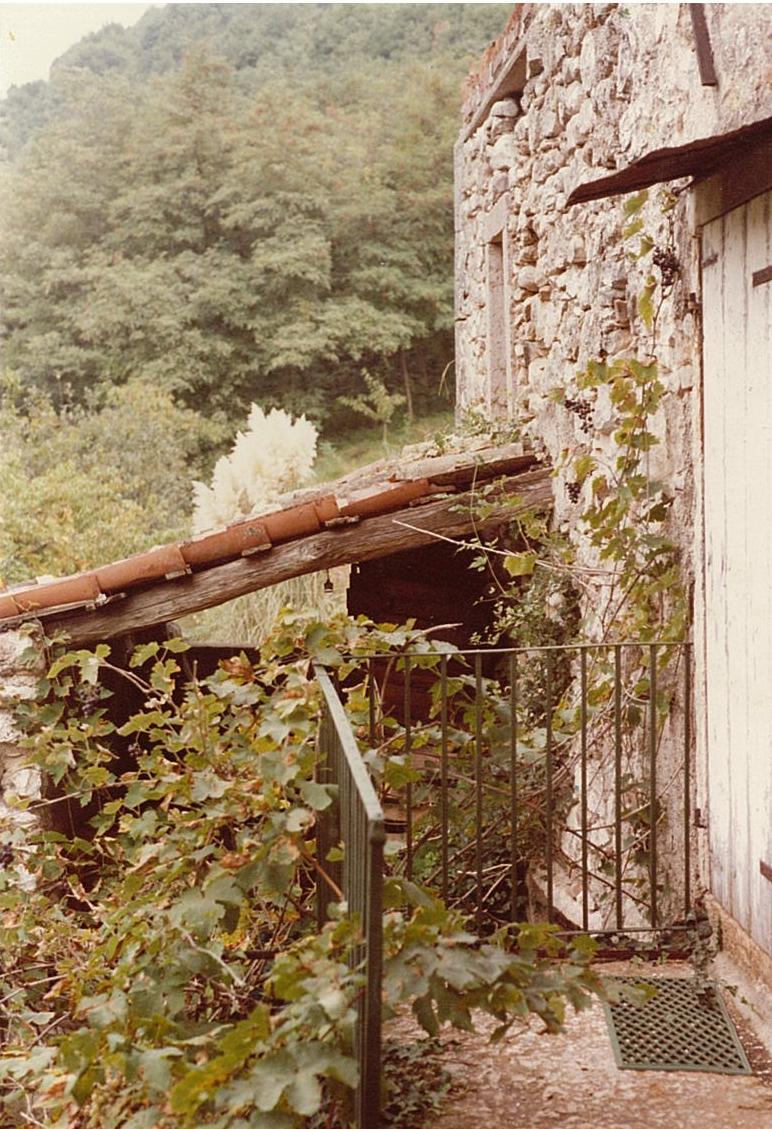
Fittingly, it was in the Veneto that I first tasted this dish of ground cornmeal prepared in the form of porridge. As a relief from apartment life in the centre of Verona I had bought one of ten or so terraced 18th Century case di contadini grouped around an uneven piazza in the Comune of Mezzane di Sotto, a small village located some 30 kilometres north west of Verona. There was a small plot of land behind the house, a field with a kaki (persimmon) tree, some long-neglected vines, a tangle of silver birch and willow along the bank of a narrow torrente. On weekends we would drive out to the house for a day of gardening and daydreaming of what we would do with the house when we had the funds necessary for its restoration. Our weekly journey took us past the village of Mezzane di Sotto, off the metal road that continued on up to Mezzane di Sopra and onto a “strada bianca” or unmade road that wound through orchards of cherry, Houseman’s “loveliest of trees” [i]. In springtime light winds dusted the track with their bloom and we drove through a tunnel of snow.

cherry trees

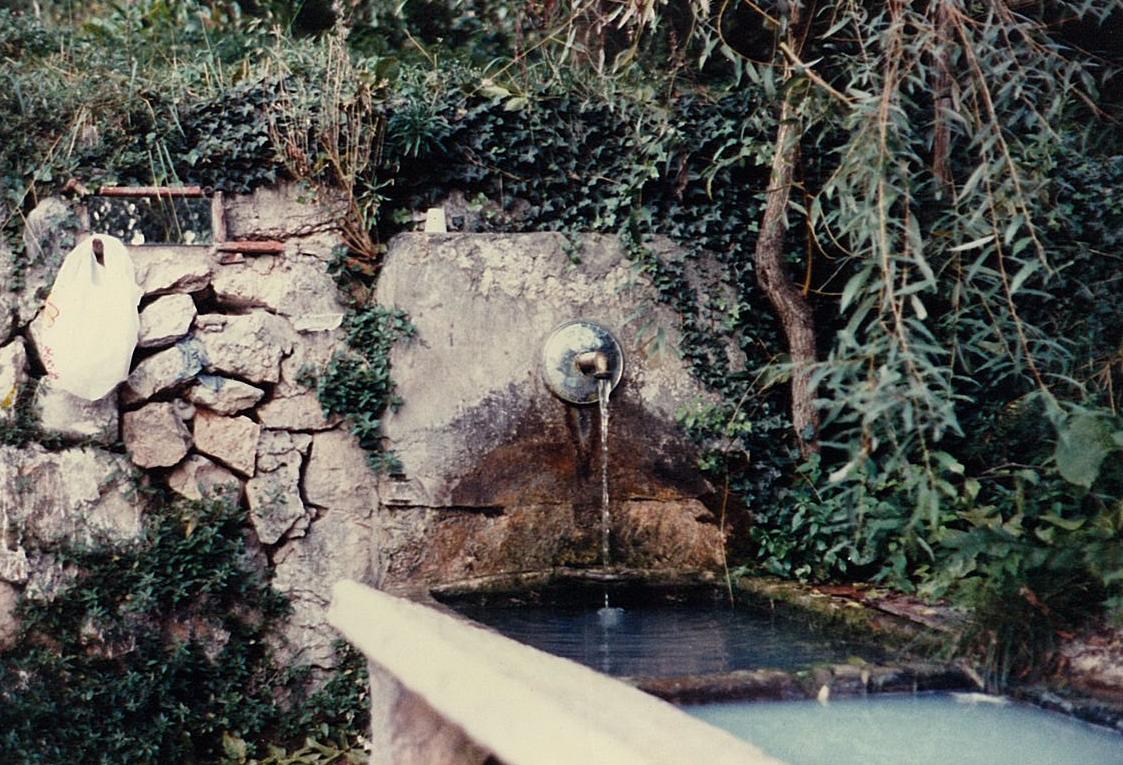
The strada bianca that brought us to the hamlet rose sharply into the foothills of the Dolomites passing a medieval stone trough, supplied by a constant trickle of cool spring water and once used for washing the community’s bedding and clothing.

fountain

Bordering the hamlet was a torrente, gushing with water from the melted snows at the outset of spring and, in summer, a hot dried bed of white stones overhung with willow and buddleia, teeming with butterflies. In this earthly paradise Antonio, the hamlet’s only permanent resident, hunted all year round with calm disregard for the imposed limits to the seasons and lists of endangered species. Nothing he killed went to waste. The flight and contour feathers of birds were made into dusters, the down into stuffing for cushions and pillows. No part of an entire pig went to waste, and from the ceiling of Antonio’s cellar hung every conceivable type and size of salami while in his shed there were cages of rabbits, wild birds and snails waiting to be served up in a sugo for the nightly polenta. The only animal safe from Antonio’s gun was Stellina, his small, black and white, hyper-active dog that would race down the track to meet and yap at any approaching vehicle.

Antonio, then retired, lived with his wife Adriana and teenage son Andrea, who worked at the local supermarket. Although they lived permanently in the hamlet, the family had no car, no hot water (unless boiled on the wood-fired stove), telephone or indoor toilet. We first met Antonio and his family shortly after we had bought the house. It was while Cristina and I were clearing the garden one warm, Sunday morning that Antonio and Adriana (then in their fifties) appeared from nowhere, scythe and sickle in hand and, without a word, began working alongside us. Later, over bread and cheese and wine, which they had also brought, we were invited to dinner. That evening over a meal of polenta con lumache (snails) we negotiated the exchange of my kaki tree for a cherry tree and began a friendship that would be terminated only by my incessant desire for change.

front door porch

We soon understood that the family ate polenta every evening, Adriana standing, stooped into the fireplace, patiently stirring a cauldron for what seemed hours before pouring the molten porridge onto a wooden board in the shape of a huge ping-pong bat where it was allowed to cool and solidify for a couple of minutes before being cut into serving portions with a length of string. The most popular of the family’s polenta dishes was “con osei” (with sparrows). Cristina was put off by the tiny, brittle feet and beaked skulls that protruded from the polenta, for the birds, plucked and fried, were tossed in and eaten whole. The rest of us crunched away happily. Antonio had his own, unique way of catching the sparrows. Scattering some seed under the kaki tree that sat in the middle of the small yard behind the house, he would stand at the window of the outside toilet and wait until there were a number of birds pecking at the seed when he would release the end of a rope (looped cunningly over the tree’s branches), letting a lampshade fall over the unsuspecting sparrows. After dinner Adriana would scour the polenta pot and then watch the black and white grainy images on their antique television while I would help Antonio manufacture cartridges for the next day’s hunt. One winter evening on a solo visit, I was persuaded to stay overnight. Adriana showed me to my room and pulled back the bedclothes to remove the bed-warmer – a wooden “cage” in which sat a saucepan full of red-hot coals. Pleasantly drowsy after a meal of polenta con coniglio and a bottle of Antonio’s unlabelled Valpolicella, I slipped between the rough, toast-warm sheets, blew out the candle and lay for a while contemplating the cold, starry sky, overcome with a feeling of peace and security. I had been, as I recognized later, experiencing true happiness.

In October of 1986, Antonio and Adriana were at our wedding lunch in Mezzane di Sotto at the Bacco D’Oro. There was Risoules ai carciofi, Tortellini al burro fuso e salvia, Rusteghi alla Selvaggina and Anitra al forno, but no polenta.

Last night I tried to locate our little hamlet at the end of the cherry road using Google’s satellite map but with no success. Perhaps, like Brigadoon, it only appears, briefly, once every hundred years.

[i]
Loveliest of trees, the cherry now
Is hung with bloom along the bough,
And stands about the woodland ride
Wearing white for Eastertide

Now, of my threescore years and ten
Twenty will not come again,
And take from seventy springs a score
It only leaves me fifty more.

And since to look at things in bloom
Fifty springs is little room,
About the woodlands I will go
To see the cherry hung with snow.

From “A Shropshire Lad”
A E Houseman


MECHOUI

In the spring of 1961 many of my fellow foreign students at Grenoble University received letters and phone calls from their worried parents, concerned that their sons and daughters would be caught up in an invasion of France by units of the Foreign Legion and the OAS, (Organisation de l’Armee Secrete) in their attempt to topple the government of Charles de Gaulle and prevent the independence of Algeria. To the French, Algeria was more than just a colony, it was as much a part of the country as Burgundy or Aquitaine and the cry of “Algerie Francaise!” was not only heard from France’s citizens who lived in her favourite colony. In the event, the Generals’ coup failed and the process of independence continued. But the ferocity of the 8 year long war and the massacres perpetrated on both indigenous and French civilians, meant that there would be no home in Algeria for the settlers after independence. Alarmed by the cry of “La valise ou cercueil” (suitcase or coffin), the settlers began seeking safety in France even before independence was finally declared in July of 1962. They were not returning home; many had never stepped foot in France before. Coming from Spain, Malta and other European countries besides France, they had been colonizing Algeria since the country’s annexation in 1834. They were the (relatively) wealthy middle class and called Pieds-Noirs or Blackfeet as the only wearers of boots among a largely sandaled or barefoot people. In 1962 there were approximately one million Pieds-Noirs in Algeria – over 10% of the total population – including 150,000 Sephardic Jews, who had arrived well before the largely Catholic colonists, originally in Roman times and more recently during the Spanish Inquisition. The 900,000 Pieds-Noirs who arrived in France during 1962, considered responsible for the war and loss of colony, encountered resentment and even violence. Many had destroyed their possessions rather than leave them in the hands of the Algerians; all had to adapt to a foreign culture, a strange climate. Many had to learn new ways to earn their livelihood. Madame Pierre Very opened a restaurant near the Place de L’Alma at 44 Rue Jean Goujon and it was there when I returned to France in the early 70s that I first tasted the cuisine of Algeria.

There were many North African restaurants in Paris, from grubby bistros catering to the poor Algerian immigrants clustered around Pigalle’s rue du Gout d’Or to the flashy charm of Charley de Bab el Oued with his “ambiance de Mille et Une Nuits” and his couscous royale, complete with the euphemistically named rognons blancs (rams’ testicles) on the boulevard de Montparnasse. In contrast the discreet, bourgeois décor of Madame Very’s restaurant, le Martin Alma, gave no indication of the provenance of the dishes on offer – Brik a l’Oeuf, Calamars a l’Oranaise, le Turban du Pacha and Madame’s signature dish, le Mechoui de Ghardaia. As the restaurant was a two minute walk from Ernst & Young’s office in the avenue Montaigne, my colleagues and I enjoyed many a mechoui at le Martin Alma, usually preceded by a brik and washed down with the powerful and fruity wines of Sidi Brahim and Mascara, a legacy of Spanish immigrants who had introduced the Carignan grape. By chance, an opportunity to taste a real mechoui was provided by an Ernst &Young client who requested an audit of a pulp and paper mill they were constructing on the Algerian coast near Oran. Joining up at Orly with Michael Morris (1), on loan from the London office, we set out for the coastal town of Mostaganem (2) on what was to be the first of many trips.

The exodus of the Pieds-Noirs had left Algeria without a professional class. Cars, including taxis, ran on near-bald tyres. Chronic overbooking by Air Algerie, coupled with a system that required departing passengers to register their baggage before their person, often resulted in luggage arriving at the destination days before its owner. No shop or restaurant accepted credit cards. The plant was also in trouble. The government, in the expectation that the project would be completed on time, had cancelled all cellulose imports, including toilet paper, from the scheduled date of start-up so that suppliers’ invoices and delivery notes, central to the audit, were no longer in the archival system but pinned to lavatory walls. To reduce costs the government had substituted the normal wastewater re-cycling and incineration systems with a simple pipe which discharged a lethal cocktail of dangerous chemicals directly into the sea, covering the bay as far as the eye could see under a blanket of sludge, depriving the local fisherman of their livelihood and the local restaurants of their fish and crustacean dishes. In spite of the shortages and shortcomings the Algerian people were still in euphoric mode; they had, after all, defeated a major Western power which, at one point had as many as 400,000 troops concentrated against the insurgents of the FLN (Front de L’Armee Nationale). Michael and I were treated with the cordial bonhomie of the victorious and none more so than by Arif, the plant’s Chief Accountant. Mostaganem was not a particularly beautiful town and the hotel had minus stars. But the people had the uncomplicated honesty and charm that the Parisians had lost in the middle ages and there was something in the air, something in the early light when the Muezzin began calling “Come to Prayer, Come to success, Allah is Greatest” from the minarets that made one eager for the day. I could understand why the Pieds-Noirs were so reluctant to leave.

Like most Arab countries the cuisine of Algeria is sheep-shaped and there was little else on offer in Mostaganem’s few restaurants. Strangely, although we dined on spicy lamb sausages (merguez), Shawarma, thinly sliced lamb wrapped in a warm khabz (arab flatbread) and lamb couscous, the mechoui I was looking forward to was conspicuously missing from the menus. But Arif was to change all that when he proposed a trip to see the Roman ruins at Timgad over the coming long weekend. We started off very early in the morning, heading East before the sun was up, well before the faithful were called to prayer, following the Barbary Coast alongside fields of esparto grass, bypassing Alger le Blanc before cutting inland towards Batna. On a plateau, some 40 kilometres from Batna lay Timgad, cunningly devised by the Emperor Trajan in the first century AD to serve both as a retirement home for Parthian (3) veterans of the 111th Augustan Legion of the Roman army and as a bulwark against marauding Berbers. The orderly rows of humble soldiers’ houses, as much as the impressive triumphal arch of Trajan, sent a chilling reminder of the frailty of civilisation. It was also as good an inspiration as any for Shelley’s Ozymandias (4) for Timgad, once in the midst of green fields, was now surrounded by the “lone and level sands” of the Sahara.

On our return, fifty or so kilometres from home, Arif pulled the car off the road and stopped where a few odd-shaped sheep, supervised by a ragbag shepherd, tugged at scattered clumps of coarse grass sprouting amongst the stones. We watched Arif point to a particular sheep, saw it hog-tied and tossed, live and bleating, into the trunk of the car like some unfortunate hostage. “Fat-tailed sheep (5)” said Arif as we drove off, “very good”. Later, as he dropped us at the hotel, he invited us to dinner the next evening.

Arif’s home was a single-storey building of faded pastel stucco, tiled floors and minimal furnishings. The room we were shown into was empty except for 5 or 6 other male guests and a table. The sheep we had seen snatched from the roadside yesterday had been roasted on a spit in the open over the embers of a wood fire, basted with butter, spices and its own fat, and now lay before us in its entirety on the bare table. It was, as it was meant to be, as authentic a reenactment of Abraham’s sacrifice (6) as you could wish. There was no cutlery. Wine was served from a Jerry-can still bearing the markings of the Willys Jeep from which it came. Shortly after the introductions a guest dipped his fingers into the sheep’s body, expertly peeled off a sliver of meat, and popped it into his mouth. Within seconds everyone followed suit. If the concept of “terroir” applies to wine, how much more should it be associated with food? This was nothing like the mechoui on Parisian menus. How could it be when Madame Very’s lamb came from the salt marshes of France and was grilled in joints on the restaurant rotissomat? These special tastes and occasions remain with us forever as unconscious benchmarks, never to be relived. Every subsequent mechoui, in some measure, would fail to please.

Some days later I left Algeria. At the airport women gargled their shrill alalalaalal farewells to their departing men-folk. In the departure lounge girls entered the bathroom veiled and came out dressed in modern, western clothes. In the air I completed the landing card of the Algerian man sitting next to me, leaving blank his date of birth about which he was unsure. Word of my literacy, ownership of a pen and general willingness to help quickly spread through the cabin and before we landed I had completed the cards of half the passengers. Many were young or middle-aged men going to Paris where they would work as refuse collectors, cleaners and Metro workers, living in squalid apartments in Barbes Rochouart, sending the bulk of their thin wages back to their families. In time their sons would become French citizens, live permanently in France and take over the corner epicerie, keeping it open 24 hours a day. In turn the shop owners’ sons would become doctors, business managers and accountants, a new generation of Pieds-Noirs.

1. Michael Morris – aka “Mercury”. Later Lord Morris.

2. Port approximately 80km East of Oran. Founded in the 11th Century, captured in 1516 by Khayrad ad-Din (better known as Barbarossa); under Ottoman rule from the early 18th Century until colonized by the French in 1833. The town now has its own tourism website.

3. Parthia – Roman province in what is now North-Eastern Iran

4. I met a traveler from an antique land
Who said: “Two vast and trunkless legs of stone
Stand in the desert …near them, on the sand,
Half sunk, a shattered visage lies, whose frown,
And wrinkled lip, and sneer of cold command,
Tell that its sculptor well those passions read
Which yet survive, stamped on these lifeless things,
The hand that mocked them, and the heart that fed:
And on the pedestal these words appear:
“My name is Ozymandias, king of kings:
Look on my works, ye mighty, and despair!”
Nothing beside remains. Round the decay
Of that colossal wreck, boundless and bare
The lone and level sands stretch far away.

Ozymandias
Percy Bysshe Shelley

5. Strain of domestic sheep common in North Africa and the Middle East and prized for the fat stored in their prominently large tail and backside. Depicted on pottery and mosaics of the 3rd millennium BC and described in Chapter 3, verses 8, 9 and 10 of Leviticus.

6. Abraham’s sacrifice is celebrated on the 10th day of the last month of the Muslim year during the festival of Eid-el-Kurban, when mechoui is traditionally served. Mechoui is also prepared for festive occasions such as weddings and receiving (special?) dinner guests.

EEYORE TIES THE KNOT (AGAIN)

Part 1 N’Awlins

Well, here we are again, gliding precariously aloft, 30,000 feet over the Pacific Ocean, Vodka Martini in hand. I’m off to meet my Honeybee in New Orleans where we shall be renewing our wedding vows. We first tied the knot in 1986 in a civil ceremony at Juliet’s Tomb in the Italian city of Verona. Always partial to a good outing, anxious to cement this arrangement and to wear a white wedding dress, Honeybee decided, two years later, to add a round turn and two half hitches to the knot we had already tied. This time it was a Church wedding in a Kentish village followed by sumptuous reception in Leeds Castle. Henry VIII bedded Catherine of Aragon there before divorcing her, so the location was fitting. And now the knot is about to grow to Gordianesque proportions. Imagine, after this latest junket, my Honeybee will have had 3 Cecil B De Mille marriage celebrations! Now I know where all the housekeeping goes and why we can only afford a car the size of a dog kennel. I knew when my Honeybee first asked for my hand in marriage that it was other parts of my body she was more interested in. I knew too, when I learned that she was of Sicilian parentage, that divorce would always be out of the question. But don’t think for one minute that I’m still married for fear of ending up in a concrete pillar supporting one of those stretches of Italian Autostrada that start in someone’s farmyard and goes nowhere. No sir! I’m flying, heart willing, into this, possibly conclusive, celebration. What makes this one special is that it will be our son, Jesse, who will be giving away his mother. I’ve never succeeded.

But what’s this? Dinner is being served. As usual it’s only the bread roll (before it cools) and the Snickers Bar that are edible. Have you ever wondered why celebrity chefs occasionally claim authorship for some of the dishes served as food on airlines? No one, wisely, is putting his or her hand up for the dish of over-cooked penne in a sauce of pea-studded, warmed-up cold cream that I have in front of me. I think I’ll see what’s on offer in Duty Free. Hmmm, I’m interested by the Lip Smacker, Coca Cola flavoured lip balm and the pair of La Tweez illuminating tweezers for those hard to find nostril hairs; just can’t think of anyone who might like them as a present.

I’m always happy going to America and that I put down to first impressions. In 1974 on my first visit, a business trip to Cleveland, I’m hardly settled into the back of the cab when the driver asks me where I’m from. England, I reply, even though I was living in Paris at the time. Apparently pleased with this information, the driver tells me at length how he had been based in Devon for several months in 1945 while preparing for the Normandy Invasion and how well he and his fellow soldiers were treated by the natives. On arrival at my downtown Hotel, my new best friend carries my suitcase into the hotel and drops it at Reception. ‘Look after that’, he tells the Receptionist, ‘I’m buying this young man a cocktail’. Americans have always been good on service. Later that evening, at a bar on the Flats, my Englishness alone scores me an invite to a party in Shaker Heights and the offer of a car for the duration of my visit.

I’ve yet to meet an American who is not happy and proud to be an American. Much of their patriotism revolves around respect for the flag. The etiquette regarding the Stars and Stripes is extensive and logical. It cannot be used for decoration. Bunting, with blue stripes upper, is used for this purpose. It cannot be used for advertising, or printed or embroidered on anything that is intended to be later discarded. It cannot be part of a costume or athletic costume (military obviously excluded). No part should ever touch the ground. I contrast these rules with those of some countries happy to see their flags on tea towels, rubber thongs and mens’ underpants.

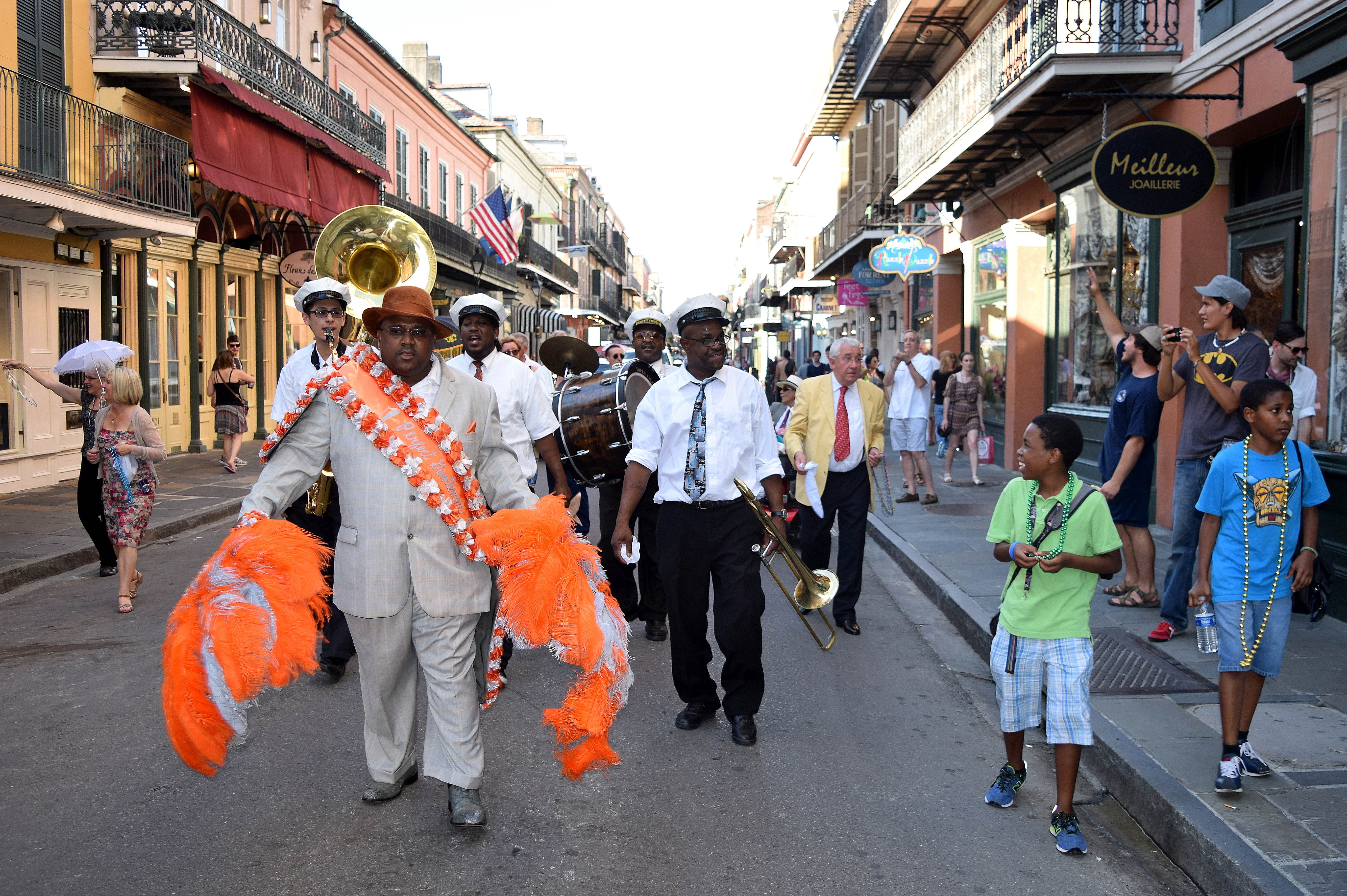
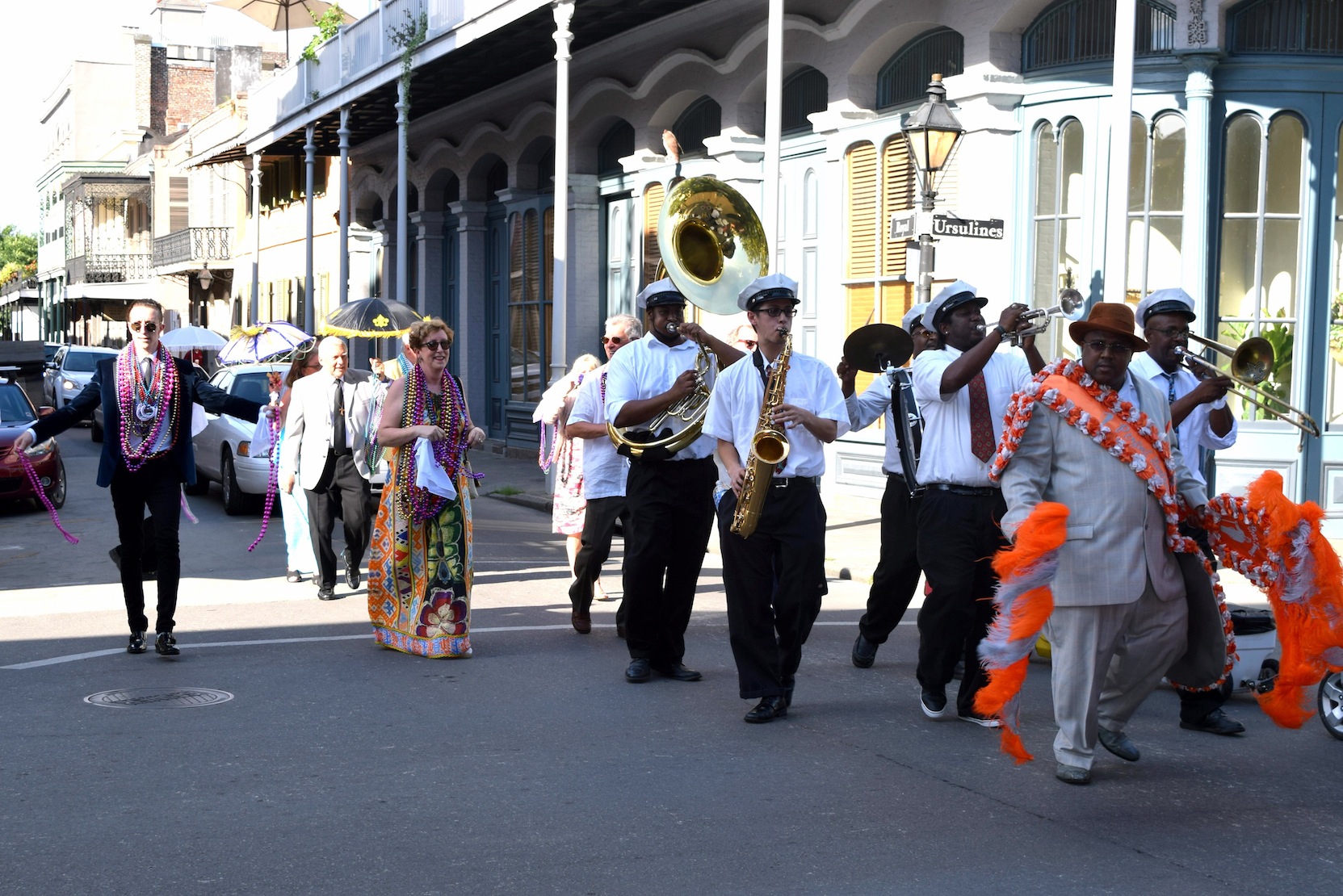
Why New Orleans? We fell in love with the city on our first visit. It’s not called the ‘Big Easy’ for nothing. The people are laid back and friendly, there is live music everywhere and the cocktails are cheap. It also has HISTORY, currently unavailable in Australia. It’s the only place I know where I can wear a white suit and two-tone shoes AND I can understand the French they speak. Where else in the world can your wedding party, preceded by a marching band, be escorted by police through streets closed to traffic? Yes Sir, we love Dixie; everyone should be sent here to learn manners. Why Dixie? Well, in 1835 the Citizens State Bank opened its doors in the French Quarter and soon after began printing its own bank notes. Although the French had ceded Louisiana to the American government in1803 the French language was still prevalent and the bank’s ten dollar note carried the word ‘Dix’ (French for ten). In time these notes became known as ‘Dixies’, a term that spread to refer to the region. Did the song ‘I wish I were in Dixie’ start life as ‘I wish I had a Dixie’? Nice thought, but the song, reputedly written by a Northerner and enjoyed by Abraham Lincoln, did become the de facto anthem of the Confederacy. Those of a politically correct nature, who like to view history from a contemporary moral outlook, find it offensive and would bar us from our past.

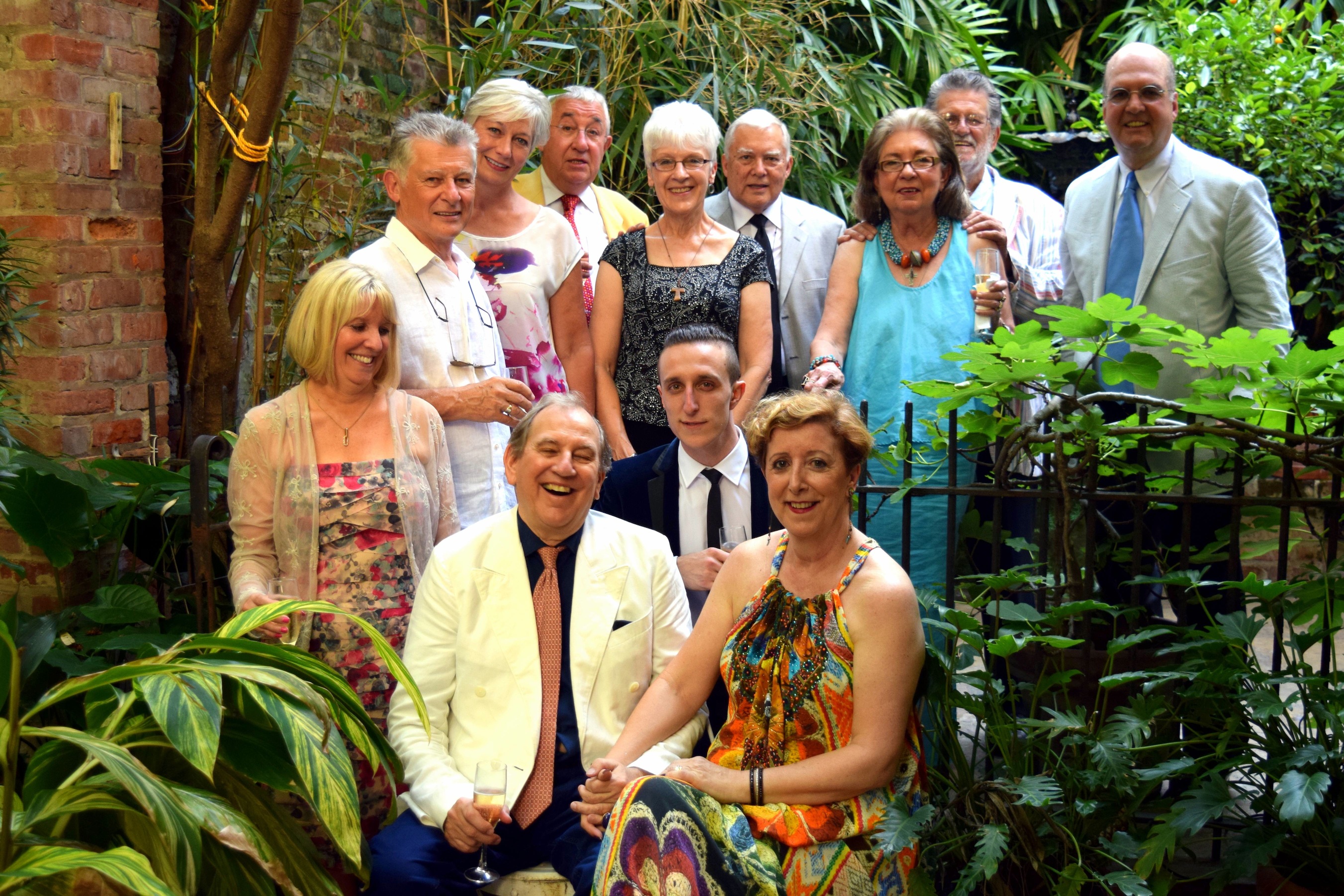
Our guests, except Ralph and Doris who are natives of the city, are all staying with us in the Prince Conti Hotel. My niece has come from England and my friend Pierre-Jacques from Paris. Larry and Bonnie have come down from upper New York State, Gayle and Jim from New Hope, Pennsylvania and John and Susan from Boulder, Colorado. Larry, Ralph, John and I all met for the first time in 1971 in the Paris office of Ernst & Young.

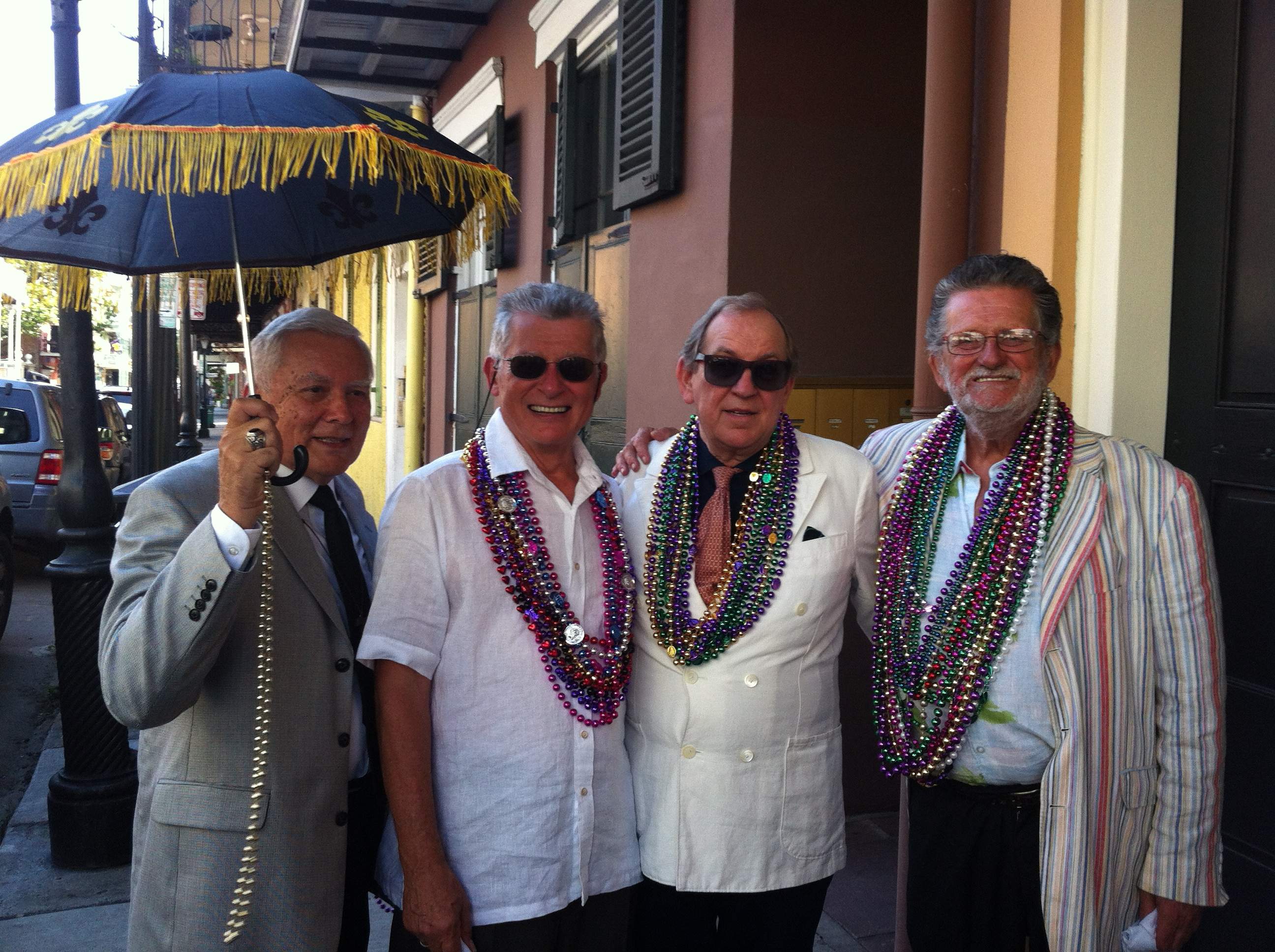
The Four Amigos

The Four Amigos

This is a serious drinking town and, apart from some areas of Bourbon Street, it’s carried out with refinement. ‘Civilisation’, William Faulkner, a native of New Orleans, pointed out ‘began with distillation.’ And so, appropriately, we start off with cocktails in what may be the best bar in the world, The Bombay Club (where happy hour lasts from 4 to 7pm).

After cocktails we all go to dinner at the Palm Court Jazz Restaurant. There’s a five-piece band playing Dixieland Jazz. I don’t remember the food due to the pleasure of reuniting with friends. At some point the band dedicates to us their version of ‘It Had to be You’ and Honeybee and I take to the dance floor and stun the diners with our nimble footwork. A bottle of Champagne arrives anonymously and when I go to pay the bill the waiter informs me that it has been ‘taken care of’ by another table. We never found out who made this generous gesture so I can only make public here my sincere thanks.

Breakfast of beignets and coffee at the famous Café du Monde. As if in a Roman bathhouse, we move from the frigidarium of the hotel to the caldarium of the street and back to the frigidarium of bar or restaurant. Someone asks Jesse where he’s from. Australia. He is asked what language they speak there. It’s the 70th Anniversary of D Day and Private Lynn scales the Pointe du Hoc cliffs at the WW2 Museum while Gayle is an early casualty on the beaches.

Help!

Help!

It’s late afternoon on Saturday, 7th June and we assemble in the courtyard of Ralph and Doris’ home on the Rue Royale. My Honeybee is wearing Camilla and looks like a Princess from Sheherazade; I’m wearing a white, double-breasted jacket and dark trousers and look like a waiter from the Sands Hotel, Las Vegas. Jesse comes as a riverboat gambler in blue velvet and bootlace tie.

The New Orlynns

The New O’Lynns

A saxophonist plays Stephen Foster songs while the guests arrive. Our first marriage was supervised by the Mayor of Verona, splendid in sash of green, white and red, our second by a Protestant Vicar in black cope and surplus of white. Conducting this ceremony is the Rev. Tony Talavera, a tall, distinguished looking African American in straw hat and tan suit. His business card announces him as an ‘Ambassador of Romance’. The ‘Reverend’ whose theological qualifications I would not presume to investigate, runs the French Quarter Wedding Chapel, which contains the welcoming totems of every religion, and God, pagan or otherwise, including my own favourite deities, Venus and Bacchus. Are we about to be blessed by a Snake Oil salesman? Who cares; what counts is what we say and mean. There’s a brief moment of panic when the Reverend asks for the rings. Rings? No one mentioned rings! Besides, my Honeybee has more rings than a shower-curtain manufacturer. Jesse produces a plain diamond number the size of a walnut and I’m seeing myself on the pavement in George Street with begging bowl. He then hands over my ring, a massive gold affair with purple stone, popular with Los Angeles drug barons. Jesse whispers ‘25 dollars the pair’ and I breathe easily once more. After I’m allowed to kiss the bride, I have another, pleasant, surprise when Jesse reads us WH Auden’s poem, ‘Tell Me the Truth About Love’.

Some say love’s a little boy,
And some say it’s a bird,
Some say it makes the world go around,
Some say that’s absurd,
And when I asked the man next door,
Who looked as if he knew,
His wife got very cross indeed,
And said it wouldn’t do.

Does it look like a pair of pyjamas,
Or the ham in a temperance hotel?
Does its odour remind one of llamas,
Or has it a comforting smell?
Is it prickly to touch as a hedge is,
Or soft as eiderdown fluff?
Is it sharp or quite smooth at the edges?
O tell me the truth about love.

Our history books refer to it
In cryptic little notes.
It’s quite a common topic on
The Transatlantic boats;
I’ve found the subject mentioned in
Accounts of suicides,
And even seen it scribbled on
The backs of railway guides.

Does it howl like an angry Alsatian,
Or boom like a military band?
Could one give a first-rate imitation
On a saw or a Steinway Grand?
Is its singing at parties a riot?
Does it only like Classical stuff?
Will it stop when one wants to be quiet?
O tell me the truth about love.

I looked inside the summer-house;
It wasn’t over there;
I tried the Thames at Maidenhead,
And Brighton’s bracing air.
I don’t know what the blackbird sang,
Or what the tulip said;
But it wasn’t in the chicken-run,
Or underneath the bed.

Can it pull extraordinary faces?
Is it usually sick on a swing?
Does it spend all its time at the races,
Or fiddling with pieces of string?
Has it views of its own about money?
Does it think Patriotism enough?
Are its stories vulgar but funny?
O tell me the truth about love.

When it comes, will it come without warning,
Just as I’m picking my nose?
Will it knock on my door in the morning,
Or tread in the bus on my toes?
Will it come like a change in the weather?
Will its greeting be courteous or rough?
Will it alter my life altogether?
O tell me the truth about love.

The Poem

The Poem


The truth about love is that life is desperately dull without it. A keen interest in sport, bee-keeping or the stock market can never make up for the deficiency. There comes a moment amidst all the fun and laughter when a note of gravitas is required; it’s supplied by Larry who gives us a short prayer. Then the Champagne is broken out and we all pose for photographs.

Te Wedding Party, sans Gayle

The Wedding Party, sans Gayle

Meanwhile the 5 piece band and police escort have been assembling in the street for our Second Line parade. ‘Second Line’ refers to the members of the general public who join the celebrations behind the ‘Main Line’ – the band, the celebrants and guests. Fronting our column are two Policemen on motorcycles, then comes our Master of Ceremonies and Bandleader, carrying monster orange ostrich feathers, and then the band in traditional costume of white jacket, black trousers and white, peaked cap. A NOPD Patrol Car follows us and our guests as these festivities have been known to get out of hand. The Rev. Tony Talavera is also there, seated on a mobility scooter dragging two cart-loads of coloured beads like a miniature road train.

The Parade

The Parade

The groom

The Godfather

Beads anyone?

Beads anyone?

The Parade

The Parade

The Parade continues

The Parade continues

And then we’re off and for the next 45 minutes we march through the streets of the French Quarter, tossing beaded necklaces to the public on the sidewalks, until we stop outside Antoine’s Restaurant. Antoine’s has belonged to the Alciatore family since 1840, and, apart from the addition of a microwave and a food mixer, not much has changed. Our waiter Chuck, who looks as if he’s been there since the opening, takes us to our private dining room on the second floor. The fare is traditional New Orleans, which leans heavily towards aquatic life and Tabasco – crawfish tails in white wine sauce, Gombo Creole of blue crabs, oysters and Gulf shrimp and baked oysters a la Rockefeller. Pierre-Jacques, a true bec fin, takes the Potage Alligator au Sherry. Then there’s Pompano fish from Lake Pontchartrain, soft-shell crabs and the Delmonico Centrecut Ribeye au Champignons et a la sauce au Demi-Bordelaise, which I was still ordering when everyone else had moved on to the Baked Alaska. I see, on page 4 of the bill, that the evening finished with Cognacs. Jesse and I took ours out onto the balcony overlooking St Louis Street where we shared our first cigar.

Antoine's Restaurant

Antoine’s Restaurant

The dining room at Antoine's

Our dining room


Part 2 New Mexico

Farewelll to N’Awlins. It’s been such a fabulous party I’d like to do it all over again. I suggest to Honeybee that we get divorced on the grounds of my adultery with Scarlett Johansson and then re-marry. The proposal doesn’t merit a response. At Louis Armstrong Airport I’m the only person wearing a proper pair of shoes, the only person, apart from Honeybee, who is not dressed either for the beach, the fitness centre or a Tattooist’s Convention. On the flight to Albuquerque a gentleman from Louisiana engages us in conversation. I say ‘engages’ in the sense that he engages us as listeners. He shows us photos of his wife, children, house, cars, boat, an armoury bigger than Boko Haram’s and a selection of the animals that he had killed in an effort to rid the Deep South of its wildlife. Don’t get me wrong; I like a man who is proud of his family and achievements, it shows he is happy with his lot. Not entirely happy however, for he tells us that he feels Americans are hated in many parts of the world. Don’t worry, I tell him, we like you.

Our destination is the town of Taos, situated seven thousand feet above sea-level, in the high desert of the Colorado plateau. The small town of 5,700 inhabitants, which consists almost entirely of adobe constructions, is surrounded by arroyos, dry riverbeds overhung with cottonwood, hackberry and desert willow. Goldfinches flutter in the branches and goshawks glide over plains carpeted with wild sage and studded with juniper. The plain is bisected in a deep gorge by the Rio Grande, on its way from its headwaters in the San Juan Mountains of Southern Colorado to the Gulf of Mexico.

Rio Grande Gorge

Rio Grande Gorge

In the distance, tiers of ochre and olive hills are capped with the Prussian blue peaks of the Sangre de Cristo Mountains. The air is clear and thin and the altitude leaves us, at first, a little breathless. ‘Touch the country and you will never be the same again’ wrote D H Lawrence when he came to New Mexico in 1922. I know how he felt. Lawrence, who intended to stay, acquired the Kiowa Ranch near Taos in exchange for the manuscript of Sons and Lovers but left for health reasons in 1925 and died five years later in the South of France. But his ashes came back to Taos. Some say they are mixed into the cement of his memorial that stands in the small chapel on the Kiowa Ranch, now owned by the University of New Mexico.

Dinner for six (served on 2 plates) at the Gorge Restaurant on a terrace overlooking Taos Plaza. My Honeybee chooses the Nachos. Despite some determined fork-work, at the end of 20 minutes she appears to have made no impression at all on the loose mountain of corn chips, black beans, melted cheese, avocado, sour cream and tomato salsa. As I pick at a rack of barbequed pork ribs I slowly uncover what appears to be the fossilised rib cage of an adult brontosaurus. A portion of onion rings, like a set of deck quoits, goes almost un-nibbled. Would we like a doggy bag? Doggy bag? We would need a cabin trunk to remove what was left on our plates! My Bud Lite is so cold it leaves a light coating of frost on my tonsils and refrigerates my stomach.

Anyone for quoits? A portion of onion rings

Anyone for quoits? A portion of onion rings

Like many places in America, Taos has no butchers’ shops or greengrocers, no markets selling cheeses and fresh fruit. A stall on the road to Santa Fe offers jerky for sale but it is never open when we pass. Where can one find a nice joint of silverside or a fresh cauliflower? Into Walmart, the nadir of supermarkets. A brown and beige grid of sofas and popcorn, of cheeses the color of Tequila Sunrise, of processed meats, of tubs of ice cream and yoghurt the size of dustbins. Along corridors of frosted windows is everything you need but nothing I wanted. I emerge into the sunlight, look out at the blue mountains and the nightmare is over. Hunger drives us into a fast food outlet. What drink did I want with my happy meal combo? Water. After repeating the word four times the assistant is still shaking his head. ‘Agua’ volunteers Honeybee and I get what I want.

New Mexico is Georgia O’Keeffe country; you need to see the country to appreciate her delicate interpretations of the dramatic architecture of the land and the shapes and textures that the dry wind and warm sun have on its nature. On a first visit in 1917 O’Keeffe declared, like Lawrence, her instant love. ‘When I got to New Mexico, that was mine. As soon as I saw it, that was my country.’ In 1929 she stayed in Taos, visiting Lawrence on his Kiowa Ranch where she painted the tall pine (‘The Lawrence Tree’), which still stands outside the chapel. Later she would spend summers in her house on the Ghost Ranch and winters in her home in the nearby village of Abiquiu. If you have never been to the Ghost Ranch, you might well have seen it on film, as it is a favourite location for producers of Westerns. Among those filmed there: Silverado, City Slickers, Wyatt Earp, All the Pretty Horses, The Missing, No Country for Old Men, 3.10 to Yuma, Cowboys and Aliens, Lone Ranger and, of course, the 2009 film Georgia O’Keefe. More interestingly, there you can inspect the very trees and landscapes that appear in GOK’s paintings and from her house you can see the massive Pedernal mesa in the distance. ‘Pedernal is my private mountain,’ she wrote, and it was there that her ashes were scattered in 1986.

GOK's tree at Ghost Ranch

GOK’s tree at Ghost Ranch

New Mexico is Roadrunner country. In fact the Roadrunner (Geococcyx Californianus, a relative of the Cuckoo) really does move faster than the traffic. Although there are no CCTV cameras, drivers here respect the speed limits; no one seems in a hurry and drivers will slow anywhere to allow pedestrians to cross the road. I sensed none of the suppressed anger you feel on the roads of Sydney. Big Harley Davison bikes are popular. They are ridden sitting upright, which Honeybee reckons is because they are a substitute for horses and a legacy of the Western riding tradition.

New Mexico is cowboys and Indians country. Billy the Kid began and ended his dark saga here. And then there was Kit Carson. Has anyone heard of Kit Carson? No? I thought not. In the 40s and 50s every young American and British boy would be familiar at least with his comic book persona. Unlike Hopalong Cassidy and Lash Larue, Kit was a real person. He started life as a trapper until a change in European fashion determined that gentlemen’s hats should be made of silk, so ending the market for beaver and ensuring the animal’s survival. In 1843 Kit scouted for John C Fremont’s expedition to explore the North Platte River into western Wyoming, returning late in the year to Taos where he married 14 year old Josefa Jaramillo. Outraged? This was a different world; in the early West 14 year olds didn’t waft around in mini skirts and heels listening to Justin Bieber; in any case they had seven children together in a long and happy marriage. In 1844 Kit joined Fremont’s winter crossing of the Sierra Nevadas and scouted for his third expedition to the Great Salt Lake Desert. Back in Taos he started a ranch and led an attempted rescue of a woman kidnapped by the Jicarilla Apache. He was appointed Indian Agent, dealing with the Cheyenne, Navajo, Ute, Arapaho and Apache. When the Civil War began Kit became a Lt. Colonel in the New Mexico Volunteers but spent most of the war fighting the Kiowas and Comanches. At the Battle of Adobe Walls he successfully extracted his small force of 200 from the onslaught of several thousand angry Indians with minimal casualties. His single story adobe cabin in Taos is now a museum. Behind the cabin the Stars and Stripes fly permanently over his tomb out of respect for his defense of the flag against Southern sympathisers during the Civil War. Carson City, capital of Nevada is named after him. He was the embodiment of America’s Manifest Destiny, the dream of Westward Expansion.

Kit Carson's cabin

Kit Carson’s cabin

A few miles out of town is the Taos Pueblo, the Place of the Red Willows. The first living UNESCO World Heritage Site, it is and has been for 1,000 years, home to the Pueblo People of Northern New Mexico. The houses, built in tiers, some as high as five storeys, are constructed from adobe – sun-dried mud bricks made of sand, clay, water and straw. Two communities, separated by a small tributary of the Rio Grande, share the newish (1850) San Geronimo Church and a sadly neglected Boot Hill. While visitors are welcome, there is a pleasing absence of blatant commerce. This is reserved for the Taos Mountain Casino (‘the only non-smoking casino in New Mexico’) on another part of the reservation. Paradise Lost.

Taos Pueblo

Taos Pueblo

Boot Hill

Boot Hill

Uniting Taos, Georgia O’Keefe, DH Lawrence, Kit Carson and the Red Willow People is the remarkable Mabel Dodge Luhan. Born Mabel Ganson to wealthy parents in Buffalo, NY in 1879, Mabel decided to set herself up as patron of the arts, first in the Villa Curonia in Arcetri, near Florence and later in Taos where, in 1919, she bought a 12 acre property on the edge of town and named it Los Gallos. Mabel had arrived with third husband, painter Maurice Sterne, but was unable to resist the attentions of Chief Tony Luhan of the Red Willow Pueblo People, who planted his tepee in front of Los Gallos and drummed each night until she came to him. Sterne left in disgust and Tony became Mabel’s 4th in 1923. In September 1922, at Mabel’s invitation, DH Lawrence and his wife, Frieda, came to stay at Los Gallos. Georgia O’Keefe, Willa Cather, Ansel Adams and Carl Jung, among others, followed. The house, now a bed and breakfast, is little changed since Lawrence slept there, and in Mabel’s tiny bathroom you can see the windows painted by a prudish Lawrence to protect his host’s privacy. Mabel died in 1962; she is buried near Kit in the Kit Carson Cemetery.

Los Gallos, Taos

Los Gallos, Taos


Windows painted by DH Lawrence

Mabel’s bathroom decorated by DH Lawrence

SOLANGE

From early adolescence Paris had always shone out as a beacon of Bohemian freedom and as soon as my Accountancy exams were out of the way I sought and found employment in the City of Light. The Paris of 1970 was a very different town to the present. Mayor Chirac had yet to order the cleaning of the city’s monuments and buildings and Notre Dame was still partially soot laden. The Folies Bergère and the Concert Mayol were still open for business, the market of Les Halles was still in full swing and the Boulevard de Clichy had not yet been turned into a parking lot for coaches from Dusseldorf. On weekend visits to a largely deserted Louvre museum you would have to ask an attendant to switch on the lights. The Marché au Puces at the Porte de Clignancourt and the bouquinistes along the banks of the Seine had not yet been hoovered clean of every worthwhile collectible; a handful of Parisian chefs led by Raymond Oliver were resisting the assault of Nouvelle Cuisine; the globalisation of Ladurée macaroons was not even a twinkle in the proprietor’s eye. Louis Vuitton was just a luggage shop. Was it a better town then? Perhaps. Certainly the marketing of the city as a product and its Disneyfication had not begun in earnest. There were still a few magical years before the girls of St Denis were replaced by pots of geraniums, before the poor were forced out into soul-less suburbs, when butchers still lived with their families over their shops and many quartiers still contained a healthy mix of all levels of society. Perhaps, unless your Hanoi suburb was being carpet-bombed, everywhere, in some respects, was better then. Now I swing between moods of nostalgia, staring into a pool of red wine and listening to the songs of Juliette Greco and Yves Montand and periods when I cannot bear to hear the name of Paris mentioned for the pain of having left it.

My employer was kind enough to put me up at the Hotel de Londres in the Rue Saint Dominique, agreeing to meet the cost of the accommodation for a period of two weeks, during which time I was expected to find myself an apartment. After a brief search I settled on a small “deux pieces” under the eaves of an “immeuble de moyen standing” at 142 Avenue de Versailles. Situated near the entrance to the Exelmans Metro, I was a mere five stops from Alma Marceau, the nearest station to Ernst & Young’s office in the Avenue Montaigne. The building was a fine example of the work of Hector Guimard and naturally attracted many enthusiasts of his flamboyant style of art nouveau, including the over-keen, who would occasionally remove the brass knobs from the apartment doors and saw off parts of the wooden banisters for their collections.

Like all new tenants in a Parisian apartment building, my first responsibility was to register my presence with the concierge. History had already endowed the profession of concierge with a bad name. Guardians of their tenants’ morals, police informers, inquisitive, smiling only at Christmas time in anticipation of a bonus for having protected you for the past twelve months from dirty staircases, ineffectual heating, hawkers, immoral company and rowdy neighbours. It was therefore with trembling hand that I knocked on the door of the loge, which was opened, not by some old harridan, but by a short, plump woman with sad brown eyes that crinkled easily with laughter. I made my introduction, ending it with “Madame….” and trailing off to allow her to give me her name. “Solange” she said, “please call me Solange”.

Solanges do not model for Balmain. They are not the wives of Deputées or steel barons or pretenders to the French throne. Solange is the name of poorer girls from the provinces, of sad heroines in the novels of Emile Zola. Solanges are barmaids and the wives of épiciers. Solanges were concierges long before the Portuguese began to monopolise the profession in the 1970s. According to the folklore of the city, concierges are repellent in their loges, smelling of cabbage, moralistic, suspicious and racist. Solange was none of these. Solange helped me through those early days in Paris, directing me to the best stalls at the weekly market at the Porte de Versailles, explaining how to pick out the sweetest Charentais melons and test the maturity of Camembert, dropping off my shoes at the menders and finding me a plumber in the month of August. One day she invited me to dinner and that same evening I entered her tiny loge and met her husband Jean-Marie and their son, Richard. I felt humbled and amazed. The loge consisted of a small kitchen/dining area, a single bedroom and bathroom. Richard, in his mid-twenties, slept on the kitchen floor.

That was the first of many evenings in Solange’s loge. Dinner was often followed by a game of chess with Jean-Marie. Between moves I learned that the families of both Solange and Jean-Marie were from Charleville-Mezieres, a town on the river Meuse where it snakes through the thickly forested Ardennes mountain range that straddles both Southern Belgium and Northern France. I also learned that Richard was the son of a Polish conscript in the occupying German army. Despised, ostracised by the people of Charleville as a collaborator after the Germans finally retreated behind their own frontiers, Solange was saved by Jean-Marie who married her and took in Richard as his own. But Jean-Marie’s own family turned against him and the family sought the oblivion of Paris where Jean-Marie hid each day inside the blue overalls of the French ouvrier, standing at a lathe in some suburban factory. A well-read communist, he loved to talk about the trade union movement and of his admiration for Orwell and Steinbeck as he paused over his chess pieces. Later he would complain of headaches and our games became fewer and fewer until one day he collapsed in the street, was diagnosed with a brain tumour and died shortly afterwards. But not before he had given me a splendid book on Michelangelo – “pour t’encourager”. I went to the funeral and to watch Jean-Marie buried in the dismal cemetery of Montrouge. There, among the few sad mourners and the bouquets of chrysanthemums was the open coffin and the first dead person I had ever laid eyes upon.

The time came for me to move. Not far, just across the river where the relocation of the old Citroën factory was turning the 15th arrondissement into the new urban paradise. The luxurious new Hotel Nikko was going up on the banks of the Seine and there was a modern shopping mall with cinema complex near the Pont Mirabeau. I had found an apartment in a modern 4 storey building at 6 Rue des Bergers. It was very different from the Guimard building in the Avenue de Versailles. Spacious and modern it came with white Scandinavian furniture that I was obliged to buy, a condition of my acquiring the lease from a Lebanese employee at UNESCO. It was, as far as Solange was concerned,“un appartement de vedette”.

Solange still came to see me and I still went to dinner in her loge where she would serve couscous and tell me about Richard and his on again off again romance with his girlfriend. ‘It is easy,’she would say, ‘to rekindle wood that has already been in the fire.’ And all too suddenly there was another funeral and another trip to miserable Montrouge. This time it was the ill-conceived Richard, the moon-faced, blue-eyed son of a Polish soldier who had self-destructed before the age of thirty. Soon after that Solange moved too, and I went to see her in a bigger, grander building close to the Porte Dauphine. But I left it too long between visits and then she too was gone. Not dead. Not then. Perhaps back to Charleville, perhaps to another loge. Now all the concierges have gone, even the Portuguese, replaced by interphones and closed circuit television.