Abelard & Eloise

One of France’s prettiest rivers, the Sevre, has its source near the village of Secondigny, which lies in Poitou-Charente in the South West of the country. As the stream widens into a river and winds North, passing through La Vendee, it gathers speed as it descends in altitude until it gushes into the Loire just South of the city of Nantes. The Sevre runs with such speed on its last leg into the Loire that, in the past, many built water mills along its banks, bringing prosperity from the tanning of leather and the weaving and dying of wool. With the tanners and weavers came the hoopers of barrels, criers of onions, carriers of faggots, scummers of pots and all the other flotsam and jetsam, including the thieves and slipshod cafards that feed on the success of others. Today the river is tranquil, a destination for the quieter kind of tourist seeking those last outposts of France’s august, provincial cuisine and the tangible remnants of the region’s ancient history.

Long before France was united under a common crown, the Sevre was already busy and important, the confluence of the independently ruled lands of Brittany, Poitou and Anjou. Then, all Europe was no more than a collection of private fiefdoms and even where claims of Kingship existed, actual rule depended upon the allegiance of the nobility, many of whom were tied only by that flimsiest of knots, marriage. In 1137, Louis VII, King of the Franks, having acquired Aquitaine by wedding its Duchess, Eleanor, promptly lost it after the marriage was annulled. Only two years after being cast aside for failure to produce a son, Eleanor married Louis’ rival, Henry II, King of England, gifting Henry the Duchy of Aquitaine and providing him with the male heirs that would continue their father’s struggle against Louis.

Ever changing alliances, the making and breaking of marriages and the resulting territorial claims, immersed Europe in constant warfare. And so it was that in 1076 the Duchy of Brittany, then ruled by Hoel of Cornouaille was invaded by the forces of Duke William II of Normandy, who doubled as King William I of England. Among the barons loyal to Hoel who helped repel the Anglo-Norman invasion was Daniel, Lord of Le Pallet. Daniel’s castle, of which only the ruined keep now remains, dominated Le Pallet, a village on the banks of the fast-flowing Sevre, only 10 miles south of Nantes.

Lord Daniel’s daughter, Lucie, was married to her father’s chief knight and garrison commander, Berengar, and in 1079 she bore him their first child. It was a boy and they called him Peter, later to be known as Peter Abelard. More children followed – Rudalt, Porcar, Dagobert and finally, a daughter, Denise. Abelard and his siblings had the good fortune to be born, in this most class-conscious of times, outside the yolk of serfdom and to parents that encouraged learning. But while his brothers were drawn towards the military and religious life customary for their class, Abelard pursued academe. He was not, and never would be, one to ‘dance the brangle gay in fits of dalliance’. Curious, obsessed with learning, he was oblivious to the normal customs and pleasantries of youth and probably friendless, for he had no space in his life for anything other than his passion for knowledge. At seven he was at the Cathedral school of Notre Dame; at eleven he was reading Ovid, Virgil, Juvenal, Aristotle, Seneca and Cicero, pagan literature that would later separate him from the Church he was to turn to, for in the12th Century it was the Church that dictated the subject matter for philosophical thought and academe and it was in the precincts of cathedrals that the first universities began. The great scholars of the age were wanderers, and their students followed them. In1093 we find Abelard at Loches, in Anjou, listening to Roscelin; in 1100 he is in Paris, being taught by William of Champeaux. In 1101 he became a teacher himself, conducting lectures at Melun and then in Corbeil. Teaching in Abelard’s day was a more harrowing occupation than now. It was not a presentation of a prepared lecture to a room full of respectful, note-taking students, but a disputation, an intense argument between teacher and audience, often revolving around obscure points of logic. By 1105 Peter was burnt out and recovering from a breakdown with his family in Le Pallet.

The Brittany that he returned to was now ruled by Hoel’s heir, Alan IV and the conflict with Normandy had been temporarily halted by Alan’s marriage to Duke William’s daughter, Constance, who, proving an unpopular choice, was promptly poisoned and replaced by Ermengarde of Anjou. The truce with Normandy was over, but Alan had a new ally in Ermengarde’s father, Fulk, Count of Anjou, ruler of that land of angels and unicorns. Overseas, more important conflicts were taking place. In 1085, after years of freedom of worship, three thousand Christian clergy and pilgrims were massacred in Jerusalem, their churches turned into stables and mangers. Ten years later, to Peter the Hermit’s rallying cry of ‘God wills it’, and with the support of Pope Urban II, the People’s Crusade, set out to reclaim the Holy Land, only to be slaughtered by the Turks in Anatolia. A more professional army was raised and in 1099 Jerusalem finally fell to the Crusaders under Raymond of Toulouse.

When recovered and refreshed and after renouncing his inheritance in favour of the eldest son of his brother Dagobert, Abelard returned to Paris and resumed his studies under William of Champeaux. Soon Abelard’s own reputation as philosopher and master of logic was as great as that of his teacher, his fame as a scholar spreading across Europe. Abelard’s teachings, inclined towards the exultation of human reason and rational thought, were often in conflict with the rule of the book that dictated Christian theology. For each student who marveled at his logic and independent spirit there was a prelate who saw him as a fomentor of dispute and division and a heretic.

At 34, after a life devoted to scholarship and at a point where his popularity and reputation were at their height, Abelard allowed his gaze to fall upon Eloise Garlande, the niece and ward of Fulbert, a Canon of Notre Dame. ‘He came to love late’ writes Helen Wadell, ‘fastidiousness and a white heat of the intellect had kept him chaste, and he had small interest in lay society.’[i] Accepting Abelard’s request to rent lodgings in his house in the Rue des Chantres, Fulbert asked if he would oblige him by instructing his ward, effectively ensuring her seduction. In the homosocial society that existed in 12th Century Europe, women were perceived as potentially evil and socially and intellectually inferior to men, the concept stemming from Genesis and Eve’s surrender to temptation. Mental inferiority also translated from assumed physical inferiority, women’s genitalia being perceived as an inverted penis. Galen’s medicinal theories also affected women’s lives, their diet determined by their ‘cold and wet’ humours, which also made them more earthly and correspondingly less spiritual.

This view of womanhood, supported by the Church, naturally impacted on all aspects of life, from family to government. With the Virgin Mary as a role model, women were required to remain chaste in a world where sexuality and honour were closely linked. A dowry system restricted their freedom, while married women were expected to confine themselves to household roles where they were subservient in all respects to their husbands. The appointment of a tutor to a woman, in these circumstances, was therefore quite radical and almost certainly propelled by Fulbert’s desire to glory from the cachet of employing so famous a teacher.

But Eloise, at 23 some ten years younger than Abelard, was an exceptional woman, the Hypatia of her day, highly literate, eager for knowledge and an independent spirit. It was, Abelard tells us, Eloise’s gift for learning as much as her beauty that set him on fire. Shared culture illuminates romantic liaisons. What Eloise saw in Abelard we cannot know. We do not see our fellow men through the eyes of a woman. We cannot see what a woman sees, some quality in a man that other men may see as a fault or perhaps a defect that, for some reason, a woman finds desirable. But the apple had been picked and the invisible worm released into the night.

For a while the affair was conducted in secret, the tutorials abandoned. ‘My hands’ reports Abelard, ‘wandered more to her breasts than our books’.[ii] Absorbed by his passion, Abelard neglected his other students, turning his talents to writing love songs of such elegance they soon found a wide audience. Despite their popularity no existing love song from the period has ever been identified as penned by Abelard. In 1803 more than 250 poems, mainly from the 11th and 12th Centuries and written in medieval Latin, were discovered in a Benedictine monastery in Beuern, Bavaria. These ‘Songs of Beuern’ or Carmina Burana, contain many poems of unknown authorship; Helen Wadell wonders whether Abelard’s work could be among them.

Take thou this rose
Since love’s own flower it is,
And by that rose
Thy lover captive is.

Inevitably, the affair was discovered and the licenciate lodger expelled. Abelard likens the exposure to Ovid’s story of Vulcan finding Mars in bed with his wife, Venus. But Mars and Venus were Gods and did not experience the shame of discovery and the pain of being apart that the human lovers suffered. Shortly after the separation Eloise sent word that she was pregnant. Waiting until Fulbert was away, Abelard stole Eloise away and took her to Le Pallet where she stayed with Abelard’s sister, Denise, until she gave birth to a boy. They called him Astrolabe, the name for a navigational instrument developed in the period of classical antiquity; today they would have called him SAT-NAV. Rather than wait for the punishment he anticipated, Abelard returned to Paris, begged Fulbert’s forgiveness and undertook to marry his niece, specifying one condition, that the marriage be kept secret, for marriage would effectively bar Abelard from a career in the church, the only career path for an intellectual at that time. With Fulbert’s agreement, Abelard returned to Le Pallet to make Eloise his wife, only to be rejected. Eloise argued that it would be a constant risk to Abelard’s advancement in the Church, that it would end in his disgrace and that it would not, ultimately, appease her uncle. She believed, as Cicero believed, that marriage was a bar to the pursuit of serious art or thought, a condition now known as ‘the pram in the hallway’ syndrome.[iii] Finally, and radically for the times, she preferred the role of concubine. ‘The name of wife may have the advantages of sanctity and safety, but to me the sweeter name will always be lover or, if your dignity can bear it, concubine or whore.’[iv] But finally Eloise reluctantly capitulated and the couple returned to Paris where they were married.

Within a very short time Fulbert’s anger had bubbled to the surface again and he began spitefully spreading news of the secret marriage. Alarmed, Abelard placed Eloise, for protection, in a convent in Argenteuil. Thinking this was a ruse by Abelard to hide his wife behind a veil and free himself from the embarrassment of marriage, Fulbert took action, sending a group of kinsmen and servants to Abelard’s lodging one night where they removed all possibility of any further physical intimacy between his niece and her husband. False hearts are easily won over. For a few coins Abelard’s own servant aided the band, joining the long list of vermin (headed by Judas Escariot) who betrayed their masters. The castration of Abelard echoes the fate mythology ascribes to Uranus, but the circumstances were quite different. Uranus, born from Chaos, lived in fear of his own sons, convinced that they would challenge his authority and eventually overthrow him. In a moment of rage he incarcerated some of his younger children in Tartarus, causing his wife Gaia such grief that she asked her sons to castrate their father. Only Cronus stepped up to take the sickle his mother had fashioned for the occasion. The blood that flowed from this castration caused Gaia to give birth to the Gigantes, the Erinyes and the Meliae.[v] The genitals, flung by Cronus into the sea, were whipped by the waves into a white foam, from which, when it reached a sandy shore, stepped Aphrodite, Goddess of Love, Incarnation of Beauty. In contrast, Abelard’s castration was a pitiful, human affair. Nor was it the end of his misfortunes.

Meanwhile, much had been happening in the real world. Henry I, whose mother was Matilda of Flanders, was now King of England. Henry married Matilda of Scotland and their son, William Adelin, married Matilda, daughter of Fulk of Anjou, a surfeit of Matildas destined to confuse later historians of the period. Leaving his son, Conan the Fat (no relation to Conan the Barbarian) to rule Brittany, Alan IV entered the Monastery of Redon followed dutifully by Berengar and Lucie, so creating the first retirement home. Louis VI (also ‘the Fat’) ruled as King of the Franks. In the Holy Land, Hughes de Payen had created an order of warrior monks for the protection of Jerusalem bound pilgrims, the Poor Fellow Soldiers of Christ and the Temple of Solomon or, as they are more widely known, the Knight Templars. In an early form of travellers’ cheques, pilgrims could deposit cash and chattels with the Templars’ agents in France against promissory notes redeemable in the Holy Land. More importantly for Abelard, in 1113 a young Burgundian noble, known to history as Bernard of Clairveaux, was admitted into the Cistercian Order. Clever, a diplomat in capouch and caligas, determined to stamp out any slackness in the ranks and to restore the rules of St Benedict to the letter, he was the natural enemy of any liberal minded Christian attempting to re-interpret the established views of the scriptures.

Once healed, Abelard withdrew to the Monastery of St Denis, the family scattered; Astrolabe staying in the care of Abelard’s sister in Le Pallet and Eloise remaining a nun in the convent at Argenteuil. Paris in the 12th century was not entirely lawless. Canon Fulbert was expelled from Notre Dame and deprived of all he owned (although the punishment was rescinded two years later). Two of Abelard’s assailants, his disloyal servant and a kinsman of Fulbert, were castrated and blinded. Abelard entered the monastic order of St Benedict, throwing himself into theology with the same passion he had felt for Eloise, but he was now cloistered with his spiritual opponents, a Church hierarchy jealous of his fame, angered at the number of students coming to sit at his feet. Casting around for means to destroy him the Bishops denounced his thesis ‘On the Unity and Trinity of God’ as heretical. Abelard was ordered to face accusations of heresy before a Synod held in Soissons in 1121. Frustrated by the scholarship and rational arguments of the accused, the Bishops and Papal Legate sitting in judgement resorted to threats, forcing Abelard to publicly burn his thesis. Logic, as he would later write, had made him hated by the world. Humiliated, he sought solitude in a remote area in the North East of France, near the city of Troyes, where he fashioned a Benedictine Monastery from sticks and rushes. He called it the Paraclete,[vi] Solitude was short lived; before long students started drifting in from far and wide to sit at the feet of their master. News of the growing number of pilgrims only further incensed his enemies in the Church. The poisoned chalice took the form of promotion. Chosen as the Abbott of Saint Gildas de Rhuys, Abelard found himself back in Brittany. The Abbey was situated near Vannes on a desolate part of the ragged Breton coastline, blasted by those salt winds that still twist trees of the littoral into grotesque shapes and send them leaning away from the sea, straining against their roots. The climate was no more pleasant inside the Abbey, for the monks were crude and uneducated, mumbling their devotion in native Breton patois. They also took a dislike to Abelard, who endured the misery by writing a history of his torments. The resulting Historia Calamitatum prompted Eloise to write her first letter, a moving outpouring of love, but at the last, asking if it would not be better for Abelard to summon her to God as he once summoned her to his bed. When Abbot Sugur placed the Convent of Argenteuil under the management of St Denis, expelling Eloise and her fellow nuns, Abelard gifted them the deserted Oratory of the Paraclete, now built solidly of wood and stone.

Finally Abelard was given permission to return to Paris, maintaining the rank of Abbott. He chose to teach at the Montagne Sainte Genevieve, where he had earlier established a school. Students flocked to hear Abelard. The area (in Paris’ 5th Arrondissement) remains to this day the cultural and social centre for students of the Sorbonne. Abelard, while remaining a devout Christian, continued with his controversial approach to theology. But he would not be allowed to rock the boat much longer, for many believed that it was the rules of St Benedict and the general acceptance of established Church doctrine that were responsible for maintaining the largely stable society that existed at the time.

While Abelard had been suffering in Brittany, Bernard of Clairvaux’s reputation grew. At the Council of Troyes in 1129 he obtained formal recognition of the Knights Templar as a new monastic Order, which he later eulogized in ‘In praise of the New Knighthood’, a document that would become influential in the development of chivalric ideals. In the following year when the Church had to face the embarrassment of having two rival Popes, Innocent II and Anacletus II, it was Bernard they chose to sort out the so-called ‘Schism’. He was the ideal champion to end Abelard’s controversial teachings and when William of St Thierry accused the latter of heresy, Bernard denounced Abelard to the Papal authorities. Possibly regretting his earlier capitulation, Abelard challenged Bernard to open debate. Wary of confronting such a formidable logician, Bernard declined until Abelard began publicizing the challenge so forcing the former to accept. On the eve of the debate set for June 1142, Bernard presented the Bishops with a list of Abelard’s heresies, asking them to condemn each one. There was no debate – Abelard had been judged before he appeared before the Council the next day. Humbled and excommunicated, Abelard found sanctuary in the Benedictine Abbey of Cluny under the protection of Peter the Venerable who succeeded in lifting the sentence of excommunication. Abelard spent his few remaining years in the Priory of St Marcel.

Scholars from Classical Antiquity through to the Middle Ages were divided on the subject of love, unsure whether it was the brain or the heart that triggered these irrational impulses. Aristotle considered that all mental activity took place in the heart, the brain being a secondary organ, a sensus communus, where all spirits come together. The Islamic philosopher, Avicenna, born at the end of the 10th century, believed that emotional outcomes were determined by the shape of the heart, type of blood and the dominance of one of the four bodily ‘humours’ (hot, cold, moist and dry). The Greek physician, Galen of Pergamon, writing in the first century of the Common Era, was correct in thinking that mental activity took place in the brain rather than the heart but quite wrong in believing the brain to be cold, moist and composed of sperm. Today we would say that Abelard was a hot-head with his brain in his trousers. For a rich language English is surprisingly poor when it comes to describing love: Love sensual, love spiritual, love brotherly, it’s all just love. The Greeks had specific, single words that clearly defined the type of love in question; they would have described the love Abelard first felt for Eloise as eros (romance) and his feelings after emasculation as storge (affection). From her letters it seems clear that Eloise, from the first encounter with Abelard to her death, experienced agape, the all-consuming, selfless, unconditional love that made hers the most famous love affair in history.

When Abelard died in 1142 at the age of 63, he was buried at the Priory of St Marcel, near Chalon-sur-Saone, before being moved, secretly, to the Paraclete where Eloise continued as Abbess and tended his grave until she was laid next to him in 1164. True fame requires the lasting attention of poets; Abelard and Eloise are remembered by Jean de Meung, Jean-Jacques Rousseau, Alexander Pope and Robert Lowell.[vii] The couple lie, or are at least remembered, in the cemetery of Pere Lachaise in Paris, a Gothic shrine to eternal love, surrounded by Oscar Wilde, Jim Morrison, Chopin, Bizet, Rossini, Moliere and Modigliani. Bernard, canonized in 1174, lies alone, still revered in many quarters but unsung by poets, in the Cathedral at Troyes.


[i] The Wandering Scholars; Helen Waddell; London, Constable, 1927; p195

[ii] Abelard & Heloise, The Letters and Other Writings; William Levitan, Indianapolis; Hackett, 2007; p12

[iii] ‘There is no more sombre enemy of good art than the pram in the hall.’ Cyril Connolly, English critic and writer

[iv] Abelard & Heloise, The Letters and Other Writings; William Levitan, Indianapolis; Hackett, 2007; P55

[v] The Giants, The Furies and the Nymphs of the Mountain Ash

[vi] No trace of the Paraclete remains although it continued as an Abbey for close on 600 years until its dissolution in 1792.

[vii] Roman de La Rose; 1275 allegorical poem on the subject of courtly love by Jean de Meung
Julie, or the New Heloise; 1761 epistolary novel by Jean-Jacques Rousseau
Eloisa to Abelard; 1717 poem by English poet Alexander Pope
Eloise & Abelard; 1973 poem by American poet Robert Lowell


The Envelope

I’m looking at this photograph of Edward Lynn, my father’s younger and only brother. He has short, blonde hair, and pale eyes and a long-stemmed pipe clenched between his teeth. He reminds me a little of Jacques Tati. He’s wearing a black jacket and striped trousers, morning wear for the better off, working wear if you were a shop assistant at Harrods. But Uncle Ted has Aunt Gladys on his arm and she’s wearing a cloche hat, coat with fur-trimmed collar, white stockings and buckled shoes and so I’m guessing that Ted is wearing morning dress for his marriage. The writing on the back of the photo tells me it was taken in 1931 at Cliftonville, a seaside town in Kent. Ted would have been 24 years old at the time and employed with his elder brother in his father’s timber yard in Rye Lane, Peckham, the strategic future of which was set out in its corporate name, W Lynn & Sons. Today it would have been called Timberco with an exit strategy for the family decided upon well before the company’s formation. Eleven years after this photograph was taken and only one year after I was born Uncle Ted died at the hands of the Japanese in South East Asia and so I never knew him, or at least, not until I opened the envelope.           Image

I was familiar with the envelope since my very early years. It rested in the drawer of my father’s tallboy along with a Webley pistol, a Rolls razor, some golf balls, a selection of coloured, wooden tees and silver medals from Alleyns School with my father’s name inscribed as the 1919 winner of the long jump and the mile. I suppose that all those times that I stood on a chair to look at the contents of this exciting cache I was chiefly attracted by the pistol and although the envelope was unusual with its crown seal and crossed bands of black, its contents – three stained and creased photographs, a letter and several pages of tiny, densely packed script – were uninteresting to a small boy. It was many years later, long after the death of my father, that I came into contact with the envelope once more and understood, for the first time, that its contents were the last personal belongings of the uncle I had never seen.

Soon after this rediscovery I gave the envelope to my sister. She and her husband had been on a holiday in Thailand and, on a visit to the River Kwai, had stumbled, by chance, upon our uncle’s grave in Kanchanaburi War Cemetery. It was her present to me of a photograph of Ted’s tomb – a polished marble plinth in the shape of a console – that made me remember the envelope, and I gave it to her to with the feeling that it may add meaning and interest to her recent experience. But I recall thinking at the time that it was strange, definitely unfortunate and perhaps even shameful that the envelope had never ended, as it should have, in the hands of my uncle’s widow or her two daughters.

Image

Now, 20 years later I have the envelope again. The three photographs are still there – a picture of Aunt Gladys with her two daughters, blonde Maureen and her darker, taller sister Audrey, walking along the front at Brighton, the pier clearly recognizable in the background, the girls with their buckets and spades, Madeleine clutching a Union flag. Another is of the two girls in the garden of grandfather’s house at Rottingdean; the last is of my father as a reserve officer in the Home Guard. Now I have time to examine the diary, evidently begun after his capture by the Japanese but beginning with the detailed events of an uneventful voyage from England to Singapore. There is no record of his capture, no reflections on his state of mind or descriptions of his Japanese guards, no mention of his wife or children. His dangerous and eventually fateful experiences evidently did not generate the poetic muse as they did for some.

When Signalman Thomas Edward Lynn marched out from Catterick Camp with the rest of 2nd Company Royal Signals on Monday, July 27 1941 Britain had already been at war for nearly two years. “There was much speculation about our destination” writes Ted. There was talk of the possibility of an occupation of the Azores and Canary Islands and of various destinations in North Africa, the Middle and Far East; it was, after all, a World War. The first leg of the journey to an unknown destination was a march of a few miles to the station at Richmond and then, by train, first to York and then to Liverpool where they embarked on the Stirling Castle. The 25,000 ton former passenger ship, equipped to transport 6,000 troops was only carrying 1,700 soldiers and airmen and so Ted and his friend Jack found themselves in relative comfort, sharing a cabin on E (top) deck. During the evening of August 2nd, after a brief stop in the Clyde estuary, convoy WS10, consisting of 19 merchantmen and an escort of 17 destroyers, slipped into the Irish Sea and headed south. Early the next morning Ted is on deck experiencing the departing soldier’s nostalgia for the vanishing landscape of his native land. He notes the names of some of the other ships – Andes, Strathallen, Windsor Castle, Vollendam. Two weeks later the convoy arrived at Freetown, the only incident during the voyage a collision in fog between the Windsor Castle and Warwick Castle. Ted records watching the locals diving for small change as if he were on a Cooks Tour. There was no shore leave and after four days the convoy turned south again, this time unescorted, reaching Cape Town on September 9th. To Ted it looked “like a place that you see in the films”. This time there was shore leave and Ted remembers 3 trips to the pictures and the hospitality of the locals who invited the soldiers into their homes and took them on sightseeing trips to Table Mountain. The convoy, now reduced by the dispersal of some ships to other South African ports, resumed its journey on September 13th, this time protected by the armed merchantman Carnarvon Castle. On September 20th the convoy entered Bombay and after a brief stay the Stirling Castle continued alone berthing finally, on September 30th in Singapore’s Kepple Harbour where the 120 men of C Company were taken by lorry to Alexandra Barracks on the outskirts of Singapore city. At this point the narrative part of Ted’s diary ends.

On December 8th the Japanese, desperately short of raw materials to fuel their invasion of China after the USA’s embargo on exports, set about the conquest of Britain’s rubber rich Malayan colony and the emasculation of American naval power in the Pacific. In lightening fast attacks on British airfields on the Malayan peninsula, all the allied front line planes were lost, exposing the battleship Prince of Wales and the cruiser Repulse to Japanese torpedo bombers which sent them both to the bottom of the South China Sea as they attempted to stop the enemy landings on the Eastern coast of Malaya.

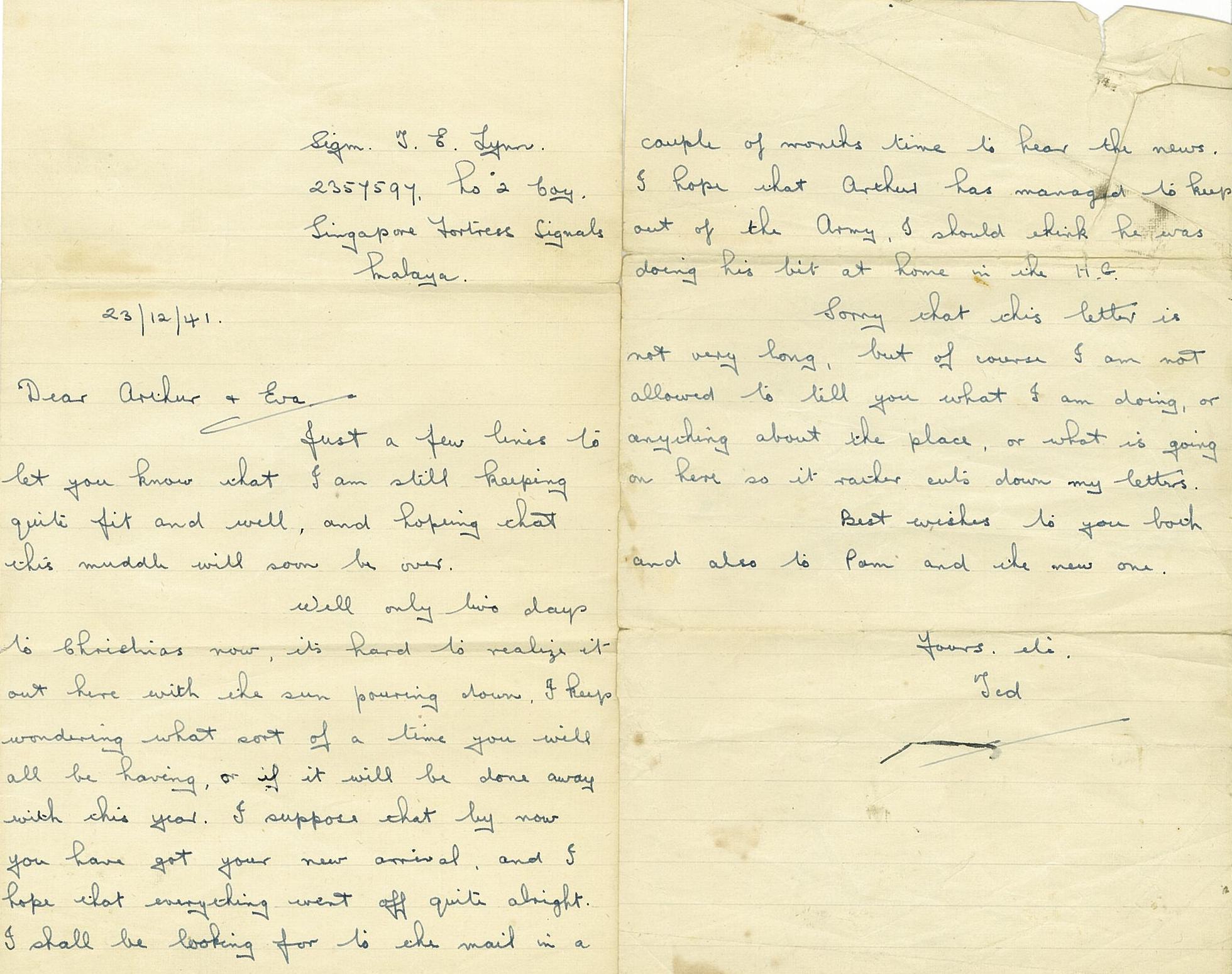
On December 23rd, as the Japanese under the command of General Tomoyuki Yamashita completed their invasion of the Malayan peninsula and pushed South, Ted wrote to his brother and sister-in-law enquiring after my birth, encouraging my father to stay out of the war and hoping that ‘this muddle’ (WW2) will be over soon.

Image

Kuala Lumpur fell January 11th and on the last day of the month the British withdrew across the Causeway, demolishing it behind them.

Singapore, with its garrison of 80,000 British, Australian and Indian troops, was not expected to fall to the Japanese and it was partly this complacency that ensured that it did. There were, of course, other factors – lack of air cover, guns facing the sea from which any invasion was confidently expected to come, incompetent commanders and a more determined enemy. The allied soldiers were also shocked by the ferocity of their opponents, operating with complete disregard to international rules of war and under orders to take no prisoners. The Japanese also had a frightening obsession with sharp instruments. In 1941 British officers carried a swagger stick, their Japanese counterparts a Samurai sword. Even now the classy Japanese suicide option is ritual disembowelment with tanto or wakizashi rather than the noose, overdose or gas oven. World War 2 footage of Japanese soldiers shows an army with permanently fixed bayonets. To kill someone with the bayonet (especially with the 20 inch long blade of the Type 30 model) was infinitely more satisfying than a bullet to the brain. It was slower, more intimate, more personal, it hinted of ancient Samurai martial arts and it gratified the need to inflict pain. And so it was that on February 14th when the invaders arrived at the Alexandra Barracks Hospital and were met by a British Lieutenant carrying a white flag he was casually dispatched by bayonet. Over the next two days all but 5 of the patients and medical staff of the hospital were similarly put to the sword.

Ted does not record how he was rounded up after the formal surrender the next day, only that on February 17th he marched with other prisoners the 16 miles to Changi, where the British barracks had now been converted to their prison. Ted found himself in the Selarang Barracks. Not all of the Allied soldiers went to captivity; 30,000 of the 40,000 Indian personnel elected to join the Indian National Army and fight for the Japanese.

British soldiers don’t have the same attitude to capture and imprisonment as the Japanese. The British join life drawing classes, form clubs to study the local insect life and present pantomime shows for fellow prisoners and enemy guards alike. The Japanese prefer suicide. My housemaster at Cranleigh School, Captain Lovell H Garrett, completed a thesis for his Oxford history degree while languishing as a prisoner of war in Colditz Castle. The British also like to escape and begin tunneling as soon as they’re incarcerated. And so it was inevitable, notwithstanding the fact that Singapore was an island and that swamps, dense jungle and a bloodthirsty enemy stood between the POWs and liberty, that some would try. On August 30th two British and two Australian soldiers attempted the impossible and were quickly recaptured. General Shimpei Fukuye immediately ordered all 17,000 allied prisoners of war onto the parade ground of the Selarang Barracks (an area of 128 x 210 metres) where each prisoner was required to sign a pledge that he would not attempt to escape. In the face of almost unanimous refusal General Fukuye applied pressure, first by ordering the escapers to be executed by a firing squad of soldiers of the Indian National Army and then by forcing the prisoners to stand, unfed in the heat and filth of the compound. On September 4th, after dysentery broke out and the sick began dying, Lt. General Holmes, in charge of the allied prisoners, ordered the pledge signed. Most signed with absurd or fake names. Ted merely records “Signed parole. Forced into it. Some funny business somewhere.”

In the autumn of 1942 Ted notes the arrival of Red Cross parcels (flour, ghee, sugar, jam, dried soup and fags) and pay reductions from 15 to 10 cents per day. During this time the Japanese were busy shipping the allied prisoners to Japan and other parts of Asia to be used as slave labour. Ted’s turn arrived on 15th October. There was no respite even though he writes that he had reported sick a week earlier. “Left Singapore. 4 days on train. Arrived Bangkok early Sunday morning. Left Tuesday; walked 15 miles. Walked another 15 Wednesday. Rest Thursday.” Ted died on January 2nd 1943 a little over 2 months after joining the teams of forced labour working on the infamous death railway, just one of the tens of thousands who succumbed to dysentery, malaria, starvation and the Type 30 bayonet. As the famous bridge over the Khwae Yai River was completed only one month after Ted’s death, we can assume that his last days were spent near or on that section of the 400 km long railway.

In spite of the slaughter unleashed by Little Boy and Fat Man it took the prospect of fighting the Russians and a series of ritual suicides by his military commanders to convince Emperor Hirohito to agree to the terms of the Potsdam Declaration. The Japanese would later renounce any form of nuclear armament and for many years limit any aggression outside of their borders to the world’s whale population and to the export of gruesomely explicit martial arts cartoons.

In 1971, during a state visit to England, Emperor Hirohito, in a morning suit similar to Ted’s wedding outfit, was taken by open carriage to visit the London Zoo (he was a keen amateur botanist). Wherever he went, he was greeted by silent crowds. “We cannot pretend” said the Queen in front of the unexpressive face of her guest, “that the past did not exist.” Not all escaped retribution. General Fukuye was shot in Selarang Barracks after being found guilty at the Singapore War Crimes Trial in 1946. General Yamashita was hanged by the American military in the Philippines in the same year.

It seems odd that Changi, once the location of an infamous prison, is now the site of a modern airport, that the island of Singapore, 70 years ago a key fortress in a world empire, is now a hub of Asian technology and political correctness and that the children of those Japanese who bayoneted helpless patients in the Alexandra Barracks Hospital, or even Signalman Lynn for that matter, may be now calmly photographing each other in front of Sydney’s Opera House.

DE RERUM NATURA

Some 300 years before Christ was even a twinkle in God’s eye, Epicurus, a Greek philosopher from the island of Samos, was writing about Particle and Quantum Physics. What he concluded and taught was that the universe, which he declared to be infinite and eternal, contains nothing except atoms and void. Atoms, freewheeling endlessly and randomly in the void, clashing and uniting, form everything of matter in the universe from a turnip to Kim Jong-Un’s (will there be a Kim Jong-Deux?) underpants, from Lady Gaga to the planet Saturn. Pre-dating Darwin by more than two thousand years, Epicurus believed that matter, whether animal, vegetable or mineral, would adapt over time to the challenges faced so that only the hardiest survived, a process of natural selection. The presence of only atoms and void naturally leaves no room for the supernatural, effectively consigning ghosts, souls and Gods to the realms of fantasy. Neither Earth nor its human inhabitants are the centre of the universe, he claimed, and when we die the atoms that combined to make us will merely redeploy. Our lives need be free of all anxiety about the afterlife, of wondering whether we shall roast in Hellfire or be reunited with loved ones for there is no afterlife. He equated moral good and evil with physical pleasure and pain and therefore one should strive for a life of peace and tranquility, free of the fear of death and the eternal damnation that, at the whims of the gods, may follow. There is no awareness in death and so we have no reason to fear it.

Much of what Epicurus taught was naturally anathema to the Christian Church because of the heretical beliefs inherent in the philosopher’s doctrine. For its first fifteen hundred years, the Church enjoyed its own pain, (self-flagellation in sympathy with Christ’s Passion) and the pain of others (immolating heretics), further removing it from the teachings of Epicurus. To counter the Epicureans the Church rubbished their philosophy, misrepresenting it as a simple desire for pleasure-seeking and over-indulgence (a belief still held by many today) when these were specifically condemned by Epicurus who believed excess eventually causes pain.

In the last century BC a Roman poet and philosopher, Titus Lucretius Carus, published the ideas of Epicurus in the form of an elegant poem he called ‘De Rerum Natura’ (‘On the Nature of Things’). Copies of this work, destroyed by Christians, eaten by worms, overwritten by vellum hungry Monks, were hard to find by the 15th Century and it was the detective work of Florentine writer and humanist Gian Francesco Poggio Bracciolini that unearthed one of the few surviving copies in a remote German monastery in the early years of that century. Poggio copied the text and sent it back to Florence where other copies were made, finding their way into the hands of humanists and influencing, among others, Botticelli, and determining the course of the Renaissance. Accelerated by the advent of the printing press, copies of De Rerum Natura eventually ended up in the libraries of many of Western Europe’s great thinkers including Sir Thomas More, Francis Bacon, Montaigne and Newton. It is thanks to Thomas Jefferson, a self-avowed Epicurean, that the Declaration of Independence includes ‘the pursuit of happiness’ as one of Man’s unalienable rights.

This true story, so much more exciting than anything Dan Brown has ever written, is the subject of Harvard Professor, Stephen Greeblatt’s book ‘The Swerve – How the Renaissance Began’ (London, The Bodley Head, 2011). Splendid stuff!

If you come upon a tomb with the inscription Non fui, fui, non sum, non curo (I was not; I was; I am not; I do not care) you will know an Epicurean lies there. I shall have no such epitaph, even though I agree with its sentiments, for I intend that my own personal assembly of atoms shall be consumed by fire. As Woody Allen once said ‘I don’t believe in the afterlife, but I’ll take a clean change of undies, just in case.’

ROMANCE

It’s St Valentines Day so a few words on the subject of Love, which I take to be (in the case of love between two humans) the condition resulting when a cocktail of respect, compatible skin texture, pheromone attraction and a strong dose of sexual desire are present. When all these are mutual and reciprocated you have the ingredients for a life-long partnership; if you toss in Romance you have the possibility of an eternal love affair. Romance is the icing on the cake of love. Love is foregoing Sunday golf to carry out the attic conversion your Lady has always wanted. Romance is when your Honeybee hangs from a chandelier wearing nothing but a bin-liner while you sip Moet from her Manolo Blahniks. Love is sharing the same bank account; romance is sharing a midnight gondola on the Grand Canal. Providing both parties haven’t flopped into a life of track-suits and thongs, romance can last a lifetime, even after that hip replacement or removal of a prostate. Romance requires effort and imagination, while a shared interest in poetry, music or the fine arts can place the whole thing on a higher plane. Once settled into marriage some men no longer wish to discuss the romantic sentiments that first brought about the union. Ella Kellog, after staring at the back of her husband’s newspaper at the breakfast table, asks him if he loves her. Unenthusiastically but firmly lowering his paper Dr Kellog says ‘My dear, I love you, I have always loved you, I will always love you. And I never wish to discuss the subject again’ [1]. Declarations of passion must not be out of context. A shared sense of humour can assist a lasting marriage but an erotic imagination will prolong the romance. Romance is the intellectualization of love; the very word referring to that period of medieval history when love became a religion amongst certain sections of French and Sicilian nobility, its codified rules known as ‘courtly love’ – a term coined in the late 19th century. Broadly, the rules are based upon the theory that true love is incompatible with and irrelevant to marriage, quite the opposite of Frank Sinatra’s position [2]. Unconsummated and even unrequited love for a married (and therefore unmarriageable) woman was calculated to produce a better courtier, a knight keen to distinguish himself in battle, a distant and adoring suitor with clean fingernails and polished boots. Andreas Capellanus, who in 1184 wrote an explicit guide to courtly love, was quite clear on the issue. ‘Love’, he claimed ‘can endow a man of even the humblest birth with nobility of character’ [3]. 19th century English poet A E Houseman was of the same opinion:

Oh, when I was in love with you,
Then I was clean and brave,
And miles around the wonder grew
How well I did behave.

And now the fancy passes by,
And nothing will remain
And miles around they’ll say that I
Am quite myself again.

And, finally, who can forget Jack Nicholson’s line to Helen Hunt in the 1997 movie ‘As Good as it Gets’ – ‘You make me want to be a better man’.

It’s not known to what extent the rules of courtly love were actually put into practice (considering adultery was a crime at the time as opposed to its contemporary position in Western society as a casual pastime). Perhaps courtly love was more a topic for discussion in that period of highly ritualized behaviour, a tasty theme for the songs and lays of the itinerant troubadours and the growing swag of legends kicked off by Chretien de Troyes in the latter part of the 12th century. This was the gentleman who spawned countless romance novels, poems and films based upon Arthurian legend. The affair between Sir Lancelot du Lac, the preux chevalier and Arthur’s Queen, Guinevere, is pure courtly love. Capellanus drew heavily on Ovid’s treatise on love ‘Ars Amatoria’ (The Art of Love), which is not a Roman version of the Kama Sutra but a series of maxims:

 ‘Wine gives courage and makes men more apt for passion’

‘To be loved, be lovable’

‘Let love steal in disguised as friendship’

‘Darkness makes any woman fair’ (deeply inappropriate, but you can’t deny the logic)

Is romance dead? Opening a door for a woman or helping seat a lady at table once upon a time would have scored a man a scented scarf to wear on his lance at the next tournament or even a file to remove a chastity belt. Now a chap risks abuse for sexist behavior. Am I alone in thinking that grunge is anti-romantic? How would Lancelot or the Duke of Windsor (Duke of Womaniser?) have fared in board shorts, thongs and a Tee shirt emblazoned with ITALIANS DO IT BEST?

Here are a few of the great love stories:

Adam & Eve
They hold the marriage longevity record at 930 years. Adam fathered a son at the age of 130, another world record. And they began the begetting.

Odysseus and Penelope
10 years to sail from the Hellespont (Dardanelles) to the Ionian island of Ithaca? Come on! And such an outrageous list of excuses for getting home so late! Still, she stuck by him and he did tie himself to the mast when he sailed past the Sirens, which separates Odysseus from a lot of married men.

Robin Hood & Maid Marion
Some people have tried to relate the legends to historical characters but there’s nothing to support the love affair. A lot of the romance we associate with this couple is based upon the scene from the 1938 film ‘The Adventures of Robin Hood’ when Errol Flynn climbs the castle wall and declares his love for Olivia de Havilland. ‘Robin and Marion’, with Sean Connery and Audrey Hepburn in the title roles, also helped perpetuate the myth. According to legend Marion relieves Robin of the agony from his mortal wounds by polishing him off with poison. An early case of euthanasia.

Paris and Helen
From the pen of Homer. Helen, the Kim Kardashian of her day, runs off with Paris, the weakest of the Trojan princes, infuriating her husband King Menelaus and initiating WW1BC.

Calvero and Terry
From Charlie Chaplin’s 1952 film ‘Limelight’. Calvero, a failed clown, now a penniless alcoholic, forms a romantic association with Terry, a suicidal dancer with dodgy legs. The whole thing ends tragically for Calvero. Hmmm, sounds very like my first marriage.

Anthony & Cleopatra
This is the real McCoy. Fiction endowed with gravitas and tragic grandeur with lines that make Romeo and Juliet seem melodramatic and unbelievable. When all is lost Anthony does what a man must do ‘Finish good lady; the bright day is done and we are for the dark’.

Duke of Windsor & Wallis Simpson
The man who would not be king. The Prince of Wales, born to be king, gives up the throne of England for a divorcee born to shop.

ElizabethTaylor & Richard Burton
The personification of Anthony and Cleopatra. The Vatican condemned the affair as ‘erotic vagrancy’. Burton said it was like ‘clapping two sticks of dynamite together’ [4].

Horatio, Lord Nelson & Emma, Lady Hamilton
Married, diminutive hero with one arm and one eye forms an adulterous relationship with married fan dancer. Nelson’s fellow countrymen ignore his last request, made as he lies dying aboard his ship, that Lady Hamilton be provided for by the nation. He now gazes down over London from an 185ft high column; she lies six feet under in an unmarked grave somewhere in Calais. Ah oui, ah oui.

Ivanhoe & Rowena & Rebecca
Wilfred of Ivanhoe, returns from the Crusades determined to win back the favour of his father, one of the few remaining Saxon nobles, and to marry his father’s ward, Lady Rowena. Ivanhoe is assisted in his struggle against the arrogant Normans by Rebecca, daughter of Jewish Patriarch, Isaac of York. Loved by two women, Ivanhoe settles for the Saxon Rowena in accordance with Ovid’s maxim – that if you would marry suitably you should marry your equal. Sir Walter Scot’s 1830 novel was influential in a revival of Romanticism that was later expressed in the Pre-Raphaelite movement. In the film Robert Taylor chooses the aenemic Joan Fontaine over the darkly beautiful Elizabeth Taylor.


[1] ‘Welcome to Wellville’. 1994 film about Cornflake King Dr Kellog and his Battle Creek Sanatorium where he provided his patients with yogurt enemas.

[2] That ‘love and marriage go together like a horse and carriage’

[3] Andres Capellanus ‘De Amore’. From The Art of Courtly Love JJ Parry trans., F Locke, ed (New York: Frederick Ungar), 1954

[4] Marie Claire 22/7/2013 Elizabeth Taylor and Richard Burton: The Most Turbulent Love Story Ever Told

Love is in the Air

It will be of no surprise to you that I can recall with astonishing clarity a girl who passed me on the elevator at Chalk Farm tube station in 1959 but cannot remember where I left my reading glasses five minutes ago. Among the choicest souvenirs in my mind’s cluttered ephemera are images of girls I never even spoke to. I remember a girl in the choir at St Stephens in Lower Norwood that inspired the purist of loves in a 12 year old schoolboy. Later there was a girl in a café in Gothenberg whose perfect Nordic beauty bordered on imperfection.(1) And then there was Number 16. Number 16 and her fiancé were the sixteenth couple programmed to be married one Saturday morning in the Mairie of Paris’ 15th Arrondissement. Clutching my ticket number 17, I was standing a few steps below her on the marble staircase with my own fiancée and small wedding party, just one degree of separation from the blonde, Polish beauty in front of me that I should have been marrying. The time to bolt was right then instead of in 5 years time, but I delayed and delayed as we moved slowly and steadily up the staircase, past a bust of the Phrygian-bonneted Brigitte Bardot, until suddenly there we were signing the register under the bored gaze of the tricolour-sashed Mayor himself. And then there was the “coup de foudre” that hit me at 11pm on 26th October 1977 when I was sitting in the departure lounge at Orly-Sud Airport.

I was looking at the owner of a cloud of ash-blonde hair and a pair of cornflower blue eyes, a tall woman, “bien en chair” with strong features and a rash of freckles; a stranger with a face I felt I had always been expecting. In contrast to most of the women in the room pretending to look bored by the prospect of transatlantic air travel or tired at the late hour, she looked bright and expectant. Her eyes may have swept over the 35 year old accountant but if they did they found nothing to arrest them. The lounge was packed for the flight to Rio and as usual the ground staff of the carrier, Varig, seemed incapable of restricting many of the 380 odd customers to a single item of cabin baggage. I’d been on this flight several times over the last months, and when boarding was finally called I made my way to my preferred spot on the aisle at the back of the bus. I had hardly settled in and nodded briefly to the man occupying the window seat next to me when the girl from the lounge came down the aisle. This time our eyes met as she passed by and settled into a seat a few rows back in the central block of seats. Eventually the DC10 began to roll. I was not a white-knuckle flier in those days and already had my head in the Herald Tribune as the plane gathered speed. At some point the ride began to get bumpy and it seemed we were taking forever to lift off into the night sky. My neighbour, who had been gazing idly out of his window, suddenly burst into life, “Jesus Christ the f*****g engine’s on fire!”  I leaned over; sure enough the starboard engine was enveloped in flames. Just as the cries of panic and alarm began to spread throughout the cabin the pilot threw all engines into reverse. The backward thrust of the two functioning engines (the DC10 has an engine in the tailplane) began to slow us and (as I learned later) we had not quite reached V1, the point when the ‘plane must take-off, and so we sailed on, over the end of the runway, through a bank of landing lights and across the grass until we finally ground to a stop metres from the fence that separated airfield from motorway. Later I learned that the plane had been over-loaded, a tyre had burst and we had been rolling along on the metal undercarriage, sending shards of metal and sparks into the starboard engine and causing it to ignite. Twenty three years later a similar accident occurred when a piece of metal left on the runway at Charles de Gaulle burst the tyre of a departing Concorde resulting in a punctured fuel tank. In this case the Concorde pilot had exceeded V1 and was obliged to take-off; the plane crashed minutes later, killing all on board. A few seconds longer on the runway and that would have been our fate.

Meanwhile the panic intensified. Further down the cabin a hostess opened an emergency exit only for the chute to inflate inside the cabin where it was hacked away by frantic passengers before they jumped. I grabbed my hand luggage and headed towards the rear exit. The girl from the lounge was groping in an overhead locker. I helped her down with her bag (strictly against emergency procedures) and propelled her to the rear exit where we slid, almost together, down the chute. When we reached the ground, cabin crew pulled us to our feet and pushed us off into the night, telling us to get as far away from the aircraft as possible. A hundred metres from the ‘plane we sat on the grass, watching the fire engines douse the burning engine and the ambulance crews dealing with the broken limbs of the passengers who had jumped. A bottle of duty free whiskey was produced and we settled down to wait for a lift back to the terminal. I don’t believe in fate or the supernatural, just luck, good or bad and the extent to which either strikes just depends upon the random cocktail of the hour. To the chance encounter, to whatever it was in a stranger’s face that drew me to her, had now been added the shared experience of danger. It was a powerful combination. The face before me when “the bolt of Cupid fell” belonged to Audrey Guy, a ground hostess working at the Air France terminal at Les Invalides and on her way to see a friend in Sao Paolo. She was a divorcee, a committed Basque nationalist and that rare jewel, a French Anglophile.

Eventually the buses arrived to round up the scattered passengers and we were taken to the Orly Hilton where we were offered free accommodation until the next flight, scheduled for the following evening. I suppose there must have been brief envelope of time, perhaps a nanosecond, when I decided not to go home and not to telephone my wife. Such a decision, with its possible long-lasting repercussions, seemed to require no internal argument at all, no assessment as to whether this was right or wrong; I would spend more time choosing a ball-point pen. By the time I reached the concierge there were no more single rooms. I asked Audrey if she would care to share a double. She would. In the anonymity of the hotel room there was an absence of awkwardness and an air of expectant intimacy, but within minutes of hanging a “Do Not Disturb” sign on the door, Audrey was violently sick and immediately fell into a deep, drunken sleep. I cleaned her up and slept chastely in the other single. Audrey was unable to find even a jump-seat on the flight the next day, but eventually we met up in Brazil; it was the beginning of an affair that lasted 3 years and which ended where it had all began, at an airport, although this time it was Linate.

Thirty years later my friend Pierre-Jacques, at home in Paris, was reading “Les Miracules du Ciel” a collection of personal accounts from survivors of air disasters (2) when he recognized a story entitled “Catastrophe, Miracle et Histoire d’Amour” (Disaster, Miracle and Love Story). Audrey had contributed her account of the Varig incident and the beginning of our affair. Some of the facts had been changed. In the book Audrey and I were sitting together; she is also described as an air rather than ground hostess, using her expertise to open the rear exit door, something apparently beyond the capabilities of the Varig cabin staff. Furthermore, the Audrey I knew was not the person described in the book as someone who “hardly ever touched alcohol”. Once, in the back of a taxi on our way home from a bout in a Rio night club, she was sick into my jacket pocket, but I loved her at the time and so didn’t really mind.

1. Tennyson’s Maud was “Faultily faultless, icily regular, splendidly null.”

2. “Les Miracules du Ciel” by Jean-Pierre Otelli. 1998, Editions Altipresse.

Drugs and Artistic Creativity

In 1906, a young Italian painter, Amedeo Modigliani, arrived in Paris and joined the bohemian colony of struggling artists in Montmartre. When he arrived, Modigliani was sober and well-dressed; within a year he had become a dissolute sociopath, heavily addicted to absinthe and to hashish, which he took in pellet form. Within sixteen years he was dead, destined to become part of the already well-established myth of the questionable marriage between art and drugs. His friend and biographer, Andre Salmon, wrote that it was Modigliani’s ‘impatience to become a genius’[i] that drove him to his addictions, later claiming that ‘from the day that he abandoned himself to certain forms of debauchery, an unexpected light came upon him, transforming his art’.[ii] It seems evident that Modigliani, like many artists and writers doubting the potency of the creative talent on which their livelihood depended, took drugs to relieve the burden of possible failure. It is less evident that drugs transformed his art, for, if his painting did improve, who is to say it was not practice, the influence of a happy marriage and a reduced drug intake during his last years that were responsible? Alternatively, given that absinthe is a stupefacient and that hashish can induce depression as well as euphoria, it is possible that Modigliani’s addictions were actually detrimental to his artistic output if not to the quality of his art.

Modigliani’s story, while certainly not uncommon in some respects was unique in others. Every case of drug use will have a different effect on the user, occasioned by his personality, prevailing mood, the locality and time of administration and the drug itself. Norman E. Zinberg codified these variables into what he called ‘Drug, Set and Setting’, claiming that ‘it is necessary to understand in every case how the specific characteristics of the drug and the personality of the user interact and are modified by the social setting and its controls’.[iii] Modigliani’s drug of choice was hashish, produced from the resin of the cannabis sativa plant. With a maximum THC content of 15%, taken in large doses the drug, reportedly, may cause a user to hallucinate.[iv] The use of cannabis and opium can be traced back thousands of years. Sadie Plant points to evidence of opium use in European Neolithic settlements, in Egyptian tombs of the fifteenth century BC and in ancient Rome, although it is not clear if the drugs were used for other than medicinal and healing purposes.[v] However, it is more recent times and the indigenous peoples of the Amazon basin that provide some first real evidence of the effect of hallucinogenic drugs on human consciousness. This evidence is important because, first, the drug (most commonly Yage) is taken by the user with the express intention of entering into a trance and using whatever visions were experienced for specific benefits to the community. Second, there is evidence of its impact. The impact cited by Andrew Weil in his paper ‘Clues from the Amazon’ [vi] does not point to life altered by psychotic, drug induced dreams, but to the complete absence of addiction and abuse. Weil attributes this ‘success’ to the positive objectives of the drug taking (normally healing or religious ritual), the purity of the unadulterated plant life that constitutes the drug and the ceremonial or ritualistic circumstances under which the drugs are administered, normally by a spiritual leader or shaman.

The factors that made drug taking in remote areas of the Amazon basin harmless or even beneficial were entirely absent in the cities of the industrialised world, where, in the mid-nineteenth century the mind-altering qualities of opium first began to be examined. Alethea Hayter, in her study ‘Opium and the Romantic Imagination’, identifies three groups of people (excluding those who take opium as a pain killer) who are likely to experiment with drugs. The first group consists of the curious, the seekers of novel experiences; the second, those desiring rest and freedom from anxiety, and the last, those who take pleasure in participating in ‘secret rites and hidden fellowships’.[vii] In 1821, English writer and intellectual, Thomas De Quincey, provided the first serious study on the effects of opium on human consciousness with the publication of Confessions of an English Opium-eater. Although a curious intellectual, De Quincey discovered opium in taking it as a medicine finding, at the same time, ‘the secret of happiness’ and his pains ‘swallowed up…in the abyss of divine enjoyment’.[viii]  Outside of his ecstatic eulogies De Quincey also provided some meaningful insight into the effects of opium on the sub-conscious and creativity.

De Quincey’s basic observations, which were to be subsequently confirmed by other opium users, covered several important topics. He claimed that ‘The sense of space, and in the end, the sense of time, were both powerfully affected’. [ix] He underlined that the experience taught him nothing new but, in the words of Martin Booth, ‘embellished what already existed, heightening awareness of latent thoughts and imagination’, in other words, improving creative talent but only in the event that the idea already existed.[x] De Quincey also reports that his memory was vastly improved and that he was able to recollect ‘the minutest incidents of childhood’.[xi] Finally he addressed the negative aspects of the drug, claiming that it rendered him too weak to record his extraordinary dreams in print and that it induced feelings of anxiety and melancholy.[xii] Later, the dreams, once of extraordinary shapes and colours, would become agonising and frightening nightmares. De Quincey, in managing to control his life-long addiction, lived to a reasonably old age and enjoyed a happy personal and professional life.

While the creative advantages expressed in Confessions of an English Opium-eater undoubtedly influenced others writers to experiment with opium, notably Edgar Allen Poe, Charles Baudelaire and Nikolai Gogol, there were many others who had discovered the drug for themselves. Many were introduced to it in the form of Laudanum, a medicine composed of opium powder and alcohol, sold without prescription until the early twentieth century. During the nineteenth century, among the millions of opium addicts trying to alleviate their misery from the gold mines of California to the dens of Shanghai, elitist groups sprang up – those hopeful that the drug would lead to enlightenment or artistic creativity. One such group formed the Club des Hashischins, while the Romantics, a group of European writers active between 1770 and 1840, included several authors who experimented with drugs. Samuel Taylor Coleridge, who was at the very centre of the Romantic movement, found inspiration for his poetry in laudanum, at the cost of his health and his income from lecturing. [xiii]

In 1954 mescalin became briefly popular when another curious intellectual, Aldous Huxley, self-administered the drug to test its possible spiritual uses. Huxley experienced the same vivid dreams, disassociation of mind from body and intensification of colour, but the result was the same – the drug can only extract what already exists within the subconscious. He concluded that it was useful as an alternative to words. [xiv] It was a synthetic drug, Lysergic Acid Diethylamide (LSD), discovered by Swiss chemist Albert Hofmann and championed by Harvard professor Timothy Leary, that became the drug of choice for musicians and artists in the ‘swinging sixties’. Even the CIA and US military, who found it caused anxiety and was therefore useful to the interrogation process, examined it closely. Again the results were the same; LSD could send you briefly to the stars, but it could also cause the user to become ‘paranoid and bewildered’.[xv] It also proved relatively unhelpful to the artistic community. Writer Anais Nin found the drug did nothing to inspire creativity; Jack Kerouac felt the drug had permanently harmed his health.[xvi] Writer Julia Ward Howe thought that to use drugs to help write was actually cheating. [xvii]

Hashish, opium, mescalin and LSD – there is no evidence that they can expand human consciousness beyond what already lies in the user’s memory. As British writer Arthur Koestler said, after experimenting with LSD, ‘There’s no wisdom there. I solved the secret of the universe last night, but this morning I forgot what it was’. [xviii]

Drugs therefore cannot contribute to artistic creativity by providing material that did not already exist in the artist’s conscious. The positive contributions that opium, cannabis and hallucinogens have made to artistic creativity lie in two different areas. First, the addicts’ world, together with the fantastic and sometimes gruesome visions that drug-induced dreams produce, have been the subject and inspiration for many fine novels and poems, notably Coleridge’s Kubla Khan and the stories of Edgar Allen Poe. Second, drugs provide, for some artists, the only influence under which they can be in any way productive. It enables the artist, perhaps poor and tortured by the possibility of failure, to escape ‘the cosmic suffering that is the inescapable lot of the Romantic artist’.[xix] It becomes not a benefit but a necessity, even though the costs, financial, physical and mental may be severe. Negro jazz musicians in turn-of-the century New Orleans, Toulouse Lautrec and Modigliani all spring to mind. Personally, I always find my art, writing, cooking and life in general improve after the second glass of wine, but that’s just my opinion.


[i] Salmon, Andre (1957) Modigliani, a Memoir, London: Jonathan Cape 1961. p.61

[ii] Werner, Alfred (1967) Amedeo Modigliani. London: Thames & Hudson. p.20

[iii] Zinberg, N E. (1984) ‘Historical Perspectives on Controlled Drug Use’. In Drug, Set and Setting: the Basis for controlled Intoxicant Use. Yale University Press. P.15

[iv] Nordegren, Thomas (?) The A-Z Encyclopedia of alcohol and Drug Abuse

[v] Plant, S. (2000) ‘Private Eyes’. In Writing on Drugs. New York: Farrar, Straus & Giroux, pp..4-5

[vi] Weil, Andrew, ‘Clues from the Amazon’ in The Natural Mind: an investigation of Drugs and the Higher Consciousness, Weil, Andrew 1986.

[vii] Hayter,A. (1968) ‘Case Studies.’ In Opium and the Romantic Imagination. London: Faber, p. 40-41

[viii] Booth, M. (1996) ‘Pleasure Domes in Xanadu’. In Opium: a History, London:  Simon & Schuster, p.36

[x] Booth, M. ‘Pleasure Domes in Xanadu’. In Opium: a History, p.36

[xi] Booth, M. ‘Pleasure Domes in Xanadu’. In Opium: a History,  p.38

[xii] Booth, M. ‘Pleasure Domes in Xanadu’. In Opium: a History,  p.38

[xiii] Booth, M. ‘Pleasure Domes in Xanadu’. In Opium: a History,  p.44

[xiv] Huxley, A. (1972) ‘The Doors of Perception’. In ‘The Doors of Perception and Heaven & Hell. London: Chatto & Windus, p52.

[xv] Levinson, M.H. (2002) ‘The Quest for Instant enlightenment: Drugs and Literary Creativity’. In The Drug Problem: a New View Using the General Semantics Approach, Westport, CT: London, Praeger. p. 88

[xvi] Levinson, M.H. (2002) ‘The Quest for Instant enlightenment: Drugs and Literary Creativity’ p.88

[xvii] Levinson, M.H. (2002) ‘The Quest for Instant enlightenment: Drugs and Literary Creativity’ p.86

[xviii] Levinson, M.H. (2002) ‘The Quest for Instant enlightenment: Drugs and Literary Creativity’ p.88

[xix] Carpenter, L. (2001) ‘Enhancing the Possibilities of Desire: Addiction as Post-modern Trope’ (Opium, Heroin, and the Novelists of the romantic Imagination), Southern Humanities Review, 35 (3): p.232

Bibliography

Booth, M. (1996) ‘Pleasure Domes in Xanadu’. In Opium: a History, London:  Simon & Schuster, pp. 36-49.

Carpenter, L. (2001) ‘Enhancing the Possibilities of Desire: Addiction as Post-modern Trope’ (Opium, Heroin, and the Novelists of the romantic Imagination), Southern Humanities Review, 35 (3): 228-251.

Cohen, Sydney, (1965) Drugs of Hallucination, London: The Scientific Book Club.

Hayter, A. (1968) ‘Case Studies.’ In Opium and the Romantic Imagination. London: Faber, pp.36-66.

Hodgson, B. (1999) ‘The Writer’s Muse’. In Opium: a Portrait of the Heavenly Demon. San Francisco: Chronicle Books, p.83-103.

Huxley, A. (1972) ‘The Doors of Perception’. In‘The Doors of Perception and Heaven & Hell. London: Chatto & Windus, pp.40-78.

Lee, M.A.(1992) ‘Psychedelic Pioneers’. In Acid Dreams. New York: Grove Wiedenfeld, pp.44-70.

Levinson, M.H. (2002) ‘The Quest for Instant enlightenment: Drugs and Literary Creativity’. In The Drug Problem: a New View Using the General Semantics Approach, Westport, CT: London, Praeger. pp.75-92

Plant, S. (2000) ‘Private Eyes’. In Writing on Drugs. New York: Farrar, Straus & Giroux, pp.3-32.

Salmon, Andre (1957) Modigliani, a Memoir, London: Jonathan Cape 1961.

Zinberg, N E. (1984) ‘Historical Perspectives on Controlled Drug Use’. In Drug, Set and Setting: the Basis for controlled Intoxicant Use. Yale University Press. Pp.1-18

Eeyore’s Italian Christmas


Warning: some food descriptions may be distasteful to vegetarians and vegans. 

I know, I know, I said I’d never fly Qantas again (or C**t-arse as a French friend unwittingly pronounces it) but our national airline is in financial trouble, its shares reduced to the level of junk bonds, so time to help out. What’s this? They’re announcing that the catering truck responsible for victualing my flight to Dubai with the usual luke-warm compost has crashed and there will be a delay in boarding of approximately half an hour. Quelle surprise! Once on board I find I’m nicely placed in an Exit row and near a toilet, which, as I’m a Gold Frequent Toilet Flyer, is a Godsend. The in-flight attendants are charming but seem terribly young. I’m worried that when the Captain orders ‘Doors to manual!’ they will open them by mistake and I shall be sucked out of the aircraft and end up in someone’s dining room in Wollongong. Better tighten the seat belt.

Genova

Back in the organized pandemonium that is Italy. I’m on my way to Genova to witness my young friend Andrea’s graduation as a Master in Engineering. I take the coach from Malpensa Airport. It’s cold and a silver dollar of a sun sparkles through banks of mist on fields of frozen stubble and woods of spindly, leafless trees. Incongruously, at a quiet country intersection, stands a beefy Siren with red lips and short skirt waiting for some lonely male on his way home. It’s Christmas time and a little ad hoc prostitution helps to secure those festive extras. My heart goes out to her. Back on the Autostrada we begin the descent off the great fertile plain of Lombardy, winding down through tunnels and viaducts until we arrive in the ancient and pleasant city of Genova. This is the city of a million scooters and should be twinned with Kuta. Narrow, steep winding roads with cars parked half on the pavement half on the road with not even the space to slide a piece of paper between them. An ancient, congested city centre and an absence of public car parks make two wheels a necessity. It’s warmer than Milan with clear blue skies.

Off to the Castello hill, the oldest part of Genova’s historic centre to collect bound copies of Andrea’s thesis. The printer’s shop is located near the Faculty of Architecture from which Andrea’s brother and his girl friend, both graduated. Genova, with some 40,000 students is one of the newer Italian universities, founded in 1481.The Faculty of Architecture, cunningly incorporated within the remains of the ancient monastery of San Silvestro and a medieval Bishop’s Palace, is an exciting mixture of ancient and modern, a labyrinth of lecture rooms and libraries cunningly installed in the irregular spaces dictated by the ancient buildings, including a triangular cloister. On the roof we look out over the port from which Columbus sailed, now filled with ferries and container ships.

Up early for an assemblage of Andrea’s family and friends at the Faculty of Engineering. Francesca, Andrea’s mamma is there along with his brother Simone, Simone’s fidanzata, Eleonora and assorted uncles.  Andrea’s fellow students are all charming young people; you would think that Italy would be in good hands when they are in charge but alas the country always seems to end up in the hands of cunning, self-serving politicians like ‘Burlesque-only’. We sit in rows behind a quintet of examining Professors while Andrea confidently presents a summary of his thesis. Then a wait outside until he is called back in to hear his mark. It is difficult to tell from his expression when he emerges whether the result is good or bad. It’s 109 out of 110! That single missing point is important to Andrea who aims high, although, to me, it’s just a whisker, a whisker that could easily have been influenced by nothing more than one irritable examiner dwelling upon an unfair parking ticket. I would have spent the next five years sticking pins into effigies of the professors, but Andrea, like the man he is, puts it behind him, dons the laurel wreath and gets on with the festivities. I had warned him before I came that, as in Roman times, I would be standing behind him in the chariot as he goes to receive his Triumphus, reminding him that he is not a God and whispering ‘Respice post te. Hominem te memento!’ But for the minute I think he deserves to be feeling like one. Who could have predicted the happy repercussions arising from our decision to take in a young Sardinian exchange student those seven years ago?

I’m waiting with Simone and Eleonora for our transport to arrive to take us to the restaurant where Andrea is holding his celebratory lunch. It’s an up-market part of town and the pavement sports a red carpet in front of some expensive boutiques. I’m trying to figure out whether I’m in front of a jewellery shop or a pasticceria, unsure whether the object in the window is a cake or a large Faberge’ egg (the price suggests it could be either) when a young man asks me for money for a coffee. A coffee? If he’s hard up, why not a sandwich or some fried potato peelings? A coffee is a luxury in my book; but then I’m not Italian. Now a man selling lighters wants a hand out. I give him a couple of Euros. If I stay here much longer I’ll be bankrupt. Chi sono io, Babbo Natale?

Andrea is hosting his family and friends in my favourite restaurant. If you are in Genova and looking for somewhere serving well cooked, classic Italian food, where any combination of antipasto, secondo and dessert costs 10 Euros and where you eat in a charming warren of green tiled rooms, then this is it. But I’m not going to tell you its name or location as I think the place should be left to the quiet enjoyment of the Genovese. In the evening we return to the Engineering Faculty for the graduation ceremony proper when Andrea gives me a copy of his thesis in which part of the dedication is to his adopted Australian family. It’s a ‘hats in the air’ occasion and Spumante corks are popping like gunfire.

After the ceremony I set off with Francesca, Simone and Eleonora whose parents, Ermanno and Marita, have kindly invited me to stay at their home in Diano Marina, a seaside town an hour’s drive west along the Italian Riviera. We arrive quite late in the evening and sit down to a marvelous feast of antipasti, tortellini in brodo, bollito misto, formaggi and Sachertorte washed down with excellent Chianti. Behind Francesca’s petitely innocent façade is one of Sardinia’s major producers of powerful moonshine and we round off the meal with some of her vintage Mirto.

The next morning is warm and sunny and after a breakfast of coffee and biscotti laced with Marita’s marmellata of mele cotogne and a charming audience with Eleonora’s nonna, we walk the through the quiet pedestrian town centre to the beach where the dogs race around like greyhounds on Ecstasy. Simone buys chunks of warm focaccia al gorgonzola, which we eat on the way home effectively reducing my capacity for doing justice to the marvelous lunch prepared by Marita with the enthusiastic assistance of Simone.

One should approach these meals as one would a 10,000 metre foot race; you must know how to pace yourself, to enjoy each course (including the unexpected ones) so that, at the end, you still have that little space for the chocolate and Mirto. Self-control has never been one of my strong points, although I’m not sure if my life would have been better with it.

In the late afternoon Ermanno drives us along the coast so that we reach San Remo as the sun is setting. The streets, closed to traffic, are thronged with Christmas shoppers although I’m not sure if anyone is doing any serious spending. Then on to Monte Carlo where the Piazza bounded by the Casino and the Hotel de Paris is decorated in a black and white theme – white Christmas trees, black Bentleys, white diamonds, black fur coats.

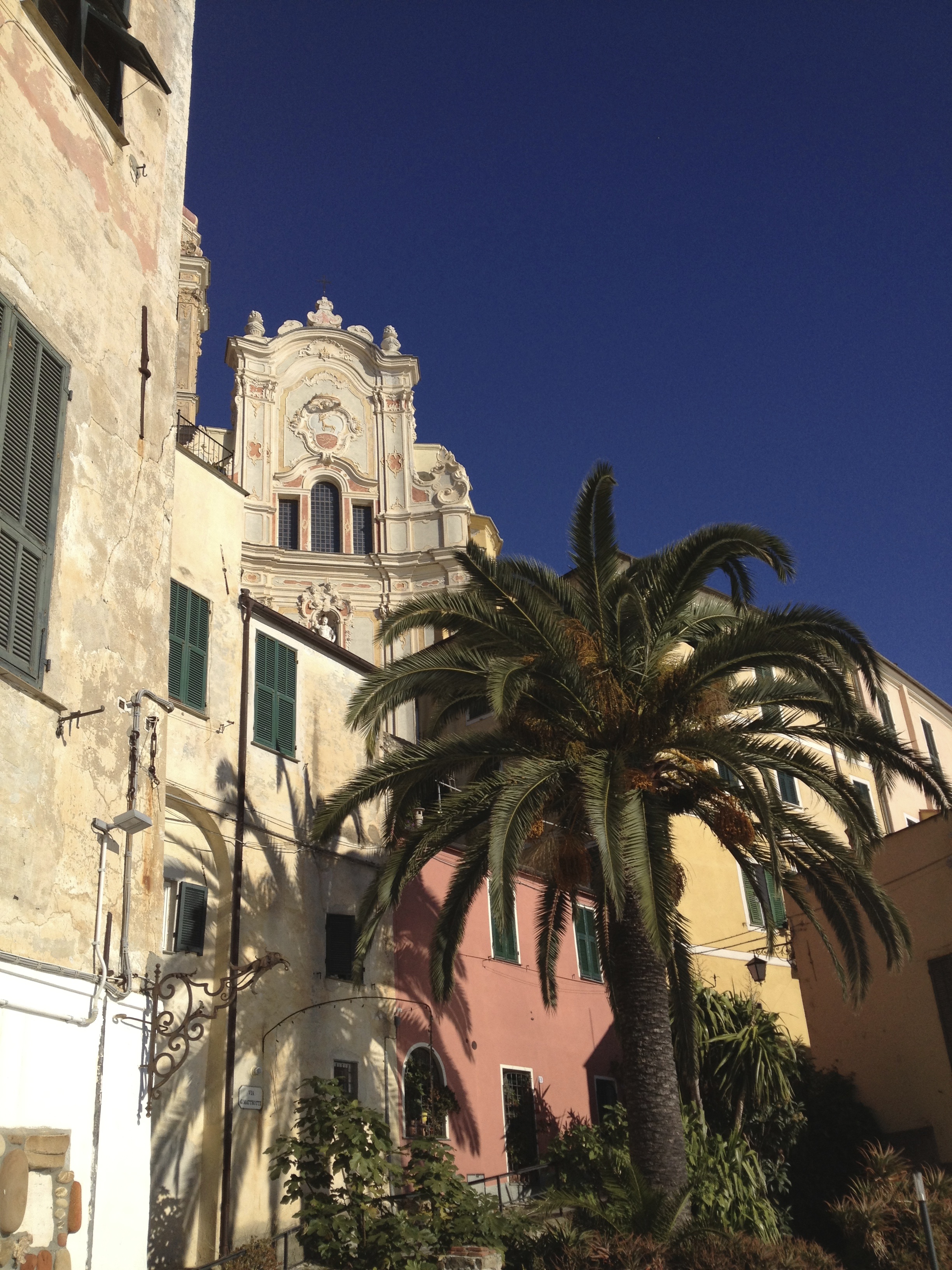
The next morning Ermanno takes us along the coast to Cervo, a medieval village perched on a hill overlooking the sea. The jewel in its crown is the pastel pink 19th Century Church of San Giovanni Battista, built from the wealth amassed by the town’s coral fishermen. The fishermen have long gone, the seabed hoovered clean of coral, but as always in Italy the Church still stands. That afternoon Ermanno takes me to the station where I catch a train to Milano looking forward to being reunited with my Honeybee. I wonder if I’ll be back here for the marriage of Simone and Eleonora; just in case the wedding’s here rather than in Sassari, I’ve taken note of a pleasant little B & B in Cervo.

S. Giovanni Battista overlooking Cervo

S. Giovanni Battista overlooking Cervo

 Milano

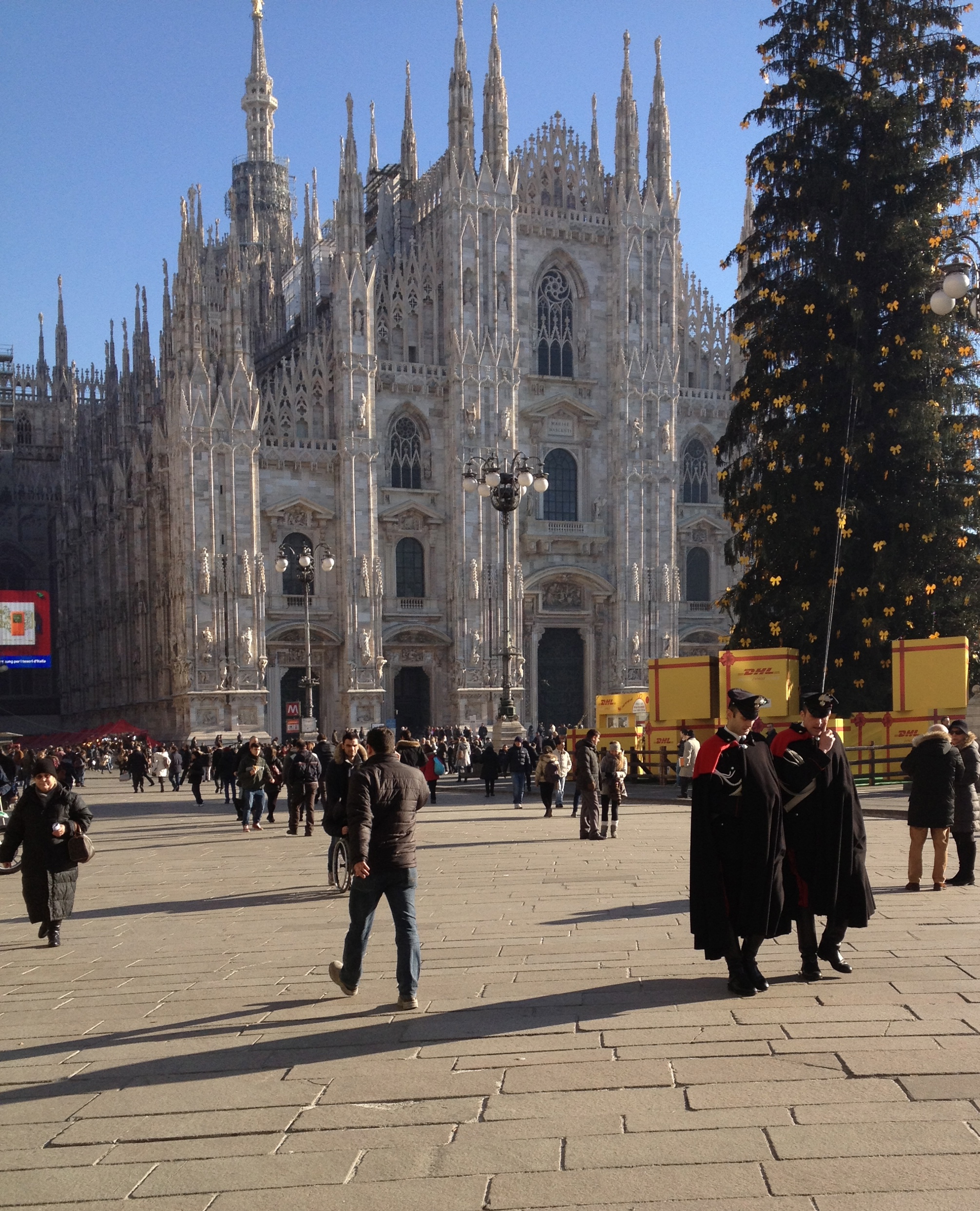
A taxi to the Castello and a stroll towards the Duomo, which I come upon suddenly, a great iceberg worked on by Grinling Gibbons that leaves me breathless. The Cathedral is surrounded by bancarelle selling salami, cheeses, panforte, Christmas trees and the traditional, ladies red underwear. Dean Martin is singing ‘Let it Snow’; a pair of Carabinieri Officers, elegant in cloaks of Prussian blue, polished boots and spurs stroll across the piazza; for the first time in many years I feel a sense of Christmas.


Il Duomo with Carabinieri

Il Duomo with Carabinieri

A tsunami of salami

A tsunami of salami


I slide into the perfumed warmth of Rinascente (Department Store) and am overcome with an uncontrollable urge to spend. Even from 10,000 miles away I can sense my bank manager checking the availability for an increase in my overdraft. Extra personnel take their places in front of their PCs at American Express, fingers poised over the keyboard. I am a magpie, drawn to anything that catches my eye – a nativity scene in porcelain by Villeroy & Bosch, a lady’s high-heeled shoe in dark chocolate, a pair of stainless steel spaghetti tongs. What am I doing? I ask myself as I squeeze into a pair of brightly coloured jeans made for someone half my size and 50 years younger. Perspiration trickles down my temples and my spectacles mist up when I see the price, but the sales lady is young and attractive and I exit with two pairs. ‘Mutton dressed as lamb’ my mother would have snorted. I may be going down but I’m going kicking and screaming.

Into the Galleria Vittorio Emanuele and into Tods, my favourite shoe shop, which appears staffed entirely by Japanese. I’m undecided whether to take the suede lace-ups or the leather slip-ons. The assistant suggests I take both pairs. Of course, how stupid of me not to think of that! The streets are full of busy shoppers and I see no evidence of the frail economy that the press harps on about, pointing to the level of Italy’s national debt, which is apparently on a par with that of the USA and Japan. As I see it, this places Italy alongside the giants rather than among the economic pygmies like Canada and Brazil.

Paolo takes me to the quiet town of Pavia where there is a Monet Exhibition in the Palazzo Visconti. The Palazzo dates from the end of the 14th century and once had Petrarch in charge of its library. The exhibition is wonderful, lots of Monet’s works from his early childhood drawings to his last oils and none of the water lily series that seem to overwhelm most shows. Everybody is out buying boxes of Ferrero Rocher Chocolates and recordings of Nat King Cole singing ‘Have Yourself a Merry Little Christmas’ and we have the place to ourselves. There’s not even a security person in sight so I can get very close to the canvases to inspect Monet’s brushstrokes.

On the way back to Milano we stop to look at the Certosa di Pavia, a monastery built between 1396 and 1495 to accommodate Carthusian monks. After a series of monastic takeovers the cloisters are now home to the silent traffic of the Cistercians.


La Certosa di Pavia

La Certosa di Pavia

Our final stop is Vigevano, home to the magnificent Piazza Ducale, the work of Donato Bramante the high priest of Renaissance architecture. It is dark now and children are ice-skating in a Piazza once overlooked by Ludovico Sforza, Duke of Milan and his protégé, Leonardo da Vinci. Thank you Paolo for those unforgettable experiences.

It’s that time of year for reflecting on the past 12 months, when every magazine trots out articles featuring the best of 2013, be it film, book, athlete, unit trust or travel destination. The Economist votes Uruguay Country of the Year and Italy’s L’Espresso magazine nominates Constantino Baratta, a 56 year old builder from the island of Lampedusa, Man of the Year. Signor Baratta’s achievement was to save 12 Eritrean refugees when their boat capsized. Surprisingly, but admirably, Italians display an amazingly generous attitude towards refugees in spite of the vast numbers crowding daily into this small country.

Ne’ carne ne’ pesce

Dinner alone in a Trattoria in the Piazza Gramsci. I’m struggling through a Cotoletta alla Milanese the size of Roger Federer’s tennis racquet when in comes the Dottore. Our Host, no longer interested in discussing my request for a second flagon of wine, rushes, beaming, to greet this more important customer. ‘Buona sera, buona sera Dottore! Make yourself comfortable at your usual table.’ Then, after inquiring into the state of the Dottore’s family’s health, the weather outside and the Dottore’s success in finding a parking space, our Host, wringing his hands in pleasure, pops the all important question:
Carne o Pesce?’
After years of trying to accommodate his various clients by reconciling their dubious tax declarations with the exigencies of a continuously changing law, the Dottore has become wary and indecisive and, through habit, indifferent to the unctuous groveling of our Host.
‘Hmmm, what fish do you have?’
‘We have fresh branzino, which we are serving grilled on a bed of potatoes, onions and wild fennel.’
‘Hmmm, do you have any scampi?’
‘An excellent choice, Dottore but unfortunately Beppe neglected to refuel the Ape and by the time he reached the fish market this morning the best scampi had gone’.
‘Hmmm, what meat dish can you recommend?’
At this point I had finally managed to secure the assistance of a sulky waitress and my attention turned to the pitcher of the house red wine she brought me, a vino vivace as pink and delicious as Lady Gaga’s lips.

It’s my birthday and we’re whooping it up in the Osteria del Borgo Antico, with Paolo, Franca and Andrea. My birthday present from Honeybee is ‘The Broken Road’ the last, posthumous, volume in a travel trilogy by Patrick Leigh Fermor. In 1933 at the age of 18, the author begins a walk from the Hook of Holland to Constantinople. Moving through an Eastern Europe still inhabited by a noble peasantry, he sleeps in barns and hedgerows, falls in love with a Rumanian Princess and lives with her in Rumania and Greece until the drums of war summon him back to England. He joins a Guards Regiment and is parachuted into German occupied Crete where, with the help of partisans, he kidnaps a German General, an event dramatized in the film ‘Ill Met by Moonlight’, with actor Dirk Bogarde playing Leigh-Fermor. It is the author’s association with Military Intelligence, his partiality to cigarettes, strong liquor and beautiful women, his good looks and his friendship with Ian Fleming that lead many to feel that he was the inspiration for James Bond. If you read his books, start with the first book in the trilogy, ‘A Time of Gifts’, published in 1977, 43 years after the event it describes. Its title will lead you to Louis McNeice’s poem ‘Twelfth Night’  (‘For now that the time of gifts is gone’) and if you happen upon a copy of the original edition still with its dust cover, you will have an introduction into the cubist art of John Caxton. What makes PLF’s books stand out from those of other travel writers is the stylish prose. Here he writes of those events, unanticipated, their importance unappreciated at the time, which shape our lives.

‘One is only sometimes warned when these processes begin, of their crucial importance: that certain poems, paintings, kinds of music, books, or ideas are going to change everything, or that one is going to fall in love or become friends for life; the many lengthening strands, in fact, which plaited together, compose a lifetime. One should be able to detect the muffled bang of the starter’s gun.’

Sicily

On our way to spend Christmas with my suocera (mother-in-law) in the town of Adrano.

On a clear day the first thing you see as you deplane at Catania Airport is the volcano. Its brooding presence dominates the horizon. To the Greeks Etna was the home of Haephestus, God of Fire, who used the lava to forge Zeus’s thunderbolts. To the Sicilians it is muntibeddu but to my mother-in-law and the others who live on its slopes it is simply ‘a muntagna, the mountain. To the vulcanologists it is the highest (at 10,890 feet) and most active volcano in Europe. In 1669 lava reached the outskirts of Catania and in recent days it blew its top, sending clouds of sulfurous dust into the air and closing down air traffic. What lunatic decided to build Adrano on the slopes of an active volcano? I picture myself in a thousand years, a museum exhibit like those unfortunate Pompeians, a lump of fossilized volcanic ash in a cowardly foetal position. Better pull the bedclothes up tonight.

Etna - 'A muntagna

Etna – ‘A muntagna

Adrano is a poor town, you can tell from the fact that cigarettes and AA batteries can be bought singly. There is no cinema, no hotels or passable restaurants, the buildings, many fine, are chipped and weed infested. In the main Piazza there is a gloomy 12th Century Norman stronghold built in black volcanic rock and the elegant church of Santa Chiara, its façade still pock-marked from the second world war. The municipal authorities have abolished dustbins (since they overflowed) and rubbish piles in the streets since people cannot wait for collection days to dispose of their rubbish. There’s little to do except drink the small, bitter espressos, smoke and hope, which in the short-term is expressed in a scratchy and, in the longer term, in a ticket for the National Lottery.

Orange tree in the middle of Adrano

Orange tree in the middle of Adrano

Poor it may be but the people are kindly and courteous, exhibiting an almost old worldly degree of politeness. The town itself is a genuine example of ‘shared space’. In a town of 20,000 people there is not one set of traffic lights and although there are marked pedestrian crossings, people only use them IF THEY HAPPEN TO BE AT THE PLACE THEY WANT TO CROSS knowing that drivers will always slow to let them pass. There are no public car parks and the people park anywhere without ever resorting to reverse parking. But nobody minds. The roads are clogged with cars the size of dog-kennels. But you never see any road rage. These conditions I also witnessed in Genoa, San Remo and Milan only confirming my opinion that Italians are the most expert and generous spirited drivers in the world and therefore Italy the easiest place for foreigners to drive in.

Sicilian eco-taxi

Sicilian eco-taxi

We come from a city where the seasons are only mildly distinguishable and everything is available regardless of the season. That is not the case in Sicily and when we enter the Caffé Europa for breakfast expecting to see the polished, mahogany domes of brioches and jugs of granita di mandorle we are informed that these are for summer only consumption. Still, some warm, ricotta filled crescents dusted with icing sugar and sliced almonds will do very nicely.

Christmas Eve and we go to the Associazione Nazionale Combattenti e Reduci, an RSL in other words, except there are no pokies. We have come to listen to a quartet (tambourine, guitar, accordion and fischietti, a Sicilian, Pan-like whistle) play traditional Christmas music. While an elderly gentleman recites a Christmas themed poem in Sicilian dialect, I inspect a splendid battlefield mural featuring a mortally wounded WW1 Italian soldier.

Sicilian RSL

Sicilian RSL

Like every shop, building and piazza the club has a presepe (nativity scene) and like all the others, the crib is empty, for all the baby Jesus, from those no bigger than my thumb to life-size examples, are in the Churches waiting to be ‘born’ the next day and transported in processions to their allotted straw cots. In the foyer of my mother-in-law’s apartment block, framed in tinsel and poinsettia, a young man is clutching a whole pig to his chest. He is there to play a selection of Christmas music on what turns out to be Sicilian bagpipes and after wailing for ten minutes moves to the first floor to annoy some other residents.


Sicilian bag-pipes

Sicilian bag-pipes

This is a very religious island and its religiosity is evident everywhere. My mother-in-law’s apartment is crammed with religious statues, crucifixes, messages from Popes and pictures of Saints in various anguished or beatific poses. As I lay in bed under a particularly harrowing Crucifixion scene I can look at a plaster statue of the Black Madonna and Child (why not?) and a picture of the new Pope. My Honeybee, a Catholic, asks what is the principal difference between the Catholic and Anglican religions and I explain that Anglicans deal directly with God while Catholics use the Virgin Mary as an interlocutor. Do Anglicans follow the Stations of the Cross, she asks and I tell her that to a heathen Londoner ‘Stations of the Cross’ can only mean Charing Cross and Kings Cross.

Christmas Day and not a turkey or a mince pie to be seen. Most Sicilians seem to eat the same food at Christmas that they eat regularly throughout the year with the addition of a bottle of Spumante and a Pandoro or Panettone. We are beginning with an antipasto of Zozzo (brawn) and baked ricotta. Although customarily a New Year’s Eve dish, we follow with Zampone, literally a ‘big foot’, in this case that of a large pig, emptied of flesh and bones, stuffed with spiced, minced pork and reassembled, complete with toe nails, and ready for boiling and eating with lenticchie nobili (good quality lentils from Ustica).

Zampone ready for the pot

Zampone ready for the pot

To finish we have pere spinelle (boiled, squash ball sized local pears) and prickly pear fruit. Some of my mother-in-law’s friends have joined us for dinner and I’m sitting next to Marcello, a courteous neighbour, who has looked at me on previous occasions, as if I’m from outer space. Tonight however, we are bonding nicely, having found a common interest, first in the inky, Nero D’Avola wines of Etna and now in a bottle of Limoncello. While Marcello cracks walnuts for us I reach for the Limoncello to toast once more the glory of Anglo-Italian relationships and my new best friend but, as so often happens, the ‘League Against Dancing on Tables’ (a movement composed exclusively by women dedicated to saving men from themselves) has spirited away the bottle. I would have thought that so many similar experiences over the years would have alerted me to the danger posed by Marcello’s diminutive but explosive wife, Graziella.  I was disappointed but not surprised to learn that Honeybee, a founding member of the League, supported her.

Palermo

My Honeybee and I are in the Trattoria Primavera in Palermo reading our favourite piece of literature – the a la Carte menu of a new restaurant. Among the primi our attention is drawn to Fettucine alla Nelson. My limited knowledge of Sicilian history suggests that the dish was invented by or (more likely) conceived in honour of Horatio, Lord Nelson rather than Nelson Picquet or Nelson Rockefeller as the English Admiral, at one time, had quite close ties with Sicily. The roots of the relationship lie in the conquest of Sicily and Naples in 1734 by Philip V of Spain ending 20 years of Austrian rule. Philip, a descendent of the Bourbon King Louis XIV, installed his son, Charles, Duke of Parma as ruler of the two separate kingdoms. On the death of his father in 1759 Charles assumed the Spanish throne as Charles III, abdicating as King of Sicily and King of Naples in favour of his third son, Ferdinand, the Spanish constitution prohibiting the holding of more than one crown. Ferdinand (styled Ferdinand IV of Naples and Ferdinand III of Sicily) married the Archduchess Maria Carolina (daughter of the Austrian Holy Roman Emperor, Francis I), who dominated her weak husband, pressing him into actively supporting the Anglo-Austrian alliance against the French Revolutionary Forces. In 1793 Nelson arrived in Naples seeking reinforcements for the British attempt to capture the port of Toulon. It was the first fateful meeting between Nelson and Emma, the soiled but ravishing wife of the British envoy, Sir William Hamilton. In September 1798, shortly after destroying the French fleet at the Battle of the Nile, Nelson was back in Naples for R & R where he and Lady Hamilton began one of history’s most famous love affairs. In November, Nelson tore himself from Emma’s embrace to join with the Neapolitan Army in taking Rome from the French, who soon regrouped, routed the Neapolitans and invaded Naples. Ferdinand and Maria, together with the Hamiltons and other notables, were safely evacuated aboard Nelson’s flagship, the Vanguard, which sailed into Palermo on Boxing Day, 1798. Nelson returned to Naples to help loyal Neapolitans succeed in ousting the French and then to punish those Neapolitans who had sided with the Jacobins. In 1806 the persistent French were back again, retaking Naples and installing Napoleon’s brother-in-law, Joachim Murat, as King, a reign that lasted until Napoleon was defeated at Waterloo in 1815. The British Navy prevented the French from taking Sicily.

In recognition of his services to the kingdoms of Naples and Sicily Ferdinand gave Nelson the Dukedom of Bronte (in Sicily) along with the Castello Maniace. Nelson never lived to see his ducal residence but if you go there now you will see the initials NB (Nelson & Bronte) set into the wrought iron gates and his coat of arms with the inscription ‘Heroi immortali nili’. Bronte lies some 10 miles from Adrano on the slopes of Etna. The Sydney suburb of Bronte is named in recognition of the Hero of the Nile. In 1815, after the final defeat of Napoleon and the execution of Murat, the separate crowns of Sicily and Naples were merged, still under King Ferdinand, into the single Kingdom of the Two Sicilies, although I feel The Kingdom of the Two Volcanoes would have made a more sensible title.

The ‘Nelson’ ingredients accompanying the ribbon pasta are melanzane, zucchine, pomodoro, mozzarella, basilico and parmigiano.

Susan Sontag, in her novel ‘The Volcano Lovers’, provides an excellent record of the affair between Nelson and Lady Hamilton.

Falcons and Pigeons

In spite of a light rain falling, a crowd has gathered in a Piazza, their gaze directed towards the narrow, fourth floor ledge of a palazzo upon which a large dog is precariously balanced. Unable to advance, having reached the end of the parapet, the dog attempts to turn. With paws scrabbling wildly on the wet stone, the dog falls, even as the mournful alarm of the vigili wails in the distance. The crowd now turns its hostile attention to the fire services, called over an hour and a half earlier, and then to the dog’s (absent) owner, who has failed to mend a gap in the railings, which enclose his terrace. This familiar story – a preventable tragedy, the tardy reaction of indifferent authorities, the minimal effect on a better future that public sentiment produces – is a microcosm of the country’s fight against the Mafia.

Of course, there is always a new hero ready to step up to take the place of Carabiniere General Dalla Chiesa (gunned down with his wife in 1982) and Prosecuting Magistrates Giovanni Falcone and Paolo Borsellino (both victims of Mafia bombings in 1992). This time it is Anti Mafia Magistrate Nino di Matteo, recently fingered for assassination by Mafia Boss, Tito ‘the beast’ Riina, currently serving a life sentence for the killings of Della Chiesa, Falcone, Borsellino and a hundred others. Government ministers have yet to announce any supportive measures for di Matteo and there are suspicions that it may have to do with the fact that it is the former Interior Minister, Nicola Mancino, who is accused of Mafia connections when he and Judge Corrado Carnevale released many of the top Cosa Nostra criminals in 1992.

Not that there isn’t any public support for di Matteo and the fight against organized crime. In the Chiesa dei Cappuccini in Adrano we listen to a youth orchestra, part of a foundation formed to honour the memory of Falcone and Borsellino, while Palermo Airport is now called ‘Falcone Borsellino’. Island clergy are in the streets announcing their solidarity with di Matteo, but perhaps the most encouraging sign is the campaign by Palermo shopkeepers to resist paying the Pizzo, literally the lace embroidery edging a piece of material but also the protection money paid to the Mafia.  In the town centre we are handed flyers saying “Paga chi non paga” (pay those who do not pay), referring to shops that refuse to pay the Pizzo. At the Punto Pizzo Free Emporio in Palermo’s city centre the shop owners have banded together, refusing to pay protection money. We wish them well.

Our hotel is in an old Palazzo rich in elaborate frescos and as we lie in bed and look up at the ceiling I feel we’re lying in state in the Sistine Chapel; anyway Honeybee doesn’t have to think of England with all this elaborate decoration to engage her attention.

Bedroom ceiling in Palermo

Bedroom ceiling in Palermo

A baby Jesus, naked except for an enormous gold crown and carried by six elderly Sicilians, parts the Christmas shoppers; behind comes a marching band playing Jingle Bells and in front a quartet of young men collecting for the Confraternita Maria SS delle Grazie dei Pirriaturi Palermo whatever that may be, but I’m sure it’s a good cause.

Baby Jesus ignoring lady's legs in stocking advert

Baby Jesus ignoring lady’s legs in stocking advert

We’ve seen la Cattedrale and the Byzantine wonder of Monreale and I’m ready to go home now and enjoy proper plumbing, but I dread the endless journey back to Sydney and that ghastly stopover in Dubai, a Middle Eastern Mecca of consumerism; people buying Rolex watches at 6 o’clock in the morning; Harrods in the January sales. Can’t understand why it takes as long flying home as it does coming here, after all it’s all downhill going back, innit? I think I’ll just go to Haberfield next time or have a stroll around Prahan Market.

Proper Food

I’m sick of “modern Aussie” and all that awful “fusion”,
A Tower of Babel on your plate – it’s absolute confusion!
The mad mix of flavours leaves my taste buds numb
And it’s always served by waiters with a pickle up their bum.

Roast goose with meatballs and red currant jelly
A Stilton with port wine that’s all ripe and smelly
Frogs legs in batter and baked beans on toast
These are the dishes that thrill me the most

I hate that Blumenthal(1) and his laboratory dishes;
If I had my way he’d be sleeping with the fishes.
He should have experimented on mice and rats and hogs
Instead of the general public who end up sick as dogs.

Foie gras with truffles and ham hock with mustard
Trifle with cherries and whipped cream and custard
A dozen big oysters all fresh from the coast
These are the dishes that thrill me the most

I’m over fish that’s “seared” and served with sprigs of parsley
And food that’s cooked in woks is nothing short of ghastly.
I’m very tired of Thai and their endless curry puffs
And those boring little bean shoots, I mean, enough’s enough!

Cheesecake and donuts and raspberry ripples
Choctops and cup cakes with little pink nipples
A slice of red beef from a standing rib roast
These are the dishes that thrill me the most  

(1) Heston Blumenthal, owner chef of The Fat Duck, a 3 Michelin star restaurant, second to El Bulli in “Restaurant” magazine’s list of the 10 best restaurants in the world. The $250 tasting menu features mustard ice cream and snail porridge. The restaurant was closed temporarily in March 2009 when diners fell ill.

Cooking With Fat

My mother was a good cook. I’m inclined to say simple but good, but in retrospect her cooking required the patience, timing and talent that rendered the technically difficult outwardly simple. Two of her dishes – tripe with onions and brawn (which required soaking a pig’s head in brine for 24 hours and simmering for another 8 hours before the gelatinous meat could be picked off the bones) demand more time and effort than most would nowadays be prepared to spend. “It must be tasty” she would say as I watched her poaching a piece of smoked haddock for my father’s breakfast or dragging a sizzling joint of silverside from the oven. She was unafraid of offal and her pies were as they should be, with a roof of light, sugar-dusted shortcrust pastry punctured by a ceramic chimney that supported it and allowed the steam to escape. She claimed that her own mother’s food was uneatable and that she had learned her cooking from her father, a chef on the railways in the days when dinner on the Brighton Belle or The Flying Scotsman was an enjoyable 3 course meal instead of a factory produced sausage roll and tea in a Styrofoam cup. The need for speed and convenience has done much to take away one of life’s great pleasures, the preparation of food and its enjoyment in company.

Home-made brawn may seem adventurous to today’s Sydney housewife but Mum would not have been considered an adventurous cook in her time. The culinary revolutions that did occur, such as that created by Elizabeth David with the publication of “Mediterranean Cooking” in 1950, passed her by and she was still serving up her same roast-based repertoire even when Dad’s teeth could no longer deal with meat.

Like most kids in post-war London, I was permanently hungry and kept alive in that era of food rationing by the humble but potentially lethal cuisine of the times. Mid-meal hunger was assuaged by doorstep sized slices of bread liberally covered in dripping (the congealed fat from the last roast) or an assortment of sandwiches, their fillings ranging from butter and sugar to Marmite and even evaporated milk. In spite of this diet and a supplement of halibut liver oil capsules and a daily spoonful of Virol (a malt extract), photos of me in the late 1940s reveal a spindly pair of legs dangling like pieces of string from a pair of oversized shorts. Our cat however, ate in a feline “El Bulli”, tucking into fresh fish and boiled rabbit. If Mum had cared to read “Mediterranean Cooking” the family might have dined occasionally on lapin au moutarde while the cat roughed it on Jellymeat Whiskas. As it was I developed a taste for rabbit by picking at the cats’ food as it was being prepared; together with stealing lumps of raw beef and bacon this habit prepared me for an instant appreciation of steak tartare, lapin chasseur and jambon de Bayonne when I arrived in France.

Along with every other citizen my diet was severely limited by the introduction of food rationing in January 1940, occasioned by the volume of imports lost in mid-Atlantic to German submarines. Rationing continued for 15 years, ending finally in July 1954, when the last remaining restriction (on meat) was lifted. I was 12 years old when Mum handed me a bent, yellow object, which she described as a banana. I was 9 years old when chocolate and candy became derestricted and I no longer had to hand over a coupon for an ounce of Bulls Eyes. To my knowledge the Germans never had to endure rationing and continued to tuck into their pig’s knuckles and sauerkraut delivered under the Marshall Plan.

At prep school, lunch was always accompanied by an obligatory quarter pint bottle of silver top milk. There was a greater choice of milk in those days, which in the 1940s was delivered by horse and cart along with the horse droppings, which Mum scooped up and dug into our rose beds. In later years real horsepower was replaced by batteries powering a small electric float. The different qualities of milk were distinguished by the colour of the foil capsule, silver, green, red, and best of all the gold with three or four inches of bottleneck filled with yellow cream. You needed to be on hand soon after a delivery of gold top in case a tit or blackbird decided to stick its beak in.

Now you collect your own carton of milk from the supermarket where the creamiest product would not even merit a silver top; after that there’s a rapid downhill slide through Lite and Pura to disgusting soy milk, fit only for oiling the lawnmower although I’ve frequently seen it used to contaminate a perfectly good coffee. Along with full cream milk, the milkman also passed into history, depriving many a bored housewife of his casual company and eliminating the source of a thousand dirty jokes.

Alan Davidson, in his “Penguin Companion to Food”, confirms my suspicion that cream no longer tastes like it did. He attributes this to the introduction of mechanical separation (so that cream is no longer allowed to “ripen”) together with pasteurisation. Surely a few people can be sacrificed to the odd batch of lethal bacteria to provide the majority of us with the taste of proper cream.

England has always endured a harsh reputation for its cuisine. In fact the word “cuisine” hints of a refinement that only seems apposite to the country of the word’s origin. In France, I became accustomed to hearing “On ne mange pas bien la-bas, n’est ce pas?” whenever I told someone my nationality. England was the land of over-roasted beef, of vegetables boiled until the colour of army fatigues, of fish encased in batter the thickness of the Polar Ice Cap.  It was a country of five cheeses and a thousand and one types of cake. In 1582, while the English were gnawing bones, the French were using forks on the duck course at La Tour D’Argent. While French and Italian housewives were using olive oil and butter my mother was using enough lard (pig fat) and suet (beef or lamb fat) to grease the wheels of the entire rolling stock of British Rail. Our larder (from the Latin Lardarium) was what it sounded, a place for storing fat. Behind this unfortunate but largely merited reputation lays the fact that ever since 880 AD, when King Alfred (distracted by an invasion of Danes) allowed a peasant woman’s cakes to burn, women have been in charge of the nation’s cooking. Where we had Hannah Glasse, Mrs Beeton, Elizabeth David and Jane Grigson, France had Vattel, Parmentier, Brillat-Savarin and Escoffier and more latterly Paul Bocuse and the Troisgros brothers.

In the early sixties there was a shift in the English attitude to food. Coffee, once poured in essence form from bottles sporting a picture of an Indian Army Officer, diluted with hot water and sweetened with a spoonful of evaporated milk, was now discharged from Espresso machines and enjoyed in coffee bars. Olive oil, previously only available in chemists for medicinal purposes, now appeared in litre drums in Soho delis. Importantly, Simone de Beauvoir published “The Second Sex” encouraging women to abandon their aprons for a two piece suit, while Len Deighton, famous for spy novels like “The Ipcress File”, published “Ou Est Le Garlic?” making cooking an acceptable interest for blokes. The Swinging Sixties placed English cuisine in the hands of men; we were now fighting on a level playing field with the French. But the sixties had only sown the seeds and it was another 20 years before there were tangible signs of the revolution. Raymond Blanc was one of the first of the men-cooks to achieve fame with his Manoir aux Quatre Saisons, which as you will gather from the name, is heavily influenced by Blanc’s native France. It was in the mid 90s that Jamie Oliver, who would normally have been a shipping clerk, became the first male celebrity cook, spawning Gordon Ramsey, Heston Blumenthal, Fergus Henderson and many others. The X-rated Nigella Lawson is the exception to the rule.

The fact that England and Australia are both currently represented among the top ten best restaurants in the world, says nothing for the overall standard of cuisine in those countries. Heston Blumenthal’s signature dishes at England’s Fat Duck include snail porridge and smoked bacon-and-egg ice cream – the sort of thing a 12 year old would dream up to shock his parents. The people who voted Fat Duck into the top 10 are the same people who judge the Turner Art Prize and the Man Booker. It’s a vote for multiculturalism; these are dishes produced in a country that no longer has an identifiably English cuisine although it did have some recognisably English dishes once upon a time – potted shrimps, Lancashire hot pot, Simnel cake, Yarmouth bloaters, Melton Mowbray pie, syllabub, pikelets, popovers and Johnny cakes to name a few. In between “Ou Est Le Garlic?” and now England has opened its doors to Eastern Europe and the Indian sub-continent and its cuisine has been largely lost in a sea of curry and kebabs or even worse, “Fusion”. If English is your thing, make for my favourite London restaurant, Fergus Henderson’s “St John” in Smithfield and try his Roast Bone Marrow on Toast, Bath Chaps and Baked Treacle Pudding. Brilliant.

A Clerk’s Tale

“You have of us, for now, the governance,
And therefore do I make you obeisance,
As far as reason asks it, readily.”

 Chaucer; The Canterbury Tales
Prologue to The Clerk’s Tale

Where did all the clerks go? Once upon a time the City of London was full of them – Shipping Clerks, Ledger Clerks, Articled Clerks, Head Clerks, Senior Clerks, Junior Clerks – they were a unique species, a race genetically designed to ensure the continued functioning of the world’s greatest financial centre. And suddenly, like the dinosaurs 200 million years before, they disappeared. As in the case of the Tyrannosaurus Rex the disappearance of the clerk was gradual and the result of not one but several events. But we can safely point to October 27th 1986 as a key date in the clerk’s demise, the day of the “Big Bang”, the day London’s financial markets became deregulated, spelling the end of the quaint old boy network, a feudal system of privilege and administrative serfdom that had managed to survive since the Middle Ages. After the Big Bang came the technology revolution, replacing thousands of clerks with PCs, reducing handwriting to an arcane craft and turning the fountain pen into a luxury item. Of course, even after these events there were still plenty of clerks in the City but the Shipping Clerk was now a Forwarding Agent, the Solicitor’s Clerk a Para-legal, the Ledger Clerk an Assistant Accountant. Only the Clerk of the Course and the Clerk of the Closet remain, the latter an ecclesiastical appointment with the responsibility of covering up the indiscretions of homosexual priests.

Mine was an accidental clerkship, entered into when I still had no idea what I wanted to do with my life. In the early 60s I was staying on and off with Clive (who I had met at University in Grenoble) at his Belgravia flat, a present from his father who sought privacy with his new and much younger bride. Clive’s father gave me occasional work recording music for his Mayfair supper club, the “41 Room” in Dover Street, and kindly offered me a traineeship with Dow Chemical. In between entertaining his costume designer wife’s showbiz friends at his house in Hyde Park Gardens and dining at Les Ambassadeurs, he managed Dow’s European operations. At that time the company was on a roll with its new product “Lurex” and had not yet become notorious for trying to incinerate the whole of Indochina. I had also been accepted at the St Martins School of Art but while I was still considering these options Clive informed me that he was going to become a Chartered Accountant and had signed Articles with Deloitte, Plender and Griffiths (or “Do Little, Plunder and Great Fees” as it was more commonly known). Accountancy was a mystery to me at the time but listening to Clive I could see that here was life insurance with the whole premium paid up-front and a ticket to anywhere. My mistake was thinking that it was something to fall back on if the paintings didn’t sell. Once a clerk, always a clerk. A few weeks later I was articled to David D’Eath, partner of Dunn, Wylie and Co, a medium sized firm of Chartered Accountants located in Ropemaker Street, a few yards from Moorgate tube station. David D’Eath was the one of the younger audit partners, tall, patrician and good-looking with an eye for the ladies. Allan Davis, another audit partner that I would work for, had come up the hard way. I liked to think of David D’Eath as the James Mason character and Allen Davis as the John Mills character in “Tiara Tahiti” (1). Davis did the work, ending up as Sir Allan, Lord Mayor of London(2), while his ex-colleague loafed around with Jilly Cooper at house parties in Gloucestershire, toasting his partner’s success. There were a couple of tax partners, gruff but kindly Scotsmen and like many City offices, our receptionist was a uniformed veteran of the Great War, lungs scarred with mustard gas. This was the City when professional fees were still denominated in guineas, when coal fires warmed pokey offices in Cheapside, a half of mild and bitter at Dr Butler’s Head(3) was 11 (old) pence, the bowler hat was still worn and British Rail had not yet phased out the “Ladies Only” compartment (4). To alleviate what little stress existed in business at the time men still ignited, sucked, cleaned and handled pipes. The pleasures of caressing a polished cherry-wood bowl, of watching a rising whisper of smoke, of inhaling smouldering Virginia Flake enriched with molasses and latakia have all long been outlawed, replaced by the embarrassing spectacle of Tai Chi or the dubious benefits of Aromatherapy.

My starting salary was five pounds per week, increasing by a pound per week for each year of Articleship. There was no time for clerks to supplement their earnings with a part-time job as there were exams to be studied for after a full day of work. Studying alone by correspondence course was difficult as I was easily distracted, particularly by our next door neighbour’s daughter, Laura, who was intellectually backward and sexually forward, an exciting combination for those of us interested by her pouting lips and overdeveloped bosom. It also took me a long time to understand just what accountancy was all about, that it was nothing to do with maths but about the subtle wording of reports that satisfied the shareholders to whom it was addressed (and who were paying the bill) that the company was financially sound and at the same time alerted the creditors and regulatory agencies to impending collapse. It also took me a time to appreciate the genius of Luca Pacioli, a Franciscan Friar who in 1494 had codified the principles of double entry bookkeeping in his “Summa de Arithmetica, Geometrica, Proportioni et Proportionita”. Once Pacioli’s formula, as beautiful in its way as E=MC2, is understood, even the complexities of a conglomerate merger can be solved in a twinkling. But these were not issues that I and my fellow clerks encountered in our day to day work, which largely consisted of examining documentary support for book entries and checking the additions of columns of numbers without the benefit of an adding machine. There were no computers and no mobile phones. There were also no lady clerks in those days; the only women in the office were in a heavily policed pool of typists, secretaries and comptometer operators.

While Clive seemed to spend his whole working life checking the payroll records of British Leyland, the clerks of Dunn Wylie roamed city and countryside, working with a clutch of smaller but more interesting clients. In his house in St George’s Hill, Weybridge, the kindly Russian émigré proprietor of the Blen Chi Tea Company interrupted work each afternoon to give us lessons in tea tasting. At the Helga Greene Literary Agency(5) I was surrounded by the works and correspondence of Raymond Chandler and in the company of the writer’s last mistress. At Painters Hall in Little Trinity Lane, home to the Worshipful Company of Painters Stainers,(6) there was a collection of medieval gold, silver and pewter plate to marvel over and check to the records. In Clements Inn we shared the boardroom of “The Municipal Journal” with the proprietor’s son, John Hemming(7)lately back from the Amazon jungle and writing “The Conquest of the Incas”, a first step to his becoming Director of the Royal Geographical Society. But the best client of all was United Newspapers and the passport it provided to the thrill of Fleet Street. In the client’s cramped quarters in Mitre Square we worked on the boardroom table of Punch magazine(8), adding our initials to the more famous names carved by James Thurber, AA Milne, Ronald Searle, Princess Margaret and William Makepeace Thackeray. At lunch time we slipped into the dark labyrinth of Ye Olde Cheshire Cheese in Wine Office Court or shouldered our way into the eternally crowded El Vino, where, at that time, women were only admitted with a male escort and were not allowed to stand at the bar or to buy drinks. This was Fleet Street before the death of the linotype machine and the removal to the bleak outpost of Canary Wharf. Nothing was more exciting for a life-struck ingénue, than to stand among the hard drinking reporters from the Daily Express, Daily Telegraph and News of The World in The Tip or The Harrow, listening in to tales of the Berlin Wall, Hemingway’s suicide, Kennedy’s Camelot, nuclear disarmament and the debut of a new folk talent called Bob Dylan. It was at lunch one day in Fleet Street that we watched Reg Foster and Brendan Mulholland of the Daily Mail frog-marched out of the pub by the police to begin a six month prison sentence for refusing to disclose the source of their articles on the spy case involving Christopher Vassall(9), a government official convicted of spying for the Soviet Union.

Still wanting to be an artist in Montmartre and at the same time afford to shop at Harrods I compromised by spending some of my evenings at the Brush and Palette in Queensway, where for the price of an espresso, you could sketch a tastefully draped nude, using the free stick of charcoal and paper provided. Waiting occasionally on table was Noel Howard-Jones who I had known at Cranleigh. He was a year or two older than me and from a different house so we had little more than a nodding acquaintance. Before my first visit to the Brush and Palette Noel had struck up a friendship with another customer, a Harley Street osteopath called Stephen Ward who had been kind to Noel, lending him money to help him out as he struggled to support himself at University and inviting him for weekends at his rented cottage on Viscount Astor’s estate overlooking the Thames at Cliveden. He had also introduced him to Christine Keeler, then a topless showgirl at Murrays Cabaret Club in Beak Street.

While Noel was enjoying a brief affair with Christine Keeler, I was seeing a dark haired divorcee of twice my age. Mary, a consultant with Mervyn Hughes & Co, a recruitment company for professional accountants run by the eccentric Colonel Muggeridge(10), had “placed” me with Dunn Wylie after which she decided to help me with other aspects of my education. Our relationship was not entirely confined to the bedroom of her apartment in Dolphin Square, (by chance, also home to both Christine Keeler and spy Christopher Vassall) and we continued to be friends long after we had both found other partners.I was also in love with the city itself, where Thames-side warehouses, yet to be converted into luxury apartments, still gave off an aroma of the spices they had stored for hundreds of years, where Billingsgate and Covent Garden were still markets for fish and vegetables and where the male staff of Fortnum & Mason wore morning dress as they sold you a packet of McVite’s Digestive biscuits. Affordable rents meant that Charing Cross road was still full of second hand bookshops and you didn’t need to make an appointment or queue for three hours to wander into Sir John Soane’s museum at lunchtime. At the Café des Artistes in Redcliffe Gardens I could dream of Montmartre, inhaling the sweet smell of hemp among the Chianti bottle candle holders and scallop shell ashtrays. But best of all was to slip up Great Windmill Street into that square mile of sinister excitement bounded by Oxford Street, Regent Street, Shaftsbury Avenue and Charing Cross Road. An oasis of Bohemia, a square mile of seedy elegance and sexual promise. It was, as Daniel Farson wrote, “a land of anticipation, if seldom realized.” Into Moronis’ newsagency on Old Compton Street for a copy of Private Eye or Continental Film Review and then a seat on a coffin for an espresso at Le Macabre. A stroll through the stalls at Berwick Street market and a rifle through Doug Dobell’s jazz records at his shop in Charing Cross Road, then back through a gauntlet of pea-shooting ‘leisure workers’ at their first floor windows in Green’s Court. Somewhere Francis Bacon was working in his bordello of a studio by the light of single bulb, the sunlight shut out by blankets over the windows, until later, like a badger, he would emerge into the night and slope down Archer Street and into Charlie Chester’s Casino. At the Coach & Horses Jeffrey Bernard would be drinking in the company of Daniel Farson and Dylan Thomas, gathering material for his future Low Life column in The Spectator. Soho and the freedom it seemed to promise were addictive. I wanted to be part of it and had pinpointed my future digs in St Anne’s Court. The wheels of my dream fell off nightly, like Cinderella’s coach, as I ran to catch the last train back to suburbia and the suffocating presence of my mother. I was a sponge, easily impressed by anything that smacked of the unusual, the unforseeable, the untried. My role models were hard-drinking losers, romantics, artists, failed intellectuals, social misfits; Simon Raven springs to mind. So do “Dandy Kim” Caborn-Waterfield(11), Jeffrey Bernard, DH Lawrence, Ernest Hemmingway and Toulouse-Lautrec.

We were an odd bunch of clerks, Rodney, earnest and bepimpled, portly Old Etonian, Sir Andrew C, lamenting the loss of the family estates by a gambling mad grandfather. Brothers Donald (ex-Charterhouse) and Ian (ex-Cranleigh) argued incessantly. Ian S was bookish, Rod belligerently Scottish. Gerald had a weakness for a tarty slip of a girl from the classifieds department of the Yorkshire Evening Post. John Y left before qualifying to take up a job in a Greek shipping company the offices of which were packed with a zoo-load of stuffed animals slaughtered by the proprietor in a determined bid to rid the world of animal life. I remember John’s desk lamp, the skin and horn of an antelope and his in-tray, an elephant’s foot complete with toe nails. I had one friend from the typing pool, Mabel, a sad but kind, single lady in her late 40s who was committing suicide in daily instalments at the Green Man. One evening, legless after one gin too many, we took her home where she showed us a whole wardrobe of rubberware, once worn for the delectation of the lover who had abandoned her, and now, like its owner, perishing quietly in a damp, basement flat in Pimlico. Ian W, who might have still been a friend today, died on a squash court before he was forty. Simon, once the naughtiest of the naughty, is still my friend.

In 1962, talk in the pubs and wine bars of Fleet Street of manned orbits of the earth, the execution of Adolf Eichmann and Sophia Loren’s bigamy was increasingly displaced by rumours of an indiscretion concerning a leading government minister and his connection to a Russian spy. The small chinks of sunlight, as the curtain of post-war depression and deprivation was pulled aside to let in rock and roll, Carnaby Street and the Way In at Harrods, were still shrouded by the Iron Curtain. Alarmed by the Cuban Missile crisis, the capture by the Russians of British spy Greville Wynne(12) and the arrest of Christopher Vassel, rumours of another Cold War incident spiced with a government official’s adultery was the stuff of journalistic Nirvana. The gossip focused on a party at Cliveden in July of the previous year, when Stephen Ward had introduced a girl to John Profumo, then Secretary of State for War; the girl was the same Christine Keeler he had introduced to Noel Howard-Jones and, fatally for Ward, to Yevgeny Ivanov, naval attache at the Soviet Embassy. The circle was joined. Eventually the rumours became so rife, so pointed, that George Wigg, a Labour MP raised the question in the House of Commons. It was only a matter of time before John Profumo was forced to address the indirect accusations. At first he chose, as many do, denial, but in the end he was forced, as many are, into an abject admission. Bloody retribution for all involved, guilty or not, was swift.

Hounded by the press, selected for punishment by the hypocritical constabulary and judiciary as an example to others, Ward committed suicide during his prosecution for living off immoral earnings. He took his life in the flat of Noel Howard-Jones one of the few friends to remain loyal, leaving a short note in which he left Noel his white, XK 150 convertible. John Profumo resigned from the Commons, dedicating his life to Toynbee Hall, a charitable institution in the East End, until his death in 2006, his whole life ruined by one small indiscretion with a brainless fan dancer and the lie he told to cover it up. Harold Macmillan resigned on the grounds of ill health and was replaced by a chinless, Scottish sheep farmer, Sir Alec Douglas-Home, who was gusted aside with the rest of the Tory party in the General Election of 1964. Christine Keeler was jailed for nine months on unrelated perjury charges. As her looks faded she returned to her caravan camp origins, the brief flame of her youthful beauty kept alive by Lewis Morley’s nude portrait of her astride an Arne Jacobsen chair. Noel left England and was never seen again at the Brush and Palette.

It was, as Dickens wrote of another age, “the best of times, it was the worst of times”.

  1. “Tiara Tahiti” 1962 film, a satire on the class system pitting the effortlessly suave, upper class layabout (James Mason) against the successful but lower class businessman (John Mills).
  2. Sir Allan Davis GBE, Lord Mayor of London, 1985. He was also Trustee of the unique and wonderful Sir John Soane’s Museum. In April 1986, along with my ex-colleagues at Dunn Wylie, I received an invitation to a reception for Sir Allan at the Mansion House.
  3. “Dr Butler’s Head” – pub dating from 1616 in Manson Alley off Coleman Street.
  4. Eventually disappeared in 1977, but actually available (for couchettes) on some French and Scandinavian rail.
  5. Helga Greene was the last mistress and UK literary executor of American writer Raymond Chandler, author of the Philip Marlowe novels (“The Big Sleep”, “Farewell My Lovely” etc.). Chandler, who was at Dulwich College from 1900 to 1905, proposed to Ms Greene from his Los Angeles hospital bed one month before he died in March1959.
  6. First reference to the Painters Guild, whose members decorated, gilded and coloured solid objects (wood, metal, stone) was in 1283. The first reference to the Stainers, who applied colour to woven fabrics was in 1263. The two city liveries came together in 1502 as The Worshipful Company of Painters Stainers.
  7. In 1961 John Hemming, Richard Mason and Kit Lambert (later Manager of The Who) were part of the Iriri River Expedition in Central Brazil. Mason was killed by poisoned arrows, the last Englishman ever to be killed by an uncontacted tribe. ‘The Conquest of the Incas’ was published in 1970.
  8. Punch magazine folded in 2002 and the boardroom table was sold to Mr Al Fayed around which he doubtless briefed his lawyers on his pursuit of the Duke of Edinburgh for the death of his son in the Pont de L’Alma tunnel.
  9. William John Christopher Vassal, British civil servant who, under the threat of blackmail (Vassal was a homosexual) spied for the Soviet Union. He was convicted and imprisoned in 1962.
  10. Elder brother of journalist (and one time editor of “Punch”) Malcolm Muggeridge.
  11. Michael “Dandy Kim” Caborn Waterfield. Old Cranleighan, con-man, lover of Diana Dors and man about Chelsea. At Cranleigh School in the late 50s I read that he had been arrested for stealing jewels from film maker Jack Warner’s villa in the South of France and wrote to him at Fresnes prison offering him the House petty cash funds. He never replied.
  12. My sister and brother-in-law once found themselves sitting next to Greville Wynne at the cocktail bar of their hotel in Majorca. Wynne, a member of MI6, was captured by the Russians in Budapest in 1963. He was released in exchange for the Russian spy, Gordon Lonsdale, the following year.