MORE CINEMA

Time and place alter perception. If a consumer’s opinion of a wine may be influenced by the wine’s receptacle, so may our enjoyment of a film be influenced by the cinema it is shown in and the theatre’s incumbent audience. ‘A Summer Place’ in a Los Angeles Drive-In, ‘Spartacus’ in the 1,300 seat Empire, Leicester Square, ‘Key Largo’ at home on TV, ‘Calamity Jane’ with the pensioners in Sydney’s art deco Cremorne Orpheum on a Saturday afternoon, ‘Behind the Green Door’ with an all-male, raincoated audience in Le Beverly Cinema in Paris’ Saint Denis district – all very different experiences.

 The Chronicle History of King Henry the Fift with his Battel Fought at Agin Court in France 1944

At school in the 1950s we were allowed to watch two films in each of the Michaelmas and Lent terms, chosen from an approved list by a committee of boys and masters. I was charged with producing an illustrated poster to be hung in the cloisters announcing the film and the time of showing, normally a Saturday evening in the speech-hall. There was not a great deal of choice; I remember “They Were not Divided”, “The Cruel Sea”, “Oliver Twist” but never were these films received by a more appreciative audience, for we were, to all intents and purposes, prisoners starved of the popular arts. We cheered the triumph of good, booed the villains and stamped our feet when the projector failed and we went to our beds transported to the bridge of a destroyer in the North Sea or into the silken embrace of Joan Fontaine. The films were always preceded by a cartoon and the mere appearance in the titles of the name Fred Quimby, veteran director of a thousand Bugs Bunny cartoons, solicited applause. I would have to wait until I got to Paris before I found other audiences prepared to openly register their approval or disapproval of whatever film they were watching.

One Saturday evening we watched the 1944 version of Henry V, commissioned by the British Government as a wartime public morale booster. Winston Churchill gave Laurence Olivier temporary leave from the Navy to play the lead and to direct. “A triumph of colour, music, spectacle and soaring heroic poetry” wrote New Yorker film critic Pauline Kael. The film starts in the Globe Theatre and travels to France (actually County Wicklow in neutral Ireland) avoiding the problems of portraying war as a dramatic event on stage (“Think when we talk of horses, that you see them”). Don’t be distracted by the fake back-drops (inspired by the colours and scenes from the 15th century French Gothic manuscript “Les Tres Riches Heures du Duc de Berri”); the trend to ever more explicit and faithful depiction of events on film may have ruined our capacity to imagine. A wonderful supporting cast includes the drunken Pistol, played by real-life alcoholic Robert Newton. In his 1989 version of Henry V, Kenneth Branagh followed suit by casting Robert Stephens (once married to Maggie Smith) in the same role. William Walton’s score is a perfect accompaniment to the film, which also has the beautiful Bailero from Joseph Canteloube’s “Chansons d’Auvergne” playing in the background as Henry gives an English lesson to Katherine of France.

Appreciating things we are obliged to learn often requires a catalyst. Watching Henry V in that uncomfortable speech hall was, for many of us present, the moment we acquired a life-long taste for the language of Shakespeare. “Oh for a Muse of fire…”

The Life and Times of Colonel Blimp 1943
(#97 in Sight & Sound’s 250 best films of all time)

One of the earliest of London’s cinemas was the Electric in Portobello Road, built in 1910 at the heyday of silent film. In the post war years, when Notting Hill was not the fashionable London suburb it is today the Electric, with its strange, curved auditorium, became a run-down flea pit. Over the next 50 years it was continually threatened with closure but always saved at the last minute. In 1985, I was staying with my cousin at his apartment in Arundel Gardens when a new date for the Electric’s demise was announced and so we went to say goodbye. They were showing “The Life and Times of Colonel Blimp”, newly restored to its original cut. Written and directed by Michael Powell and Emeric Pressburger the film tells the story of military man Clive Wynne-Candy going first backwards in time as he dives into the pool at the Royal Automobile Club in Pall Mall in1945 and emerges in 1903 and then forward through Candy’s involvement in the first and second World Wars. It’s the story of one man’s belief that the battle can still be won by playing fairly, even in the face of total war waged by the Nazis. The part of Candy, originally offered to Laurence Olivier, was eventually played by Roger Livesey after Churchill, who was violently opposed to the film’s message, refused to release Olivier from the Navy. The film is also about friendship, personified in the enduring bond between Candy and German officer Theo Kretschmar-Schuldorf (Anton Walbrook). Deborah Kerr, playing three roles, represents Candy’s ideal muse, a cocktail of beauty, elegance, discretion and understanding. “Sic transit gloria Candy”.

Ran 1985

In 1895 Monsieur Morin, then owner of Au Bon Marché, the Paris department store, was so wealthy and so in love with his wife that he had built for her a full-scale replica of a Japanese Pagoda complete with curved beams and tea garden. After the divorce it was hired out for events until converted into a cinema in 1931. It’s still there, a temple of independent film, at number 57 rue de Babylone, continually threatened, like London’s Electric, by town planners, developers and accountants. It was saved from demolition in 1970 with the help of French film director Louis Malle. In 1985 I went to La Pagode for the last time before moving to Italy and, after tea in the oriental garden, settled down to watch Kurosawa’s “Ran”, a violent film of filial treachery (Ran means ‘rebellion’ in Japanese) with hints of “King Lear” and set in Japan’s Sengoku era. This is a film of great beauty, set on the slopes of Mount Fuji with much attention to detail. It is Kurosawa’s Sistine Chapel ceiling; he spent 10 years storyboarding every shot as a painting before rolling the cameras.

Rocco and his Brothers 1960

Realism, as an artistic movement and revolt against the romantic traditions of the past, began in Europe in the middle of the nineteenth century finding its expression in the paintings of Courbet and Corot in Europe and Whistler and Winslow Homer in America. While Thomas Edison and the Pathé and Lumière brothers delivered the movement a new vehicle in the early 1900s, the end of World War 2 gave a second generation of French and Italian filmmakers the opportunity to express their social and political conscience. Jean Luc Godard’s 1960 film ‘Breathless’, totally improvised and filmed with no script, was an example of what, in France, was called “Cinèma Verité”. Weaned on romanticism, I was unimpressed with what appeared to be a poorly made, boring, plotless work of self-indulgence. Italy’s contribution to realism, delivered by Vittorio de Sica, Michelangelo Antonioni, Roberto Rossellini, Federico Fellini and Lucchino Visconti however, was another kettle of fish. In one quantum leap I left behind the roomy auditoriums of my local cinemas and their diet of Hollywood standards for the refined and air-conditioned comfort of Mayfair’s Curzon Cinema and its program of art films. I was spell-bound by a whole new world that, even though it may have seemed ultra-real to Italians, was as foreign as the Mountains of the Moon for me. As good as England’s own crop of realism (“kitchen sink” dramas) like “The L-Shaped Room” and “Saturday Night and Sunday Morning” were, they were also depressingly familiar, while stories of a child sold to a traveling strongman (“La Strada”) and sex and skullduggery among the rice fields of the Pò delta (“Riso Amaro”) were excitingly new.

“Rocco and his Brothers”, made in black and white in 1960 by Visconti and starring Alain Delon and Annie Girardot, tells the story of a widow from the South of Italy moving with her four sons to Milan where her eldest son is already living. The city rewards some of the brothers, corrupts others and tears holes in the family’s unity. It’s a violent and passionate film that contrasts the pastoral and emotional South with the impersonal and industrial North. It’s also about family and the unimaginable pain that one member can inflict on another because they are, well, family.

Le Sexe qui Parle 1975

I once proposed a motion at a meeting of the school’s Debating Society that there should be no censorship of any means. In spite of employing Milton’s arguments from his ‘Areopagitica’ and stealing ideas from D H Lawrence’s essays in ‘Sex, Literature and Censorship’, I failed to persuade our opponents but managed to convince myself. I was therefore delighted (also for salacious reasons) when ‘Lady Chatterly’s Lover’, written in 1928, was finally published in 1960 following a successful defence by its publishers from prosecution under obscenity laws. Nobly and correctly, the publishers (Penguin) dedicated the first edition issued after the trial to the twelve jurors who returned a verdict of “Not Guilty”. Of course ‘Lady Chatterly’s Lover’ along with ‘Count Palmiro Vicarion’s Book of Bawdy Ballads’, ‘The Pearl’ and ‘Fanny Hill’ have been available in Paris to the English traveler almost from the moment they were written. The French have always understood and supported the art of titillation.

In its way “Le Sexe qui Parle” (Pussy Talk), released in 1975, was a milestone in the history of censorship, for it was one of the first full-on pornographic films to be shown in a public cinema following a relaxation of film censorship in France, an early offering in what was to be the brief, golden age of cinematic pornography. It also links the medieval fabliau ‘Le Chevalier qui fit les cons parler’ with the recent ‘Vagina Monologues’. The film was showing in Le Beverley on the Boulevard Bonne Nouvelle, close to the once risqué district of Strasboug St Denis, and I went with a friend to sample this new freedom and to experience the thrill provided by dark public places. Once a ballroom during WW2, Le Beverley is still there and still showing erotic films from the 70s. Now, in a new marketing ploy, there is a ‘couples night’ each week and, on occasion, an evening when a naked lady reads poetry. Any means that encourages people to enjoy poetry must be applauded.

Le Sexe qui Parle, along with many of those that followed, had high production values and triggered a ‘porn chic’ movement. Some of the actors, like Brigitte Lahaie, have become icons, French equivalents of Betty Page. Alas, bad taste eventually forces out good and we are now left with cheaply shot rubbish from America that goes straight to DVD and into the dustbin. But you can’t legislate against it.
EEYORE AND THE CELESTIALS – PART 2 CHINA

  ‘In the market place there is money, but under the cherry tree there is rest and peace.’ Chinese proverb

We are flying to Kunming, capital of Yunnan province, a two and a half hour journey from Hong Kong by Dragonair, an offshoot of Cathay Pacific. The cabin staff is all female and all pretty. Perhaps Dragonair would be a more appropriate name for Qantas. I am with my son, his friends Chris and Sunny, whose Chinese mother, Mesa, meets us at the airport.

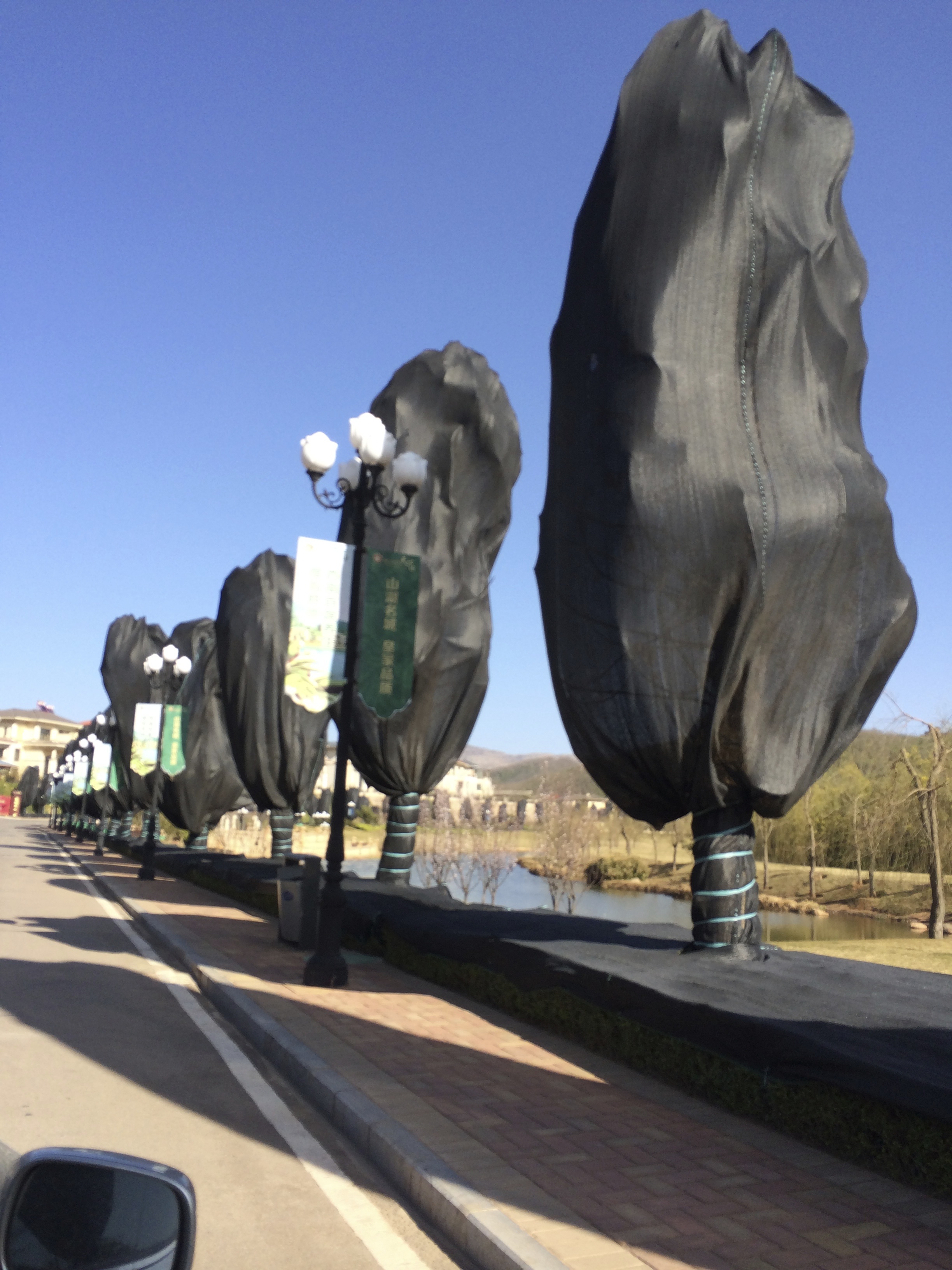
Kunming, so-called ‘city of eternal spring’, is home to the Han people and has a sub-tropical climate like Sydney although, being on a plateau 6,200 feet above sea-level, there is little or no humidity. This totally modern city of six and a half million people sits on the shores of Lake Dianchi with the Shiumennen mountains holding it in a bowl. European cities evolved slowly leaving their historical development clearly visible – the glass skyscraper next to the Roman Forum, the 11th century Tower of London next to Victorian Tower Bridge. In Kunming the past has been bulldozed away. There has been a quantum leap from rough houses to modern skyscrapers in less than a single generation. The streets are broad and straight and lined with trees and shrubs, the plazas spacious. Trees and plants unsuited to Kunming’s climate are wrapped for the winter, making the sidewalks and parks look like an immense project by Christo and Jeanne-Claude.

Tree Wraps not by Christo

Tree Wraps not by Christo

The New Kunming

The New Kunming

The lampposts are all topped with wind turbines and solar panels. Now why didn’t we think of that? What lacks, for European eyes, is the unusual, the juxtaposition of ancient and modern, the bend in the road, the slight architectural deformity that provides interest and creates charm. While we are being persuaded to become cyclists, the Chinese, once a race of bike-riders and took-took drivers, have tossed out their bicycles and took-tooks for BMWs.

We are staying in a house on the edge of the city. It is in a gated community and a smartly dressed sentry salutes us each time we enter and leave. Our neighbour keeps chickens and I wake to the sound of crowing roosters at sunrise; not a bad way to start the day. The days are warm, even though we are in the last days of winter, but as soon as the sun goes down it becomes very cold. There is no heating in the house and I lose two toes to frostbite before we sit down to dinner. Luckily my bed has an electric blanket, which I leave on all night, popping out in the morning like a slice of burnt toast.

The boys have gone clubbing and I am having dinner in a restaurant with Mesa and her friends. We are sitting at the traditionally round table with lazy susan where I have been placed next to Evita, a charming law student who speaks English. The susan slowly revolves, depositing in front of me comestibles previously unknown to science. I pick at a carpaccio of marinated bamboo and some quick fried snail. ‘What is this?’ I ask Evita, nimbly transferring a battered object into my rice bowl. ‘Fried bees and larvae’, she tells me. Risi e beezy![1] After dinner I pose for a photo with Evita. The picture shows me with the slightly dippy, bewildered look of the old and timid. I think of T S Eliot’s poem ‘The Love Song of J. Alfred Prufrock’.

‘I grow old… I grow old…
I Shall I wear the bottoms of my trousers rolled.
Shall I part my hair behind? Do I dare to eat a peach?
I shall wear white flannel trousers, and walk upon the beach.
I have heard the mermaids singing, each to each.
I do not think they will sing to me.’

Evita and J Alfred Prufrock

Evita and J Alfred Prufrock

O to be young! To walk out in Old England on a May morning with hawthorn in bloom and heart pounding for Maisie Hardcastle behind the counter at the Post Office!

We are taken to visit Lake Dianchi by Yi Fang, the 17 year old son of Mesa’s friends. He drives a big Series 7 BMW Coupe through the city traffic with speed and aplomb. ‘You drive well’, I tell him. ‘I’ve been driving since I was 12’, he replies, and then, almost as an afterthought – ‘my father likes to drink’. The view across the 24 mile long lake is clear; there are no yachts, cabin cruisers, kayaks, jet-skis or windsurfers clogging shore lines and surface. Nor are there any fishing boats as the water is highly polluted. The sky around the lake teems with screaming sea-gulls from Siberia, here for the milder winter and to pose and be fed by wedding couples and their guests.

On the shores of Lake Dianchi

On the shores of Lake Dianchi

That same evening we sit around a restaurant table with Yi Fang, his sister PanPan and their parents. After Yi Fang’s earlier remark I wasn’t surprised to see his father produce a silver hip flask the size of a hot-water bottle, charge our glasses and kick off a series of toasts. If you are singled out to be toasted, you must stand, take a sip, clink glasses and sit down. But if the toaster says ‘Gangbei’, which translates as ‘Bottoms up and no heel-taps’, you are obliged to drain your glass. And so began the first ‘Gangbei War’ between East and West, which I feel I won but at the cost of a serious headache the next morning. Run of the mill Chinese rice wine is only good for cauterizing wounds and pouring into a petrol tank, but the wine of Yi Fang’s father was a match for the very best Grappa. Intent on suicide, I mixed this Oriental rocket fuel with occasional morsels of pickled and chili-infused garlic. If I had breathed down a bowling alley I would have knocked all ten pins flying.

After a 4 hour drive from Kunming, passing through the Valley of Dinosaurs, we arrive in Dali, home of the smaller, darker Bai people. We skirt the new town and enter the old, once the capital of Yunnan province and now a beautifully restored, mainly pedestrian, city of the 12th and 13th centuries, lying on the shores of Lake Erhai and at the foot of the Cangshan Mountains.

The hotel is beautiful, the roofs, with their carved and painted gables, rising at each end in imitation of the Chinese character meaning ‘people’. There are courtyards with ponds and the reception staff is dressed in traditional costume.

Bai people in traditional costume

Bai people in traditional costume

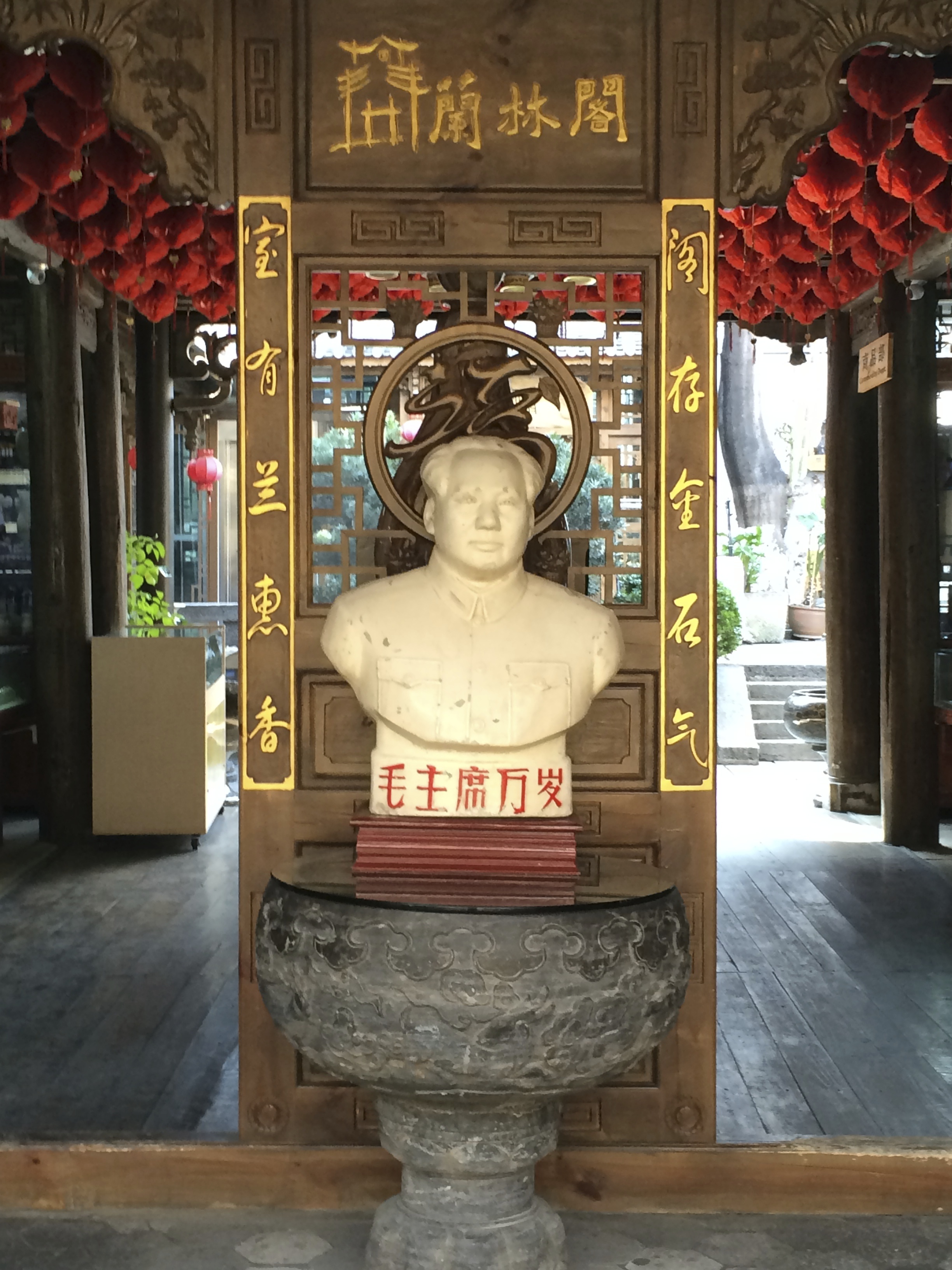
The rooms have all mod cons including -thank Buddah! – proper toilets. At last, within the confines of the hotel, I find a bookshop. So far I had seen precious little evidence of literature, no people reading novels or newspapers in cafes; the only reading matter I could find in our house in Kunming was the instructions for the washing machine. A quick look around tells me that nearly all of the books are communist themed. The owner offers me tea and we talk of Mao, of the Long March and of the Cultural Revolution while a Chinese version of the Carpenters’ song ‘It’s Only Just Begun’ plays in the background. We tend to think badly of Mao because of the tens of millions that died in the late 1950s during the Great Leap Forward when he changed China from an agrarian to an industrial economy. But here he is still deeply admired. Every banknote bears his portrait, the hotel reception is flanked by two fine busts of Mao and many shops still display fading posters of the Chairman in his cap, ill fitting suit and clumsy boots.

The Chairman

The Chairman

I am told that it was during the Long March and the struggle against Chiang Kai-Shek that he won the battle for hearts and minds by billeting his soldiers outside rather than inside the huts and houses of the people. I am more concerned by Mao’s Great Proletarian Cultural Revolution that took place from 1966 until his death in 1976. I would guess the present lack of books and art are part of its legacy. The shop has a large selection of vintage Little Red Books and I choose one with some handwritten notes and a bit of wear so that I can imagine it sitting in some soldier’s tunic pocket. With my change the bookshop owner gives me a two-sided photo of Chairman Mao and Chou en Lai. As custom requires, when a young person serves an older person, he presents change and gift with both hands. I must introduce this at home.

What is the greater good, to have a strong and respected leader, appointed by an unelected council, who permits 4 on a scooter with no helmets, optional seat belts, smoking in restaurants and the purchase of fireworks or the freedom to elect a bunch of self-seeking politicians who appoint a gaffe prone moron (detested by the greater part of the electorate) and who make Australia one of the most regulated societies in the world?

Dinner in Dali and Mesa chooses our menu from the fresh vegetables and mushrooms displayed. There is a choice of slabs of dried pork and buckets of eels from the lake. But what’s this? – a tub of ugly, black toads! No, surely not; Chinese toad in the hole!

Mesa takes us up into the mountains where, after a lengthy drive and hike we settle down on the terrace of a tea-room.

Kangshan mountains

Kangshan mountains

The Chinese don’t buy their tea in the form of tea-bags but in plate-sized hard disks which are priced according to their age and quality like fine French wines. Behind us are snow-capped peaks and below us pagoda- roofed temples and the pale, blue waters of Lake Erhai. Around us, on the slopes, azaleas and tea roses bloom among the rows of tea plants. We take the Cloud Travellers’ Path further up the mountain to see a waterfall, but the snows have not yet melted and the ravine is dry. Turtle doves flap around carp-filled ponds; people doze in the sun.

Choosing Tea

Choosing Tea

Sounds like Shangri-La? Well, in 1933 English novelist James Hilton published a novel called Lost Horizons. His story, concocted without the benefit of a visit to China, tells of a plane crash in a mountainous area of that country. The survivors stumble into an isolated, peaceful Utopia where the inhabitants live to a very old age. The author called this fictitious paradise ‘Shangri-La’ and it has been used to sell the idea of oriental paradise ever since the book’s publication. A 1937 film version, which used bleached corn-flakes for the snow scenes and starred Ronald Coleman, only increased public fascination. After Doolittle’s famous bombing raid on Japan in April 1942, when President Roosevelt was pestered to reveal where the planes had come from, he merely said ‘Shangri-La’. The town of Shangri-La, not so far from Dali, was once the city of Jiantang, renamed in 2001 to promote tourism.

We drive to Shuanlang on the opposite side of Lake Erhai and while the boys go climbing Mt Jizu with a professional guide, Mesa and I take tea and visit the old town.

Lake Earhi

Lake Erhai

Mesa in the old town of

Mesa in the old town of Shuanlang

Lake Erhai

Lake Erhai

Street food in Shuanlang

Street food in Shuanlang

We lunch on the tiny, sweet, lake shrimp and browse the stalls selling antiques, old strips of brocade and various bric a brac. I buy a brass statue of a cheerful looking Buddha, money cradled in one arm, strong drink in the other, and a big silver coin, a three masted junk on one face and the face of Sun Yat-Sen on the other. Mesa tells me the coin is dated 1918, 6 years after Sun overthrew the Qing Dynasty (which had lasted from 1644) and became the first President of the Republic of China. Seven years later he would die and later, Chiang Kai-Shek, Sun’s heir to lead the Kuomintang Party, would compete with Mao and his Communists for mastery of the country. We can read, learn of and imagine historical events but handling Mao’s little Red Book and the coin remove, for me, a whole layer of mystery.

From Shuanlang we drive 160 kms to the city of Lincang where Sunny’s grandpa lives in a walled compound in a quiet lane. In the courtyard is a fish-pond and tubs of camellias, tea roses and palms; birds flutter, agitated, in their cages from the steady stream of friends, relatives visitors and suppliers of sugar cane, rice and fruit. Although there are modern hotels and buildings in Lincang much of the old city remains; chairs on the sidewalk tell me street life still lives here as it does in the South of Italy. But whereas in Italy an Australian tourist would attract no attention, here in Lincang, as we stroll through the market, we are followed and photographed. Younger Chinese try to engage us in conversation and in restaurants the waitresses peek at us around the door and giggle.

The Chinese prefer to call their New Year celebrations The Spring Festival, for it is the beginning of the earth’s renewal, not, as in our case, the first day of the Roman calendar. Festivities have started well in advance of the new year and most houses are already decorated with red lanterns and images of Tao Gods. There are intermittent reports from fire-crackers and large explosions during the day but on the stroke of midnight the whole city erupts making us feel we are in the front-line of a war zone.

Fireworks Stall

Fireworks Stall

Families traditionally spend the first day of the new year together, feasting, drinking, playing mah jong and lighting more fire-crackers. Sunny’s family revolves around 92 year old Grandpa, its oldest member. Old people are well respected in China. I’m invited to inspect a whole pig that has been dismembered on the kitchen porch and which we will eat in various forms (except a pork chop) over the next few days. Someone announces that there has been fighting in Burma between Government and rebel forces leaving 70 dead. The conflict provokes martial law and causes a stampede of refugees across the border. Mesa has a hotel in a town near the border and offers free accommodation to refugees while other hotel owners are raising their rates. Love and you shall be loved. The incident failed to make the news back home as there was a cricket tournament in progress.

Mesa breakfasting at the mah jong table

Mesa breakfasting at the mah jong table

On day two of the festival everyone wears red and each guest receives a gift of cash in a red envelope. Grandpa is kitted out in a splendid red and gold satin jacket and we walk with him and the rest of the family to the Taoist Temple where they pray and make offerings to the Gods.

Grandpa, Mesa and Sunny dressed for the temple

Grandpa, Mesa and Sunny dressed for the temple

There is none of the pious solemnity and discipline of the Anglican Church. Rows of scribes collect cash offerings and write out people’s prayers, which are later burnt, the smoke, combining with the smoke from didgeridoo sized incense sticks, rises to heaven to receive the attention of the deities. Out of respect we decline to enter the temple proper, but through the smoke I could make out the giant sized Jade Emperor and the Pure Ones. Taoists believe in the natural movement of energy (the ‘Way’ or Tao), the sort of thing Stephen Hawking has been trying to work out on a blackboard for the last 30 years. Taoism has given us Tai Chi, Qigong and yin and yang as well as a history free of child abuse. Its Three Treasures are compassion, moderation and humility. Doesn’t this sound like what the world needs?

Day three of the Spring Festival is reserved for paying respects to one’s ancestors. There are no cemeteries as we know them; the Chinese bury their dead randomly on hillsides on plots bought from farmers. The tombs of Sunny’s ancestors are on a hill a short drive from Lincang, grouped in a small spinney. Offerings of cakes, fruit and flowers are placed on the tombs, which are circled with burning incense. Family members trim back the trees to let sun in; sacred music is playing against the noise of firecrackers. A pile of gold and silver fake money is burnt, the smoke trailing heavenward towards the ancestors. A light wind suddenly shakes the tree- tops; are the ancestors responding? There is a joyful atmosphere here, so remote from the morbid silence of Christian cemetery ritual. There is an intimacy with past generations that I never knew with my extant parents. Trying to decide where to dine in Florence is fun, but this has been a truly enlightening experience.

Day four and we are in the car park of a Karaoke club where management is entertaining staff by providing 3 pigs and free beer. I’m not sure how we came to be invited. When we arrive the pigs are being chopped into cuts totally unknown to European butchery.

No pork chops!

No pork chops!

Intestines sizzle in a giant pan; ears and feet are being shaved. Around the car park groups sit on low benches barbecuing pieces of pork and drinking beer from bowls. I join a group and within minutes I am being plied with beer and the best pork I have ever tasted. Someone proposes a toast and before long the second ‘Gangbei War’ breaks out.

Gangbei!

Gangbei!

New Best Friends

New Best Friends

That night we return to a re-opened Karaoke club. Grandpa sings a couple of numbers. My offering of ‘Rose, Rose, I love You’, a 1940 Mandarin song recorded in English by Frankie Laine in 1951 has a mixed reception.

There seems to be no dish recognisably designed for breakfast, lunch or dinner. No restaurant owner will tell you that you are too late for breakfast or too early for dinner. The same savoury dishes bubble away all day. Here in Yunnan nearly all are heavily spiced with chili. Over the Bridge noodles and Congee are popular morning dishes. Congee, made from rice with broth of chicken, onion and lumps of pork, when good, can be very tasty; bad, it is only fit for whitewashing your garage walls. Most chicken dishes are prepared with the flesh and bones of black (Silky) chickens, which can be quite alarming to those of us used to the glad-wrapped, anemic birds sold in Sydney supermarkets, especially when a leg still has the foot attached.

We are spending a night at The Supreme Peoples Hot Springs Hotel; accommodation for 200 guests and 3 billion mosquitoes. After a game of mah jong I slide into a pool of natural, warm spring water. The temperature is perfect and I decide to stay there until I die. I feel both relaxed and exhilarated at the same time. After a while a young lady summons me to a couch where she scrapes me from head to toe as if paint-stripping some old bannisters. I wonder if it’s the first time she’s had her hands on Occidental flesh. If it is, she’s concealing her excitement very well. Flesh not as springy as it used to be, but she can’t have everything. I’m directed under a shower to clean off and I watch half my body weight disappear down the plug-hole. Back to the couch for an oily massage before being popped into a baking sauna. I’ve now been soaked, scraped, oiled and steamed; I feel a new man. I was going to buy Honeybee a pair of jade earrings but I think she’ll be happy with this new body between the sheets. Hmmm, on second thoughts, perhaps I’d better lock myself in the spare bedroom for a couple of weeks.

We are back in Kunming where the magnolia and walnut trees in Mesa’s garden are now wearing white and pink for the new year. We go into the city for some last minute shopping and a visit to one of the few old buildings left in the city. It is a restaurant, but a plaque near the entrance tells us that this was once the headquarters of the Flying Tigers. In the early years of WW2, with Burma and the whole of Eastern China in Japanese hands, President Chiang Kai-Shek asked American General Clare Lee Chennault to help train the demoralised Chinese air force. In the summer of 1941 Chennault organised a group of American volunteers including 90 pilots and 150 mechanics. The Chinese called them the Flying Tigers after the tiger shark teeth painted on the nose of their P-40 fighters. In the first 7 months of 1942 the Tigers shot down 297 Japanese planes and lost 21 pilots in resisting the invaders and protecting the 500 mile long air-cargo route from Assam to Kunming, China’s only life-line. The Tigers must have been happy to get back home to Kunming after their dangerous missions, which they called their ‘Shangri-La’.

Flying Tigers HQ

Flying Tigers HQ


Well, I’ve entered Dali by the same gate used by Marco Polo eight centuries ago, taken the Cloud Traveller’s trail in the Cangshan Mountains, bathed in hot springs by the Langcan river and stood by Lake Dianchi to watch newly-weds feed the migrating seagulls from Siberia. I’ve been taught mah-jong and the manners and poetry of tea. Most importantly I have enjoyed the hospitality of a large and happy Chinese family and, for the small inconvenience of an occasional upset stomach, I have had a life lesson in hospitality and generosity.

Just in case some of you are wondering why you haven’t received a post card, there are no post cards. In fact there are no post boxes. To post a letter you must go to a post office. To post a letter to another country you must take the letter to a special post office for international mail. The letter must be unsealed, just in case you’ve written something rude about Xi Jinping or enclosed plans for their new aircraft carrier.

[1] Risi e bisi is a typical Veneto dish of rice and peas.

EEYORE AND THE CELESTIALS – PART 1 HONG KONG

Off to China with my 24 year-old son and his two young friends. I call them the Three Musketeers. Too old to play d’Artagnan any more, I stumble along behind them, their ancient and clumsy manservant, Planchet. Honeybee is not sure who will be looking after whom. Quite simple really, I shall make sure the boys clean their teeth and ring home occasionally; they will make sure I don’t smoke too many opium pipes and am in bed before the sun rises.

First stop Hong Kong and we all squeeze into a small, battered saloon that is masquerading as a taxi. Our driver Ng (his friends call him N for short) sets off for our hotel in Kowloon, unfazed by the amount of luggage, which forces him to leave the trunk open. There’s a No Smoking sign on the dash but the cab reeks of stale tobacco. There are minus air-bags. This, for a frail septuagenarian, is what passes for adventure.

Why the ‘Celestials’? Because in the 19th century that’s what North Americans and Australians called the Chinese who came to help build their railroads and work their mines. The name arose from the contemporary translation of Tian Chao, the traditional name for China, as ‘The Heavenly Kingdom’. I find the term ‘Celestials’ quite charming, but I’m sure there will be some politically correct body out there anxious to take offense on behalf of the Chinese people.
Lunch of half a goose, chicken feet, pork buns, congee, shrimp dumplings, bok choy and tea. Aus$15 each and really good! Apparently the Chinese achieve the crispy skin on their ducks and geese while leaving the meat moist and tender by separating the skin from the flesh.

Dinner in Stanley Street. More goose. I’m eating so much geese and duck I’m afraid there won’t be many migrating North at the end of winter this year. I’m settling in to Chinese street food very nicely. Much more fun sucking the cartilage off a pig’s foot than cutting into a wagyu steak in some air-conditioned restaurant in Central. So far I haven’t encountered a pea or a potato. Not quite so keen on the so-called century eggs, which are preserved in a mixture of clay, ash, quicklime and rice husks for several months; I prefer mine soft-boiled at 4 minutes.

After paying a small fortune for a quartet of Hemmingway Daiquiris in the Quinary bar on Hollywood Road, we retreat, passing similar bars filled with braying European executives and their horsey English secretaries, and moving down, nearer the waterfront, where we settle into a likely looking bar. In no time adrenalin, unavailable in Mosman, is flowing as we order round after round of Caipirinhas while sharing a Shisha, or waterpipe (a sort of industrial sized e-cigarette), taking turns to inhale and exhale the banana-flavoured steam.

Sure enough, I rise late the next day, numb-headed with a palate like the roof of a pizza oven. It seemed a good time to recall Byron’s lament to the time when the restless energy of youth gives way to the weariness of old age.

So we’ll go no more a-roving
So late into the night,
Though the heart be still as loving,
And the moon be still as bright.

For the sword outwears its sheath,
And the soul outwears the breast,
And the heart must pause for breath,
And love itself have rest.

Though the night was made for loving
And the day returns too soon,
Yet we’ll go no more a-roving
By the light of the moon.

Funnily enough, Byron wrote this when he was only 29; but then he did party quite hard.

A man squats outside a calligraphy shop, fashioning pens out of lengths of bamboo. Much of Chinese art derives from the graphic interpretation of the 10,000 or so Chinese logograms, of which the epistolary literate would need to know 3 to 4 thousand. The world’s oldest, continuously used system of writing is no longer morphosyllabic; a character now corresponds to a single morpheme, the smallest meaningful unit of a language. Here in Hong Kong, the most important character is the letter S cut by two vertical lines.

The whole of Hong Kong, from the cut-throat executives in Central to the cut-price tailors in Kowloon, seethes with feverish commercial activity. Even a Big Mac has been renamed Prosperity Burger. The rampant consumerism, the obsession with profit, has its roots in the late 18thcentury when Hong Kong Island contained nothing but a small fishing village. At that time the British were concerned about the substantial trade imbalance with China. While the British were importing porcelain, brocades, silk and tea, Quangzhou (Canton) was the only port open to the West and silver the only commodity the Chinese would accept in return for their goods. The only item the Chinese wanted and did not produce was opium and so the British ‘Hong’ (companies licensed to trade in Canton), decided to even the playing field by flooding the market with cheaply produced opium from Bengal, spreading the habit of opium smoking from the rich to nearly all of the younger men in the coastal regions. In 1839, concerned by the resulting net outflow of silver, the Emperor’s emissary Lin Ze-xu (no relative) reacted, confiscating quantities of opium and closing Canton to commerce. The British sent in the Navy, their iron-clad gunboats sweeping aside the Chinese wooden junks. It was a grossly unfair fight; the Chinese, having invented gunpowder, used it for firework displays; the British with more deadly intent. In 1842, aboard a gun-boat in the mouth of the Yangtse, the British forced the Chinese to sign a series of treaties in which they ceded Hong Kong island, opened 5 ‘Treaty’ ports and paid substantial compensation for the confiscated opium. By 1900 China was producing 22,000 tons herself.

A natural reluctance on the part of the Chinese customs officials to enact the treaties made a second round of hostilities inevitable. The arrest of the Arrow, a Hong Kong based ship and her crew, in 1856 provided the excuse for the British to send an expeditionary force, while the French, eager for a share of the pie, joined in the fray when one of their missionaries was murdered. In 1860, after the coalition had sacked and looted Peking, the Chinese signed a Convention ceding Kowloon to the British, establishing foreign embassies in Peking and agreeing to the export of indentured workers to America and Australia. Naturally enough the Chinese labourers took the opium habit with them and introduced it to their hosts. Those watching the TV series ‘The Knick’ (about a hospital in 19th century New York) will have noticed that Doctor Thackeray relieves the daily stress of the operating theatre with a comforting pipe in a Chinese opium den.

Three of the very early members of the British Hong, William Jardine, James Matheson and John Swire, were quick to establish themselves in Hong Kong, creating substantial trading empires. They and their succeeding family members took it in turns to be tai pan (literally ‘top dog’), the unofficial ruler of the colony. The companies, Jardine Matheson and Swire Group, now among the top 200 trading companies in the world, are still owned by descendants of William, James and John. Assets you will recognize – the Mandarin Hotel (Jardine Matheson) and Cathay Pacific (Swire).

A heavily made-up lady of indeterminate age has attached herself to me, imploring me to visit her massage parlour while thrusting a card exhibiting a pair of poorly drawn breasts in my face, evidently unaware of my feeble resources, both financial and physical. The boys eventually prise her loose; but along with the sense of freedom, along with the knowledge that I had no intention of being ‘laid in China’, remains the faint regret that I would not have experienced that bizarre pleasure of sitting in some cavern of lost hope, among the fading velvet and Chinese lanterns, paying $500 for a bottle of poor quality sparkling wine. Only the French can understand such sentiment, which they charmingly refer to as Nostalgie de la boue.

There is little of expressly Hong Kong literary culture and I take this as further proof of the determinably commercial mindset of the people. If you are interested in the history of Hong Kong I recommend Timothy Mo’s 1986 novel ‘An Insular Possession’, shortlisted for the Booker Prize.

We take the ferry to Lantau Island, able to see the Hong Kong shoreline bristling with cranes unloading container after container of Chanel handbags and Rolex watches. We ride the cable car to a mountain top and climb 290 steps to an immense Buddha. I was a little disappointed to learn that the statue was early 20thcentury and constructed of concrete. There are crowds of visitors; if a toe or finger fell off there would be serious injuries. Standing on the underground light rail journey back to Kowloon I am twice offered a seat by young women. I shall be looking for powdered rhino horn and a wig tomorrow.

Into a tailor and the four of us are fitted up for suits, which we are assured will be ready in 2 days. All happy with the finished products we spend Saturday shopping, surprised to see long queues of Chinese with suitcases outside Chanel, Louis Vuitton and other luxury brand shops. The shoppers, it turns out, are parallel traders from the mainland, taking advantage of the multiple entry visa policy to import luxury and other goods into the mainland. The practice has caused shortages in Hong Kong’s Northern districts and intensified conflicts between Hong Kong and the mainland. Time now for us to see what is going on in China proper.

CINEMA

Understanding that “The Simpsons” had contributed a great deal to my son’s store of both serious and trivial knowledge of the world, I wondered what damage or benefit I had received myself from a lifetime of watching moving pictures. Has my knowledge of history been seriously impaired by watching “Braveheart”? Am I a better person for having endured both parts of Eisenstein’s “Ivan the Terrible” at a single sitting? Should I be ashamed of holding back tears each time I watch “Cinema Paradiso”? I thought I might answer these and other questions by examining a few films that stick in my memory, trying to understand why I have already forgotten a 100 million dollar production I saw a week ago but still remember images of the fleeing Jew shot among the drying bed sheets in “Kanal”, a 1957 black and white Polish film about the last days of the Warsaw ghetto. These things seem apparent:

  • That some films remain locked into the times in which they were made while others are ageless;
  • That unless you are a scientist, life, particularly the part containing sex and violence, is not meant to be viewed in High Definition;
  • That most of the films that I feel taught me something were in black and white;
  • That it was a sexual odyssey that saw me reject the ethereal Olivia de Havilland for an English rose (Jean Simmons) and her for an American tom-boy (Doris Day) and then her for a sensual Italian in a black slip (Anna Magnani);
  • That adding mud and grime in the name of authenticity to remakes of Robin Hood will never improve on Errol Flynn’s 1938 version;
  • That horses are the real stars of westerns;
  • That time and place alter perception;
  • That once upon a time it was impossible to become a Diva of Italian cinema without a large bust;
  • That dialogue has been subordinated to visual effects; accordingly, films no longer contain any quotable lines;
  • That Jeremy Irons is one of the few actors who can be understood without the use of subtitles;
  • That, in spite of increasingly refined technology, the Golden Age of cinema is passed.

In 2012 Sight & Sound, the journal of the British Film Institute, published a list of the 250 best films of all time as compiled by 846 film directors, academics and critics. The most heavily voted film was Alfred Hitchcock’s 1972 production, ‘Vertigo’. More interestingly only two films in the top 50 were produced in the 21st century, the most recent being David Lynch’s ‘Mulholland Drive’ (2001). Only in respect of two of the films did the taste of the general public concur with the experts – City Lights (1931) and 2001 Space Odyssey (1968) were the top grossing films in their year.

I’m not sure what this says about the selection process or the quality of films made over the last 15 years. Perhaps films have to be viewed as history before we can understand how important or unimportant they are to our lives.

What we do know is that few of the current crop of red-carpet baggers feature as actors in the chosen top 50; no Brad Pitt, no George Clooney or Scarlett Johansson. But forget Hollywood, Paris, since the days of Leon Gaumont, and the Lumiere brothers, is still Mecca for cinema lovers. Before the invention of the cell-phone, before the advent of the 70 hour week, I occasionally had time to slip out of my office on the Avenue Montaigne and into the dark, anonymous womb of one of the cinemas near L’Etoile. One day in 1976 I emerged from rue Marboeuf to see a reclining, 40 foot long King Kong being paraded down the Champs Elysees. Surreal Paris! Pariscope of June 2001 lists 250 different films to see and you watched them in the company of enthusiasts. One evening in Frederic Mitterrand’s art-house cinema I was part of an angry crowd hurling abuse at the projectionist because he had stopped an old WC Fields movie before the credits had finished playing out.

Here are few films that stick in my mind, not necessarily because they are great art but for reasons sometimes unclear even to me.

The Adventures of Robin Hood

Probably, because it was made in 1938, one of the first films I ever saw and one I have never tired of re-watching. The standard tale of the outlawed Sir Robin of Locksley and his merry band living comfortably on venison and wine in Sherwood Forest and protecting Saxon peasantry from cruel and arrogant Normans until liberated and restored to his lands and title by King Richard (a Norman) but made with a panache and style that keeps you riveted to your seat for the duration. Errol Flynn, his face and physique still untouched by the louche living that would kill him at 50, dances across battlements and greenwood with the grace and vigour of a young God, defeating the cloddish men-at-arms and the convincingly evil Sir Guy of Gisbourne (Basil Rathbone). There’s romance with Lady Marion Fitzwalter (Olivia de Havilland) and humour with her middle-aged handmaid who manages to captivate her own outlaw, a humble miller’s son, thereby not crossing the strict social boundaries of the day. The final masterful touch is provided by the music of Erich Wolfgang Korngold. Listen to his powerful, romantic music as the combating shadows of Robin and Sir Guy fight up and down the stone staircase of the castle keep; it won him an Oscar. Michael Curtiz directed. The non plus ultra of adventure films.

Key Largo

How, I ask myself, would Frank McCloud survive in today’s crop of gangster movies? Frank (played by Humphrey Bogart) was 5 foot 8 inches tall, untrained in Karate and quite puny, no match for the steroid-fed Atlases that we now see fighting on celluloid for or against the forces of evil. Mind you, Frank’s adversary, the diminutive psychopath Johnny Rocco (Edward G Robinson), was only 5 foot 5 inches. But Bogie didn’t need to resort to physical violence, he relied on guile, resourcefulness and a refusal to be intimidated that, together with his wisecracks, left villains both infuriated and impressed.

In “Key Largo”, released in 1948, Frank arrives at a small hotel in the Florida Keys run by Nora Temple (Lauren Bacall) and her father (Lionel Barrymore) to find they (and now Frank) are hostages of Johnny Rocco and his henchmen as they wait to conclude a deal and sit out a hurricane. There is an award winning performance from Rocco’s good-hearted, drunken moll, Gay Dawn (Claire Trevor), and Johnny himself is the archetypical, snarling gangster of the Al Capone School of Thuggery, consumed with self and greed. “I’ll tell you what you want, Rocco” says Frank, “You want more”. Rocco savours the insult, smiles at Frank’s perception; “Yeah”, he agrees, “that’s what I want… more.”

Key Largo was the fourth and last film Bogie made with his wife. One day at lunch in the Bar du Theatre on the Avenue Montaigne, I looked up from my steak frites to see Lauren Bacall, then in her late fifties and still coolly beautiful, waiting for a table. Bogie would have known what to do.

The Wild Bunch (#84 in Sight & Sound’s top 250 films)

As far as American leading men are concerned William Holden was as good as any and better than most. George Clooney is the only current leading man in his class, and even then he seems to lack the humanizing foibles that create character. Holden was a hard drinker and elegant smoker with a taste for fine women and who reputedly captured the hearts and bodies of Audrey Hepburn and Grace Kelly. He also had style and, like Clooney, spent much of his life overseas, in his case in Switzerland and Kenya. He had a successful career, which included an Academy Award, but his defining part was towards the end of his shortish life when he made a film, which was both an elegy to declining manhood and to a vanished age.

Sam Peckinpah’s 1969 Western “The Wild Bunch” cast Holden in the role of Pike, an ageing outlaw at the head of a band of bank robbers looking to score one last hit before the modern world closed in on them. Encroaching civilization (this is 1914) has already pushed them into Mexico where Pike, basically an honourable man, is forced to deal with the brutal participants in a civil war where good is on neither side. The film is also a paean to violence, which Peckinpah believed was insufficiently realistic in action films of the day. The last scene, when Pike and his gang of Ernest Borgnine, Warren Oates and Ben Johnson kill the entire garrison of Mexican soldiers, can only be described as homage to carnage.

Khartoum

Walking past the National Portrait Gallery in St Martin’s Place one morning I saw that it was showing an exhibition of paintings relating to the life and times of Major General Charles George Gordon, the hero of Khartoum. Nothing beats having the time to indulge a spur of the moment inclination and I spent a pleasant hour learning about this extraordinary soldier and veteran of the Crimea, 2nd Opium War and the Sudan; an eccentric, five foot five Evangelist who believed the Garden of Eden was situated on an island in the Seychelles. For some it may well be. On leaving, I saw later that same day the film “Khartoum” was to be shown in the Lecture Room and so duly returned and settled myself in with 12 or so others for the solitary pleasure of an afternoon’s cinema. A Gallery official introduced the film with a brief history of Gordon before announcing that he was pleased to have with us the star of the film who would add a few words. And with that, a tall gentleman sitting next to me rose to his feet, took the dais and addressed us. What Charlton Heston delivered was an apology for a career in which he felt “Khartoum” stood out as one of the few films of which he was proud. The actor, nearing the end of his professional life, appeared concerned for his legacy, perhaps trying to add some thespian credentials to his post mortem resume. Well, his CV is a little short on character roles but, all in all, I didn’t think he needed to be ashamed of “Ben Hur” or “The War Lord” or “Will Penney” and he had every right to be proud of “Khartoum” a 1966 film of tragedy on a massive scale where the cavalry (or in this case a flying column of camel-borne troops) fail to arrive in time. A good foot taller than the man he portrayed, he was not overshadowed by Olivier playing the Mahdi in his Othello grease paint. The story of how Gordon is sent to defend the Egyptian residents of Khartoum from a local Muslim population, impoverished and angered by Gordon’s previous suppression of their local slave trade, is reasonably faithful to history. Gordon’s failure is relative; the Sudan still remains in the hands of criminally minded, whirling Dervishes.

An entire Sydney suburb is named after the General.

The Remains of the Day
The English Patient

How amazing is it that masterpieces of quintessentially English literature can be produced by people who had to learn our language before they started. Men like Joseph Conrad, Kazuo Ishiguro and Michael Ondaatje. Ishiguro’s Booker Prize winning novel “The Remains of the Day”, filmed in 1993, is set in the period between the World Wars and tells the story of Stevens, a butler (Anthony Hopkins), who, after a life of dedicated service, understands that his life-long loyalty has been misguided when he learns of his employer’s sympathy for the Nazis. Help is at hand with the arrival of the new housekeeper (Emma Thompson) but, alas, Stevens cannot undo 30 years of repressed feelings to accept the love she offered. It is a love story without an embrace in the whole film.

Michael Ondaatje’s Booker winning novel, The English Patient, was filmed in 1996 and scooped a hatful of Oscars. The story revolves around the affair between Katherine (Kristin Scott-Thomas), a married Englishwoman and Laszlo Almasy (Ralph Fiennes) a Hungarian Count engaged in mapping the Sahara. Her guilt and his jealousy eventually drive them momentarily apart. What might have been a permanent reunion is tragically ended by both the British and Germans in their fight for control of the Western Desert in the early years of WW2. Juliette Binoche won an Oscar for her part as the nurse who makes Almasy’s last few days bearable as he recalls the passion and defeat of his affair. Scott-Thomas, the thinking man’s pin-up, and Fiennes display real passion, which, in the latter’s case centres on the supersternal notch, the soft thumb-print in his lover’s throat.

LEAVING

Leaving is intensely satisfying. That journey to a distant destination may well be the best part of a vacation; the taxi to the airport the happiest moment. Even leaving home to go to work to a job you hate carries with it possibilities for new outcomes, unobtainable if you call in sick and stay indoors. Always better to be the leaver than the left behind, the abandoner rather than the abandoned. Odysseus had a tough time, first fighting the Trojans and then encountering all manner of obstacles during his 10 year journey home. But at least he was experiencing novelty; poor Penelope spent those years just waiting and knitting.

There are many poems about leaving; here are four from the pen of four disparate poets. The first, by Constantine Cavafy, a Greek journalist and petty civil servant – a Byzantine Philip Larkin – writing in Alexandria in the latter part of the 19th and beginning of the 20th centuries, his poems unpublished during his lifetime. The settings for his work are the warm, pagan sites of ancient Greece and Egypt, his characters mythological Gods, heroes of the Golden Age and perfumed Ottoman boys.

Here he deals with the very island in the Ionian Sea that was Odysseus’ destination, in this case perhaps a symbol for the hunger for life or ‘rare excitement’, without which we fail to live. To reach Ithaka, you have to leave Ithaka. Not everyone gets to leave Ithaka; not everyone wants to leave Ithaka; there are those that remain unimpressed by the sound of the outward bound.

As you set out for Ithaka
Hope the voyage is a long one,
Full of adventure, full of discovery,
Laistrygonians and Cyclops,
Angry Poseidon – don’t be afraid of them:
You’ll never find things like that on your way
As long as you keep your thoughts raised high,
As long as a rare excitement
Stirs your spirit and you body.
Laistrygonians and Cyclops,
Wild Poseidon – you wont encounter them
Unless you bring them along inside your soul,
Unless your soul sets them up in front of you.

Hope the voyage is a long one,
May there be many a summer morning when,
With what pleasure, what joy,
You come into harbours seen for the first time,
May you stop at Phoenician trading stations
To buy fine things,
Mother of pearl and coral, amber and ebony,
Sensual perfume of every kind –
As many sensual perfumes as you can;
And may you visit many Egyptian cities
To gather stores of knowledge from their scholars.

Keep Ithaka always in your mind
Arriving there is what you are destined for,
But do not hurry the journey at all
Better if it lasts for years,
So you are old by the time you reach the island,
Wealthy with all you have gained on the way,
Not expecting Ithaka to make you rich.

Ithaka gave you the marvelous journey,
Without her you would not have set out,
She has nothing left to give you now.

And if you find her poor, Ithaka wont have fooled you.
Wise as you will have become, so full of experience,
You will have understood by then what these Ithakas mean.

This next poem, ‘Christmas Day at Sea’, is by Robert L Stevenson, written in that unique style that seems to appeal to both young and old. Like D H Lawrence he was physically delicate, sought the sun and died young. Like Lawrence it took many years before his qualities as novelist, travel writer and poet were recognized. Between 1888 and 1890 he sailed the South Pacific finally settling on Opolu in the Samoan group of islands where he renamed himself “Tusitala” (Storyteller). “I wish”, he wrote, “to die in my boots; no more Land of the Counterpane for me.” He got his wish in December 1894. He had already written his own epitaph (1), which the Samoans translated and apparently still sing in the islands. The son of a lighthouse architect, Stevenson understood the difficult shores of England. Here a young sailor leaves home for the first time, the difficulty with which the ship beats away from a lee shore reflecting the pain of separation from the only life he knew. But we know, instinctively, that his was the hard but right decision.

The sheets were frozen hard, and they cut the naked hand;
The decks were like a slide where a seaman scarce could stand;
The wind was a nor-wester, blowing squally off the sea;
And the cliffs and spouting breakers were the only things a-lee.

They heard the surf a-roaring before the break of day;
But ‘twas only with the peep of light we saw how ill we lay.
We tumbled every hand on deck instanter, with a shout,
And we gave her the maintops’l, and stood by to go about.

All day we tacked and tacked between the South Head and the North;
All day we hauled the frozen sheets and got no further forth;
All day as cold as charity, in bitter pain and dread,
For every life and nature we tacked from head to head.

We gave the South a wider berth, for there the tide race roared;
But every tack we made brought the North Head close aboard:
So we saw the cliffs and houses and the breakers running high,
And the coastguard in his garden, with his glass against his eye.

The frost was on the village roofs as white as ocean foam;
The good red fires were burning bright in every long shore home;
The windows sparkled clear, and the chimneys volleyed out;
And I vow we sniffed the victuals as the vessel went about.

The bells upon the church were rung with a mighty jovial cheer;
For it’s just that I should tell you (of all the days in the year)
This day of our adversity was blessed Christmas morn,
And the house above the coastguard’s was the house where I was born.

O well I saw the pleasant room, the pleasant faces there,
My mother’s silver spectacles, my father’s silver hair;
And well I saw the firelight, like a flight of homely elves,
Go dancing round the china plates that stand upon the shelves.

And well I knew the talk they had, the talk that was of me,
Of the shadow on the household and the son that went to sea;
And O the wicked fool I seemed, in every kind of way
To be hauling frozen ropes on blessed Christmas Day.

They lit the high sea-light and the dark began to fall
“All hands to loose the top-gallant sails’ I heard the Captain call.
‘By the Lord, she’ll never stand it’ our first mate, Jackson, cried,
’It’s the one thing or the other, Mister Jackson’, he replied.

She staggered to her bearings, but the sails were new and good,
And the ship smelt up to windward, just as though she understood.
As the winter’s day was ending, in the entry of the night,
We cleared the weary headland, and passed below the light.

And they heaved a mighty breath, every soul on board but me,
As they saw her nose again pointing handsome out to sea;
But all that I could think of, in the darkness and the cold,
Was just that I was leaving home and my folks were growing old.

Rudyard Kipling is no longer popular, condemned by the politically correct for his subject of an Empire too recent to be held in the same regard as the Roman, his name now more commonly associated with mince pies. Nevertheless, in ‘The Feet of the Young Men’, he writes compellingly of the ‘Red Gods’ that call us from tepee, hut, house and condo in a pilgrimage of discovery.

He must go – go – go away from here!
On the other side the world he’s overdue.
‘Send your road is clear before you when the old
Spring-fret comes o’er you
And the Red Gods call for you!

It’s a longish poem and, apart from the above quoted refrain, I submit one verse only as a taster for Kipling’s description of the lure of a then, largely untraveled world.

So for one the wet sail arching through the rainbow round the bow,
And for one the creak of snow-shoes on the crust;
And for one the lakeside lilies where the bull-moose waits the cow,
And for one the mule-train coughing in the dust.
Who hath smelt wood-smoke at twilight? Who
hath heard the birch-log burning?
Who is quick to read the noises of the night?
Let him follow with the others, for the Young
Men’s feet are turning
To the camps of proved desire and known delight!

Can a poet, who spent most of her short life in the solitude of her bedroom, communicating largely by post, immersed in a herbarium, explain the excitement of leaving, of the ‘first league out from land’? In her poem ‘Exultation is the Going,’ frail, morbid, agoraphobic Emily Dickinson captures, and I can only use her own words, the ‘divine intoxication’ of departure. I understand that the devout Emily is referring to the passage of the soul after death, but I will take it for the metaphor she uses.

EXULTATION is the going
Of an inland soul to sea,
Past the houses, past the headlands,
Into deep eternity!

Bred as we, among the mountains,
Can the sailor understand
The divine intoxication
Of the first league out from land?

***

‘Ithaka’ is from C. P. Cavafy, Collected Poems, translated by Edmund Keeley and Philip Sherrard; Princeton University Press, 1975, 1992.

‘Christmas at Sea’ (as well as Requiem – Under the Wide & Starry Sky) are from ‘Poems by Robert Louis Stevenson’. Chatto & Windus; London, 1913.

‘The Feet of the Young Men’ is from ‘The Five Nations’ by Rudyard Kipling;
Methuen & Co. London, 1905

‘Exultation is the Going’ is from ‘The Complete Poems of Emily Dickinson’; Little, Brown; Boston 1924

(1)             Under the wide and starry sky,
Dig the grave and let me lie.
Glad did I live and gladly die,
And I laid me down with a will.

This be the verse you grave for me:
Here he lies where he longed to be;
Home is the hunter home from the hill
And the sailor home from the sea.

LAWRENCE OF EVERYWHERE

“Don’t you find it a beautiful clean thought, a world empty of people, just uninterrupted grass, and a hare sitting up.”
Women in Love
DH Lawrence 1913

My uncle’s holiday house was perched right on the tip of the North Foreland, that wedge of South East England that points directly at France, only a narrow private road and a few metres of grass separating house from cliff edge. There, lying in the warm grass, I could train binoculars on the passing shipping and, on a clear day, glimpse the outline of the French coast, while kittiwakes hovered and swooped overhead, guarding their nests in the chalk walls of the cliff. Failing that, there was pleasure, then, in the minute inspection of a blade of grass or an individual dandelion. On the grassy cliff-top, hidden by a tangle of hawthorn, was the entrance to a staircase, carved from the chalk, which spiraled down through the cliff and exited onto an otherwise inaccessible part of the rocky shoreline. Crabs scuttled into hiding as you moved warily among the rocks and pools, green algae lay drying on the stones and the ever-cold waters of the English Channel flowed and eddied in the miniature inlets. At night, every 30 seconds, my bedroom would be swept by a beam of light from the North Foreland lighthouse. In the daytime we would drive down to the nearby seaside resort of Broadstairs where my uncle kept his boat in the tiny harbour and where, in the town, was a vast warehouse of second-hand books.

It was there, and only shortly after I had finished reading ‘Women in Love’, that I unearthed “The Romance of Words”, a work on semantics by Ernest Weekley, Professor of English at Nottingham University and one time tutor to Lawrence. On the fly-page was the bold signature of a DH Lawrence. Was it THE Lawrence? Alas, I gifted the book to someone who I mistakenly assumed would be an everlasting love and would re-incorporate the book into my own library, so I will never know.

Lawrence, on a visit to his old tutor in 1912, fell in love with the professor’s German born wife, Frieda von Richthofen, a mother of three, a cousin of the famous Red Baron and, at thirty three, six years older than Lawrence. Eloping with Frieda, he set out on what his friend Catherine Carswell called his “savage pilgrimage,” an amazing odyssey that took the miner’s son and his aristocratic lady from Cornwall to Austria, to the Abruzzi, Florence and Sardinia, to Sicily and Malta, to Sri Lanka and Thirroul in New South Wales, to Taos in New Mexico and finally to Vence in the South of France.

It is almost impossible not to run into Lawrence somewhere. On the Kiowa Ranch, just outside Taos, New Mexico, once Lawrence’s and now the property of the University of New Mexico, I visited the little chapel, the author’s last resting place and in Mabel Dodge Luhan’s house, Los Gallos, I inspected Mabel’s bathroom windows that Lawrence had painted in an uncharacteristically prudish effort to protect his hostess’s privacy.

Windows painted by DH Lawrence

Windows painted by DH Lawrence

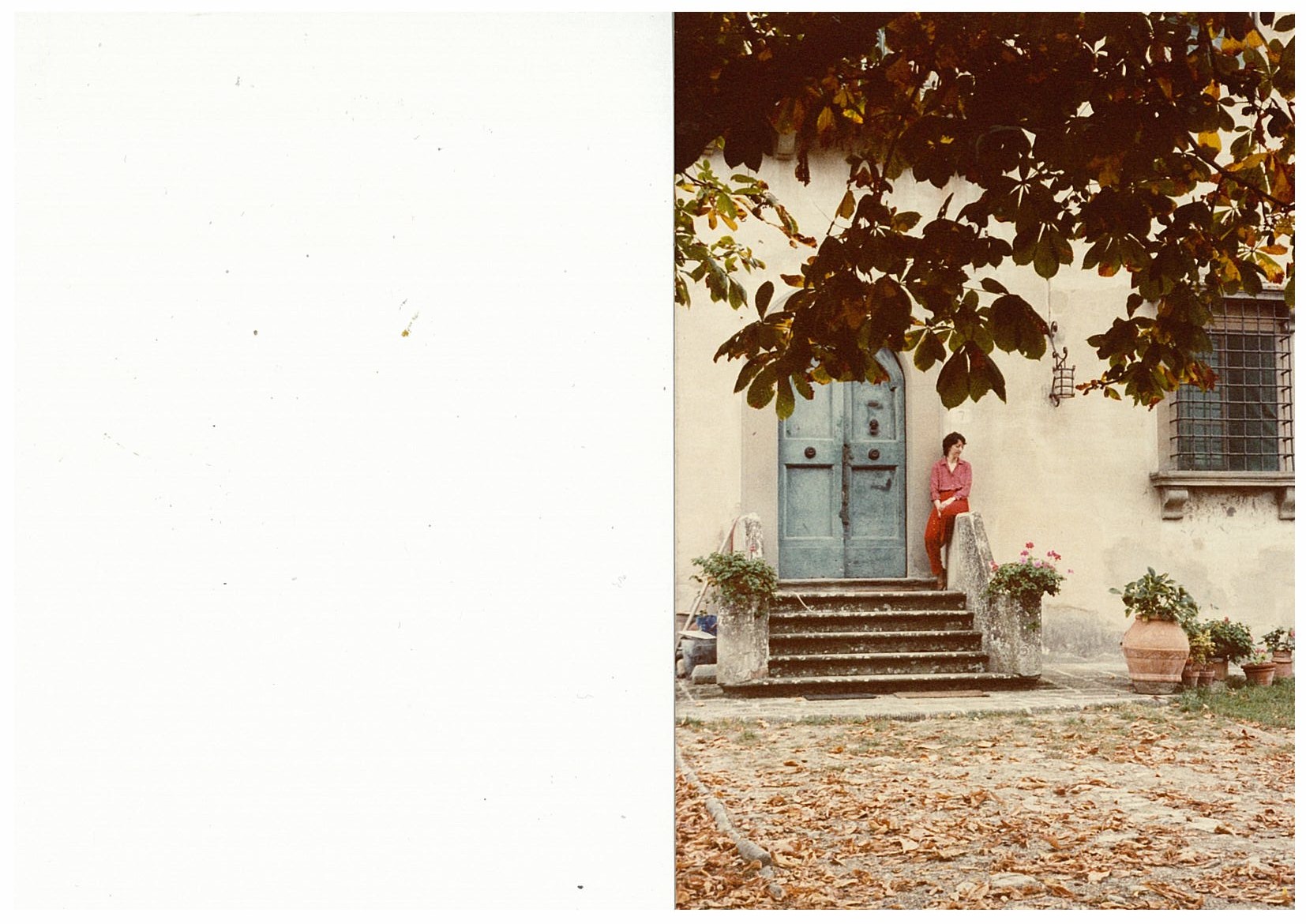
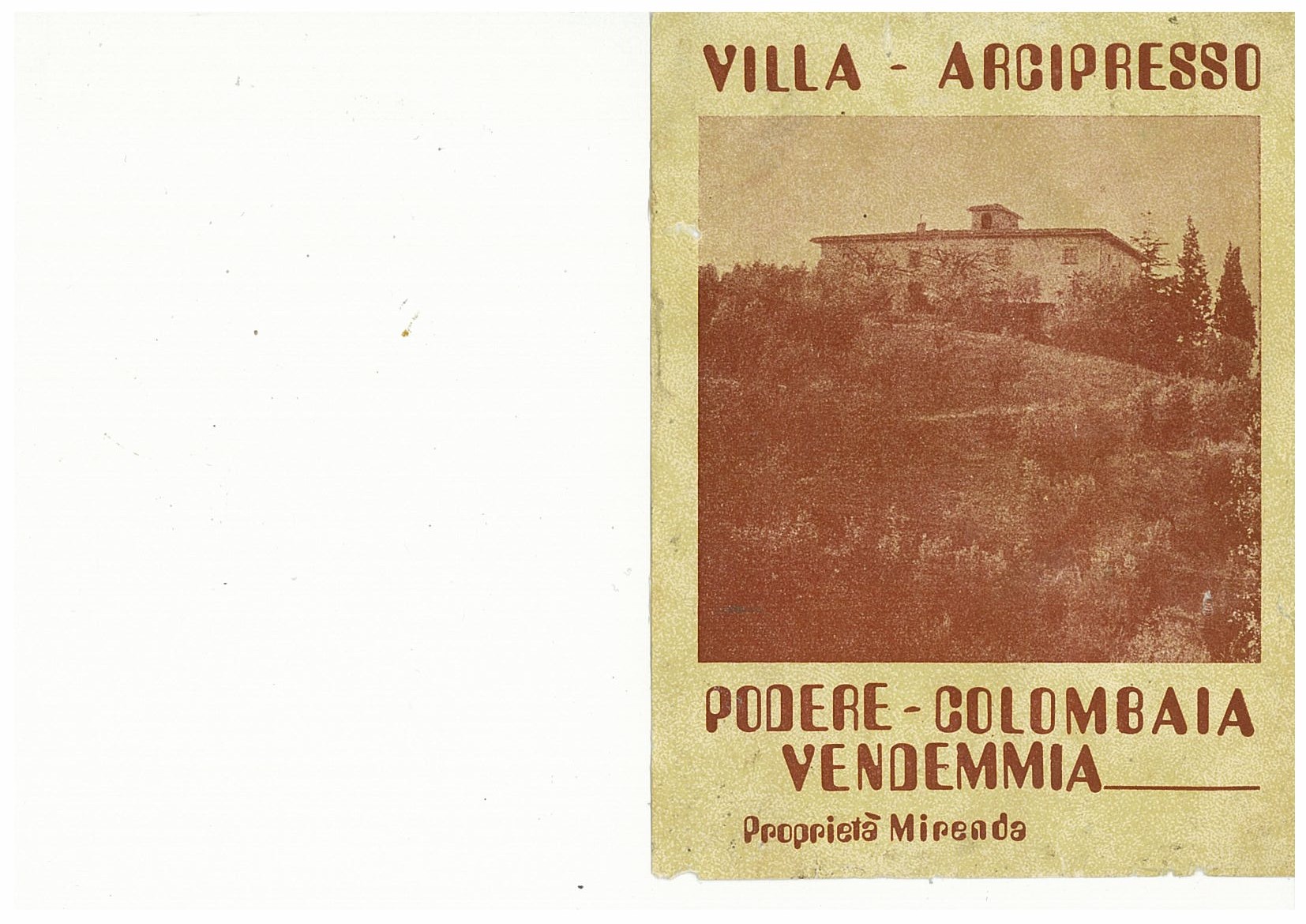
But I came closest to him in 1980 when I was offered rooms to rent in the Villa Arcipresso (often referred to as the Villa Mirenda), a house in San Polo Mosciano, near Florence, where more than sixty years previously Lawrence had written “Lady Chatterley’s Lover”. I was shown Lawrence’s rooms, apparently unchanged from his visit, a spot in the garden where I was told he sat and wrote in the shade and a large fresco in the hallway, allegedly Lawrence’s work representing the lady of the house fleeing from the author himself. My potential landlord, Signor Mirenda, was the grandchild of Lawrence’s landlady; was she, as her grandson claimed, the model for Lady Chatterley?

Honeybee on the front steps of Villa Mirenda

Honeybee on the front steps of Villa Mirenda

Wine Label c. 1980

Wine Label c. 1980

‘Lemon trees, like Italians, seem to be happiest when they are touching one another.’
The Sea and Sardinia

Always seeking the essence of place with his keen and poetic eye, Lawrence produced sublime descriptions of the stations of his journey.

‘The day was gone, the twilight was gone, and the snow was invisible as I came down to the side of the lake. Only the moon, white and shining, was in the sky, like a woman glorying in her own loveliness as she loiters superbly to the gaze of all the world, looking sometimes through the fringe of dark olive leaves, sometimes looking at her own superb, quivering body, wholly naked in the water of the lake.

But Tahiti repelled him as did California, while Ceylon had failed to shift the false idealism, which had so far dogged him. Even the ‘exquisite beauty of Sicily, right among the old Greek paganism that still lives there, had not shattered the essential Christianity on which my character was established.’ His pilgrimage came to a temporary halt in New Mexico, ‘the greatest experience from the outside world’ that he had ever had. ‘It was New Mexico that liberated me from the present era of civilization, the great era of material and mechanical development.’ He felt, at last, exalted. ‘There was a certain magnificence in the high-up day, a certain eagle-like royalty. In the magnificent fierce morning of New Mexico one sprang awake, a new part of the soul woke up suddenly, and the old world gave way to a new.’

He and Frieda bought a ranch and settled down until a sudden and serious downturn in his health in 1925 sent him back to Europe, first to the Villa Mirenda and finally to the Villa Robermond in Vence where he died 2nd March 1930. Exhumed and cremated at Frieda’s request in 1935, he is now back in New Mexico for good.

‘But better die than live mechanically a life that is a repetition of repetitions.’
Women in Love

Set in the Midlands and in the years following the end of the Great War, Women in Love, follows the affairs of Brangwen sisters, Gudrun, an artist who falls for Gerald, the oafish son of a mine owner, and Ursula, a school teacher who loves Rupert, a physically weak but spirited school inspector. The book also deals with the mutual physical attraction the men share. Ursula and Rupert stagger towards a compromised but settled relationship; Gudrun’s affair ends in tragedy. Gerald, on finding she had betrayed him with a German artist, abandons an attempt to murder her and ends his own life instead. Rupert is, of course, Lawrence, and the mouthpiece for his ideas on life, which were heavily influenced by Friedrich Nietzsche’s ‘The Genealogy of Morals’. Christian morality, Lawrence argues, has limited the human instinct for creative development. ‘The delicate magic of life’ lies buried in an ‘un-replenished, mechanized’ world from which we must escape. Ursula, ‘wants to strut, to be a swan among geese’ but she ‘lived a good deal by herself, to herself, working, passing on from day to day, and always thinking, trying to lay hold on life, to grasp it in her own understanding. Her active living was suspended, but underneath, in the darkness, something was coming to pass. If only she could break through the last integuments.’

Lawrence’s vision of a society where beauty is more important than bread is so much harder to achieve than success as a wage-slave in the socio-industrial world he despised. Love can change you, Lawrence says, ‘Let yourself fall in love. If you have not done so already, you are wasting your life.’ The sexual act was ‘not for the depositing of seed’ but ‘for leaping into the unknown, as from a cliff’s edge, like Sappho into the sea.’ Love cannot be sought; ‘Those that go searching for love only manifest their own lovelessness, and the loveless never find love, only the loving find love, and they never have to seek for it.

‘The most evil outpouring that has ever besmirched the literature of our country. The sewers of French pornography would be dragged in vain to find a parallel in beastliness.’
Press reaction to Lady Chatterley’s Lover

Periodically the English Establishment exercises its beastly and bigoted prerogative to destroy harmless individuals merely to enforce its mistaken belief it is protecting our morals. Lawrence was a victim as were Oscar Wilde and Stephen Ward. I cannot read about Lawrence without boiling over with rage at the mean-minded treatment he suffered at the hands of his own countrymen. He was turfed out of his Cornish home on suspicion of spying for the enemy (on account of his opposition to the war and marriage to a German), barred from exhibiting his paintings, subjected to hostile criticism of his work and vilified in court after his death by the Chief Prosecutor in his efforts to stop the 1960 publication of Lady Chatterley’s Lover. To the publisher, Penguin’s great credit the second edition of the book is dedicated to ”the twelve jurors, three women and nine men, who returned a verdict of “Not Guilty” and thus made Lawrence’s last novel available for the first time to the public of the United Kingdom.”

Catherine Carswell, Lawrence’s life-long friend, provides a more moving portrait of the writer than I could ever write.

‘In the face of formidable initial disadvantages and life-long delicacy, poverty that lasted three quarters of his life and hostility that survives his death, he did nothing that he really did not want to do, and all that he most wanted to do he did. He went all over the world, he owned a ranch, he lived in the most beautiful corners of Europe, and met whom he wanted to meet and told them that they were wrong and he was right. He painted and made things and sang, and rode. He wrote something like three dozen books, of which even the worst page dances with life that could be mistaken for no other man’s, while the best are admitted, even by those who hate him, to be unsurpassed. Without vices, with most human virtues, the husband of one wife, scrupulously honest, this estimable citizen yet managed to keep free of the shackles of civilization and the cant of literary cliques. He would have laughed lightly and cursed venomously in passing at the solemn owls – each one secretly chained by the leg – who now conduct his inquest. To do his work and lead his life in spite of them took some doing, but he did it, and long after they are forgotten, sensitive and innocent people, if any are left, will turn Lawrence’s pages and will know from them what sort of a rare man Lawrence was. ‘

I think you will understand from the above exactly what was meant by the sentence “He spent his short life living.” with which the publisher ends Lawrence’s short biography in my Penguin edition of Women in Love.


BOOKS

“The best moments in reading are when you come across something – a thought, a feeling, a way of looking at things that you’d thought special, particular to you. And here it is, set down by someone else, a person you’ve never met, maybe even someone long dead. And it’s as if a hand has come out and taken yours.”
Hector in Alan Bennett’s play “The History Boys”

Not so long ago there lived a generation of children in a world without television and Playstations, without DVD-players, iPods or mobile ‘phones and, as a consequence, these children spent much of their time out of doors, playing in their backyards and gardens or in the parks and in the streets, for in those days not every male stranger was considered a possible pedophile, there was no fear of melanoma and the traffic was sparser and slower. In the evenings children would do their homework, build and paint airplanes from kits, stick postage stamps into albums, listen to the radio and read. Most of them developed their early reading skills from the bubble encapsulated words of the characters that featured in the vast selection of comics like Beano, Captain Marvel, Eagle or Girl, progressing to the weekly, story-only Hotspur or Wizard. After that there was Enid Blyton, even now, a half century after her death, the fifth most translated author in history after Disney, Agatha Christie, Jules Verne and Shakespeare. Enid, born in Lordship Lane, East Dulwich, a ten minute walk from my grandparent’s house in Court Lane was, even in the 1950’s, considered by some to be politically incorrect and a purveyor of trivia, but she was the children’s choice and the bookshelves in my bedroom carried not only my collection of The Famous Five but my sister’s hand me downs such as “The Children of Cherry Tree Farm.” There were other books, but Grimm’s dark and sinister “Fairy Tales”, Charles Kingsley’s “The Heroes” and R M Ballantyne’s “Martin Rattler” are those that stick in the mind.

Books bind us closer together. The right books enrich your life. Some books, especially those you enjoyed in your early years, will stay with you forever. Even as I sit here writing I see Jason leaping from the bows of the Argo into the arms of the women of Lemnos, the Walker children steering The Swallow towards Wild Cat Island, Long John Silver standing parrot-shouldered on the poop deck of the Hispaniola, and Buffalo Bill locked in hand-to-hand combat with Yellow Hand.

Anyway, it’s Christmas and a time of gifts, and in my book, there’s no better present than a book. My local bookseller’s holiday catalogue is bung full of new novels, many of which will have been written after a week’s writing course in Ireland and destined to be remaindered in early January. Here are three novels and a book of short stories that will still be around in a hundred years. First editions will be difficult unless you are Donald Trump, but definitely no Kindles, for the attraction of books is also in the handling of them, their smell, the bookplates and inscriptions of past owners and finding that Paris metro ticket you used as a bookmark twenty years ago.

Blood Meridian, or the Evening Redness in the West
Cormac McCarthy 1985

In 2010 Wyoming legislation was changed to admit the principles of “Cowboy Ethics”. The new law, which carries no criminal penalties if broken, spells out 10 ethics singled out by Texas author James Owen in his “Code of the West”. The State of Wyoming now admonishes residents and lawmakers to live courageously, take pride in their work, finish what they start, do what’s necessary, be tough but fair, keep promises, ride for the brand, talk less and say more, remember that some things aren’t for sale and know where to draw the line. Although these seem principles that could stem from any civilized society, I can understand the cowboy association. In fact, when my son left home to spend six months overseas with a strange family, he took with him a similar, Western-slanted, letter of advice from his father.

Remember you are a cowboy’s son. We are tough and resilient. We can ride alone for days through unforgiving country or we can join with like spirits to defend our home and families from marauding bandits. We are always prepared; we look after our ponies and saddles and keep our six-shooters in good order so that we can do our job properly. On the trail we can mess down with the roughest roughnecks; in town we can sup at The Golden Slipper without embarrassing the Mayor’s daughter who loves us for our panache. We fear no man because we know that courage itself is a more powerful deterrent to our enemies than our trusty Colt. We are honest, straightforward and uncomplicated, but not naïve. We are not surprised by the knife in the boot or the guile of the bushwacker. We help the weak and stand by our friends. We love women because they are on earth to be loved. But if we are alone on the trail we take our pleasure from the bounty the world offers, be it from the journey itself, from the sip of whiskey at sundown or the knowledge that you are young and alive and a cowboy.  

These were the rules left in the psyche of two or three generations by the great volume of Western literature and films ground out from the mid-nineteenth century to the mid-twentieth century, mostly stories of hardship in a beautiful but uncompromising land. Gradually, from the 1960’s the mythology of the period was exposed by books like “Bury my Heart at Wounded Knee” and films like “Soldier Blue”, although the whole question of the “American Dream” had already been questioned by Scott Fitzgerald in that finest of novels, The Great Gatsby. We now see that the future envisioned by the pioneers as they rolled their wagons Westward has been surrendered for a world of soulless communities, fast food, insincere commercial cheeriness, red-neck obstinacy and silicon breasts. From the plains of Kansas to the canyons of Wall Street.

It has been Cormac McCarthy’s lot (with some help from Larry McMurtry and Pete Dexter) to restore some of the grandeur and dignity to the West. Blood Meridian, a story of violence and slaughter based on the true history of the Glanton Gang, a bunch of scalp hunters operating on the Tex/Mex border in the mid 19th Century, has all the beauty and horror of a Hieronymus Bosch painting, the writing almost Old Testament in its blunt purity and intensity. Moving forward in time McCarthy produced his “Border Trilogy”, novels that trace the movement and fortunes of men and horses across the hard land that was “No Country for Old Men”.

Boule de Suif and Other Stories
Guy de Maupassant 1880

Lack of sex played a big part in a school boarder’s days and nights. There were the occasional glimpses of the Burser’s secretary, her clicking heels echoing down the cloisters, but fantasies were mainly fed by the literature available in the School or House libraries where certain passages from seemingly harmless books were singled out to provide some level of erotic stimulus. Charlie and Rose’s moment of passion on the deck of the African Queen from CS Forester’s book of the same name springs to mind. But there was one book in the library that, without containing any overt descriptions of sexuality, provided a special kind of titillation. The title story takes place during the Franco-Prussian war of 1870 where ten citizens from Rouen, deciding to flee the conflict by coach to Le Havre, unwittingly enter enemy occupied territory and are placed under indefinite house, or rather Inn, arrest until such time as one of the captured party – Elizabeth Rousset, a plump, attractive prostitute (Boule de Suif or “Suet Dumpling”) – agrees to sleep with the Prussian’s commanding officer. At first Elizabeth refuses, exercising her right to sleep with whom she chooses and declining the Prussian’s offer out of patriotism. The other passengers, who represent a cross section of French society, from the petit-bourgeois Loiseau to the aristocratic Comte de Breville, eventually tire of their detention and, using every form of argument, persuade Elizabeth to surrender herself so that they can continue their journey. Having given herself to the Prussian officer and once aboard the coach Boule de Suif is rudely ostracized by her hypocritical fellow passengers. “She felt herself swallowed up in the scorn of these virtuous creatures, who had first sacrificed, then rejected her as a thing useless and unclean.” There are great similarities between this story and Ernest Haycox’s “Stage to Lordsburg”, filmed by John Ford in 1939 as “Stagecoach” with Claire Trevor playing the Boule de Suif role.

In another story, “A Day in the Countryside”, Monsieur Dufour, a shopkeeper, and his family spend a day on the banks of the Marne near Argenteuil. Two cynical young men that the family meets in a restaurant plan to seduce Madame Dufour and her daughter Henriette. While Monsieur Dufour and Anatole, his shop assistant, fish, Madame Dufour flirts with one of the young men and Henriette falls in love with his friend Henri. The whole interlude by the river is infused by the sleepy lushness of the countryside, the idle hum of bees, a languorous sensuality. On the family’s return to Paris Henriette yields to her parents’ petit bourgeois expectations and marries Anatole, condemning herself to life in a loveless marriage.

De Maupassant fought in the Franco-Prussian war, saved Swinburne from drowning and was a protégée of Flaubert through whom he became acquainted with Zola, Turgenev and Henry James. He died, fittingly as a chronic womanizer, of syphilis at the age of 43.

Across The River and into the Trees
Ernest Hemingway 1950

Hemingway had very firm views as to how a man should live. His main characters were men of action, much like himself – uncomplicated, knowledgeable and philosophical about the craft involved in the violent lives they had chosen, whether it was soldiering, bull-fighting or big-game fishing. Knowing how to face death was also part of that code. Confederate General Thomas (“Stonewall”) Jackson’s attitude to death must have impressed him for they are Jackson’s last words –“Let us cross over the river and rest under the trees” – that provide the book’s title. In what many consider to be one of his less successful books, fifty year old Colonel Cantwell looks back on his recent involvement in WW2 and his passionate affair with a young Venetian Contessa as he hunts for duck in the marshes near Trieste. Knowing that the next round of heart attacks will finish him, he climbs into the back of his staff car and calmly sets his affairs in order before the final hammer blow takes his life. Although The Old Man and the Sea won Hemingway the Pulitzer in 1952, the seeds of his decline are already evident in “Across the River”. Dogged by health problems, alcoholism and depression Hemingway staggered through the last 10 years of his life until one July morning in1961 he walked out onto the front porch of his home in Ketchum, Idaho, and blew his brains out with his favourite shot-gun. It was, says Janet Flanner (1) ‘a permissible act of liberation from whatever humiliating bondage on earth could no longer be borne with self-respect.”

At his best and even with his hard pruned language, Hemingway managed to communicate layers of feeling that more verbose writers never achieve. “In his writing,” says Flanner “his descriptions of the color of deep sea water beside his boat or of the trout’s fins in the pool where he angled were like reports from the pupil of his eyes transferred by his pen onto his paper.” While many famous novelists remain faceless, their personalities and lives seemingly incompatible with their writings, Hemingway himself intrigued as much as his characters. I made the island-hopping pilgrimage to Key West; on evenings at the Closerie des Lilas in Montparnasse I would seek out the chair with its little brass plaque recording the writer’s patronage in the 1950s and in a bar in Genoa I met a man who had competed in (and won) a drinking competition with the author. It was clear from the care with which he pulled a creased and fading photograph of himself and Hemingway from his wallet just what the encounter meant to him.

Venice in autumn has that melancholic gravitas that suited Colonel Cantwell’s tragic end. Harry’s Bar and the countryside of the Po delta also figured in my story with Honeybee but the outcome, fortunatamente, has been somewhat happier.

1. Janet Flanner. American journalist based at “Les Deux Magots” from the early twenties when she began writing her “Letter from Paris” for “The New Yorker” under the pen-name Genet. Member of the Left Bank American colony, which included Hemingway, Gertrude Stein and Scott Fitzgerald.

Ulysses
James Joyce 1922

This is an interesting book, not just because of its place in the history of English literature as the first truly Modernist novel but also because of its difficult and exotic birth. Although his greatest book is set in the city of his birth, Joyce spent nearly all of his life in self-exile working as a journalist, writer and English teacher in Paris, Trieste and Zurich. It was in Zurich during WW1 that he first began work on “Ulysses”, which follows a day in the life of Leopold Blum as he wanders through Dublin, carousing with his mates, whoring, arguing, his peregrinations roughly following a contracted version of the journeys of Odysseus and Jason. In its allusions, puns and ribaldry it has echoes of Rabelais. Between 1918 and 1920 excerpts of the book were serialized in “The Little Review” in America where the rude bits, catching the attention of the authorities, resulted in the book being banned. In need of money Joyce turned to a Pastor’s daughter from New Jersey who had arrived in Paris in 1917 and opened a bookshop called Shakespeare & Company in the rue de l’Odeon. Sylvia Beach worked tirelessly, finding subscribers, organizing the printing in Dijon, and on 2nd February 1922, Joyce’s birthday, she presented the Irishman with the first two copies of “Ulysses”, bound in blue Morocco and printed on white Dutch paper. The book was an instant sensation. Janet Flanner was enthusiastic; “In its unique qualities, in 1922 it burst over us, young in Paris, like an explosion in print whose words and phrases fell upon us like a gift of tongues, like a less than holy Pentecostal experience.” Not everyone approved; Gertrude Stein and her companion Alice B Toklas both cancelled their subscriptions to Sylvia’s bookshop.

The book, which almost caused Sylvia’s financial ruin, immediately made Joyce a rich man and even richer in 1932 when Random House paid him an advance of forty-five-thousand dollars when the ban on the book’s US publication was finally lifted. Sylvia, who has her own footnote in literary history, never begrudged the fact that Joyce did not as much as tell her about his good fortune. “I understood” she later wrote “from the first that, working with or for Mr. Joyce, the pleasure was mine – an infinite pleasure, the profits were for him.”

Physical love is hard to write about in fiction; it can sound crude or self-conscious and even famous writers can fail. These last lines of Ulysses, from the longest sentence in English literature, leave you saying yes, this is how it should be.

“…and O that awful deep-down torrent O and the sea the sea crimson sometimes like fire and the glorious sunsets and the fig trees in the Alameda gardens yes and all the queer little streets and pink and blue and yellow houses and the rose gardens and the jessamine and geraniums and cactuses and Gibraltar as a girl where I was a Flower of the mountain yes when I put the rose in my hair like the Andalusian girls used or shall I wear a red yes and how he kissed me under the Moorish wall and I thought well as well him as another and then I asked him with my eyes to ask again yes and then he asked me would I yes to say yes my mountain flower and first I put my arms around him yes and drew him down to me so he could feel my breasts all perfume yes and his heart was going like mad and yes I said yes I will yes


WHAT WOULD I DO WITHOUT ME?

“I don’t believe in an afterlife but I’m taking a clean change of underwear just in case.”
Woody Allen

At 9am on September 11th 2001 my cousin Keith and I were sitting in his shop in the East End of London watching the attack on the World Trade Centre on a portable TV. Together we saw the smoke pouring from the North Tower, listened to the hesitant commentary as the reporter tried to explain something that he himself didn’t understand. And then there was the dot in the sky that disappeared into the second tower in a silent puff of smoke, the unsteady images from hand-held cameras, people running from the tsunami of dust and paper that swept down the streets as the towers sank to their knees in defeat. Even now, thirteen years later, after the whole tragedy has been dissected, re-enacted on film, analysed and grieved over, even now that I have seen for myself the bleak cavity of Ground Zero, the overwhelming shock remains at this pure manifestation of evil which somehow became personified in the wall-eyed expression of Muhammed Atta. This meticulously planned and religiously inspired attack provoked an invasion of Iraq, fortified the radical Christian Right and brought forth, 6 years after the event, a trio of books from Christopher Hitchens, Michel Onfray and Richard Dawkins that made me think.

We were not a family of church-goers; religion, along with politics, sex and anything that required exposure of feelings, was never discussed. In fact, I don’t remember a single thing my father ever said to me; no repeated piece of advice that might have shaped a boy’s future. I have the impression his life stopped sometime before I was born, perhaps when he laid down his cherrywood pipe and started smoking cigarettes. I realize now that I was a smoker at the age of four, inhaling the smoke from the 60 un-tipped cigarettes he smoked each day. Photographs of him sitting alert and arms akimbo as a member of Alleyns Soccer Eleven of 1921 or smiling with his Pioneer Corps unit in Egypt in 1944 suggest that I had two fathers. The man I knew seemed to be always on a ladder painting drain pipes or sitting cross-legged on a lawn removing weeds with a chisel. He may be in his Parker Knoll watching Morecombe and Wise on our Radio Rentals TV with its detachable legs or reading the Daily Express over a cooked breakfast. Perhaps he’s shoveling salt into a water-softener or in his attic darkroom, developing undistinguished black and white prints. Even if he stood before you, dragging deeply on a Capstan Full Strength, he was somewhere else, probably in the smoky, hop-scented saloon bar of the Heaton Arms; let’s not mistake him for a deep thinker.

Mum had more to say. She’d sit and talk over cups of PG Tips with Mrs Smith who came once a week to polish the silver tea service on the sideboard and the brass frogs and bells and Spanish grandees that sat in niches in the brickwork around the fireplaces. While I collected newts from the village pond, she’d chatter away with her friend Sheck who managed an antique shop in Chislehurst. She talked to me too, often about a past that sounded more fun than the present. Along with an introduction to guilt she also offered endless warnings, “You can stoop low and pick up nothing” (a veiled reference to my father), “Chew it properly” and “Look both ways” still reverberate down the dark tunnels of my un-sleep.

“Mundania is a very drear place where the people do not believe in magic.”
Review of “The Man from Mundania” by Piers Anthony

Our house in Mundania Road, Honor Oak, was in a quiet grid of streets named after places in the Crimea, part of a 1930s development of gravel-walled semis. Beyond us was a series of gloomy, late Victorian houses and then, on the corner of Forest Hill, a dilapidated block of white, art-deco apartments opposite a church. I can still recall the smell of sun-warmed creosote on fence palings, of dock and nettle and privet; the oily fumes of combusted fuel from London Routemasters; the savoury steam from Sunday roasts and poached haddock; the aroma of newsprint and confectionery, of polished linoleum and most of all, of damp, that awful damp that pervades the inseparable boroughs of Camberwell and Peckham, Lewisham and New Cross, Deptford and Penge. I also remember the first thrills of escape, of slipping through a gap in the fence at the bottom of the garden to roam the wide open spaces of the playing fields that backed on to our row of houses, the lone visits to my Uncle and Aunt’s house around the corner in Therapia Road and scaling the wall of the underground reservoir in Homesdale Road to search for cartridge cases.(1)

On weekdays my father would drive his old cream and blue Sunbeam down to 190 Rye Lane where he would slowly destroy the timber merchant business his father had begun and built up. My grandfather had taken advantage of the canal built in the 1820s for the transport of softwoods from Surrey Commercial Docks to New Cross to set up a saw-mill on its banks and a retail outlet in Peckham. He called it “W Lynn and Sons” for he had expected both his sons to continue the business but my father’s younger brother, Ted was rounded up by the Japanese when they took Singapore in February of 1942, and after a spell in Changi, died in January of 1943 helping build the infamous Burma Railway. (2) Would things have turned out differently if he had been there? Who knows? There were further complications when grandma died (3) and was replaced by her husband’s house-keeper, Constance, a humourless, dessicated prune of a woman with illusions of Gran’dad.

It is easy to see now the strategic options that would have been open at the time to someone interested in developing or even merely saving the business. But my father was not interested. The body language, the resigned attitude, the constant resort to the temporarily uplifting saloon bar of the pub across the Rye told it all. Often, on a Saturday, my mother would help with the bookkeeping and I would be taken along to play on the piles of timber or in the heaps of sawdust in the old stables that was sold as bedding and toilets for rabbits. I could also escape into Rye Lane, in the 1950s still a bustling shopping centre with its fruit and vegetable stalls in Choumert Road, Austins Antiques warehouse, the Tower cinema, the stall under the railway arches selling cigarette cards and the confusing labyrinth of Jones & Higgins, at one time the largest department store in South London. How my father coped with the final collapse I cannot imagine. “He aimed low and missed,” explained my mother some years later.

In the early 50s we left Forest Hill and moved a dozen or so miles south to Petts Wood, a garden estate of Tudorbethan style houses surrounded by woods of oak and silver birch. To create a village atmosphere the developer had grouped the shops in a square surrounding a mock Tudor pub called the Daylight Inn named in commemoration of William Willet, the inventor of daylight saving, who had lived most of his life in nearby Chislehurst. The owner of the Dunstonian Garage, a dealer in Hillman and Humber cars, had even been persuaded to cover his petrol pumps with a canopy and to incorporate oak beams into the façade of his workshop and office. Slightly out of keeping was the local church, St Francis, set in woodland and built of wood and Sussex brick, its long straight hammerbeam roof recalling a medieval tithe barn. Our own house at 17 The Chenies (4) was all white with leaded-light windows and an elaborate porch and oak front door with gothic panels. There was a crop of silver birches in the front garden and a pond with water lilies and frogs in the back. Although there was a nice lounge with inglenook fireplace and a view of the garden with its screen of pine trees at the far end we lived grouped around the television in the dining room or in the kitchen.

In this paradise of “rus in urbe” I watched relations between my parents deteriorate. Apart from my father’s lack-lustre performance in the work-place and his heavy drinking my mother confided to me that he also had a “weakness for women” and enrolled me as her private investigator. Children, in both fact and fiction, have always been used for nefarious ends by their elders. The experience of young Leo Colston in L P Hartley’s novel “The Go-between” left him psychologically impaired for life. How will those 8 and 10 year old Junior Streetwatchers (embryo Stasi agents?) employed by Ealing Council (5) to identify and report on enviro-crime issues (graffiti and fly-tipping) fare as adults? My duties were to search the ashtray of dad’s car for lipstick stained cigarette ends when he came home late and to make sure he was never left alone with unattached or unaccompanied women. On at least one occasion I was sent out to call my mother from a public ‘phone box, a supposedly mysterious admirer designed to provoke my father’s jealousy. I doubt whether the plan worked. When on occasion I became the subject of discussion between my parents I was never referred to by name but as “that boy” (even if I was within earshot) as in “That boy needs a new pair of shoes” or “Don’t you dare hit that boy, Arthur”. Like all children I didn’t like to hear my parents arguing and I would creep from bed to listen to what my mother would later, in comforting me, describe as “just a discussion”. Was my father joking when he announced, in response to my mother’s threat that she would dance on his grave when he was dead, that he would be buried at sea?

My sister, ten years older than me, was already planning her escape into matrimony; my escape for the moment was into the branches of the pine trees at the end of the garden, among the books that lined the shelves over my bed or into the Embassy, Petts Wood’s art deco cinema on the other side of the railway line that divided the town both territorially and socially. On those evenings the family went to the cinema we were greeted in the foyer by the manager, Mr Helstine, resplendent in evening suit. There was chop, chips and peas in the first floor café lounge with its fashionable tubular chairs before we settled into the rose and gold auditorium for a full evening of cinema – Movietone News, cartoon and a double bill of A and B films, spoilt only by my mother fidgeting and grumbling about the “stupid slobbering” when the actors happened to embrace. Better still when I could travel alone to the kids only sessions on a Saturday morning and follow the adventures of Johnny Weismuller, Buster Crabbe and Hopalong Cassidy. Cinema was not the only casualty when the Embassy closed its doors in 1973; the building’s new tenant, Safeway’s, spelt death for many of the local butchers, fishmongers and fruit and vegetable shops. A regrettable loss was David Grieg, a meat and dairy shop in Station Square where assistants in long aprons would cut your order for butter from a pale yellow mountain with cheese-wire and then slap it around between wooden paddles before packaging it in grease-proof paper.

My sister’s marriage to her Dutch boyfriend, in St Francis church (with reception at the Daylight Inn) did not result in her immediate liberation. For the first year or so of their marriage she and her husband lived with us in The Chenies. This is not an easy situation in the best of circumstances and it must have been a happy day for her when she and her husband moved into their own home some five miles distant on the other side of Orpington. After my sister left, my mother moved into her own bedroom (newly and un-tastefully decorated in pale grey Formica) while my father slept on in his cold room with its heavy mahogany veneered furniture and smell of stale cigarettes until he decided to move full-time into the Heaton Arms. ‘He was called to the bar,’ explained my mother.

“I am constantly going into churches, but for architectural reasons; and, more widely, to get a sense of what Englishness once was.”
Julian Barnes
“Nothing to be Frightened of”

If religion was never discussed and we were not church-goers there was also no sign that either of my parents were private believers. Grace was not said at meals; there were no framed prints of Saints on the walls as there were at my mother’s sister’s house. God’s name was only called upon in contexts of blasphemy. In spite of all this I still have a fading card that says on April 5 1942 at St Augustine’s Church in Honor Oak Park I was made a Member of Christ, A Child of God and An Inheritor of the Kingdom of Heaven but it was not until I was packed off to boarding school for nearly eight years that I was fully exposed to religion or, more accurately, to the Boys Own Anglican version of Christianity. At Dulwich College Prep there were prayers and hymns morning and evening and, on Sundays we were shepherded in a crocodile up College Road, past the toll-gate and into St Stephens for morning service. (6) At Cranleigh School there was chapel each morning and every evening we would kneel on the bare boards of the dormitories for prayers before bedtime. On Sundays there was Evensong as well as morning chapel when some visiting cleric would deliver a sermon to a largely uninterested congregation. I enjoyed chapel, listening to future organ scholars playing “Jesu Joy of Man’s Desiring”, sun illuminating stained glass, gripping the wings of a brass eagle as I read the lesson from a massive Bible and the carols at Christmas. I was a good divinity student and passed it at GCE. I still take great pleasure in the language of the King James’ Bible, in Donne’s sermons and the poems of George Herbert. At fifteen I was confirmed by the Bishop of Guildford, kneeling on the black and white marble tiles hoping for, but not expecting, some magical revelation as I received the sacraments.

But I never believed. My lack of belief was instinctive not something I thought about or intellectualized over; certainly I never had Christopher Hitchens’ self belief or intelligence as a schoolboy to voice my rejection of religion in general. I knew then that Genesis was a fairy tale and still find it amazing that there are educated people who believe the earth is 10,000 years old. I could never accept Jesus’ divinity or any New Testament tales of the super-natural; after all, what was the so-called miracle of the five loaves and two fishes other than an equitable redistribution of pooled assets, the burning bush other than a natural phenomenon. Faith was required and I had none. Why would anyone place faith in something that for two thousand years had never provided a single instance of justification? Judging from history those who had faith were seldom rewarded in this life and as far as I was concerned there was no other. And isn’t it strange how contemporary Greek Othodox ritual seems as alien to an Anglican as Sumerian Sun worship, that Sunnis and Shiites slaughter each other over interpretation of some arcane procedures of the same religion and that educated men like Latimer and Ridley were toasted for their intransigence by the separate branch of a common Christian faith. And wouldn’t the faithful Christian be a loyal Muslim if he had been born in Islamabad rather than Ipswich? And so, looking back, I can see Bible study was just another part of the broader study of history in general and history, or a large part of it, the struggles of one religious sect against another. Hitchens and Dawkins and Onfray were only making me feel more comfortable with something I had always felt. The love of churches and cathedrals, of Christian ritual at the time of birth and marriage and death remain as mere memories of England and Englishness and not objects of guilt over lack of faith.

I wonder what my father thought of in those post-stroke years, in bed alone or silent in his slippers in front of the television as my mother discussed him within earshot with visitors. Did religion or the possibility of afterlife ever cross his mind? We’ll never know.
He finally gave up at 75. Weakened and emasculated by a stroke, deprived of tobacco, strong drink and the ear of a friendly barmaid, he sat quietly watching the sport, mother clicking her dentures while he wobbled a lower front tooth until he could pluck it from his gum and start on the next. He was buried in a postcard country churchyard, four men in black carrying him through the yew trees to be lowered into the earth. Somehow this was a betrayal. He wasn’t meant to be there alone in a churchyard next to a church he had never visited in a village he had never known. Better his ashes in an urn, flanked by bottles of Bells and Teachers, on a shelf behind the saloon bar of the Heaton Arms. At least, reduced to dust, he could have been himself. Mother chose not to attend the funeral although she removed Dad’s signet ring and wore it to her own. In a final act of misandry when her time came she elected to be consigned to the flames and her ashes scattered in a Garden of Peace rather than bear the eternal proximity of her husband. Presumably, among her powdered remains are flecks of my father’s gold signet ring.

Mother had longer to reflect on past life and after-life in her retirement home bed-sit in a large Victorian house on the outskirts of Maidstone smelling faintly of stale pee and cabbage. Too proud to mix with the other inmates, she must have watched those last seasons come and go alone, writing out shopping lists – Jay cloths, shortbread biscuits, note paper – to hand my sister when she came to visit, cutting unwanted faces from photographs of the past, re-writing history in her head. On my own infrequent visits we had nothing much to say to each other. On one occasion, jet-lagged from a 24 hour flight and overcome by the heat in the tiny room, I passed out on the bed and was unconscious for two and a half hours out of the three I had allowed for the visit. And so, as the years ticked by it sometimes seemed as if she would go on forever. Even though choked with the horrible finality of it all when she was finally swallowed in the inferno, I experienced a mild feeling of release afterwards as I joined the mourners for tea in my sister’s garden and when Keith and I later sped off towards London I felt quite happy it was all over.

(1) The biggest underground reservoir in London. Used as a rifle range during WW2; now a golf course
(2) Signalman 2357597 Thomas Edward Lynn, Royal Corps of Signals. Born March 1907; died January 2nd 1943. He is buried in Kanchanaburi War Cemetery, located 129 kms WNW of Bangkok and close to the famous Bridge 277 over the Khwae Yai River, which was completed one month after Signalman Lynn’s death.
(3) Grandma Alice died at the age of 62 in 1934. She was 6 years older than her husband.
(4) The Chenies, a cul de sac of 29 houses, was designated a Conservation Area of architectural and historic importance in 1982
(5) Article in the Weekly Telegraph 10th September 2008
(6) Both St Stephens and Dulwich College were the subjects of paintings by Camille Pisarro who had fled France in 1870 on the outbreak of the Franco-Prussian war to live with his half-sister in Palace Road, Upper Norwood.

Too-O-AteAte

2088 is the Postcode of the Sydney suburb of Mosman

By the shores of Sydney Harbour
By the deep-sea-shining-water
Lies the land of Too-O-AteAte
Once the home to pine and gum,
Now to ersatz Tuscan town-house
And the box of glass and steel.
Gone the lean and dreaming Dharug
Dharawal and Kuringgai,
With their legends and traditions
Gone to lodges in the sky.
Now the Elders of the Council
Send their brownshirt Rangers ranging,
Seeking, seeking, tracking, stalking
Smokers, parkers, pedophiles,
In the land where Burger’s King.
Once the sound of wood birds calling
Now the urban hum of engines,
Now the growl of four wheel drives.
See them at the Crystal Car Wash
Where the bridge points east and west.
There, the wives with yellow tresses,
Warpaint damp on botoxed lips
i-phones clamped to dainty ears,
Moving Spandex covered hips
Seeking weight loss, seeking thinness
To celebrate the Christmas break.
Sun sets on federation semis,
Husbands home from desk and mall,
Hunter Valley Chardo’s tippled
As ABC presents the News.
In the hushed retirement villages
Lonely and abandoned Elders
Microwave remaindered off-cuts,
As they clutch TV remotes.
Should you ask me, whence the car-wash?
Whence the leg wax and the lattes,
Whence the soy milk double de-cafs,
Whence the muffins, gluten free.
I should shake my head in sorrow
At the endless meals of Thai,
At the worship of all things Tuscan
At the long departed Kuringgai.


AT HIS COUNTRY’S CALL

On the idle hill of summer,
Sleepy with the flow of streams,
Far I hear the steady drummer
Drumming like a noise in dreams.

Far and near and low and louder
On the roads of earth go by,
Dear to friends and food for powder,
Soldiers marching, all to die.

A E Houseman

It’s a sad fact that some questions that should have been asked only take form after the responses are no longer available. Answers to questions I would like to pose now were mine for the asking a long time ago, but lack of curiosity at the moment leads to the lonely vigil of later research. I suppose it should not be surprising that the facts provided by research often fly in the face of the memorized version handed down; after all, one has to allow for the passage of time since the event was witnessed or heard as well as for the long and general tradition of embellishing legend. It was entirely understandable therefore that I was unable to substantiate much of our family’s history passed down by way of mouth. I have been unable to locate among my ancestors a sea captain, although I did find that Able Seaman Stephen Mayne(1) was aboard the Neptune, anchored off Beachy Head when the census for 1861 was taken. I could find no evidence to support my mother’s claims that my maternal grandfather was part-owner of a restaurant in the City of London or that we were somehow associated with the Delaware-Morgans, purported grandees of Belgravia. However, I did substantiate one story my mother used to tell and that concerned the death of her uncle Harry.

Harry, she would tell me, died at the battle of Polygon Wood and this fact alone secured my interest as, from an early age, the Great War had held me spellbound. The roots of this interest lay on the shelves of my bedroom and in a black trunk that sat underneath the window. Among other treasures, the trunk contained a History of the Great War collected by my father in monthly installments in the 1930s and therefore available to be inspected piecemeal each night by torchlight under the blankets. On the shelves, among my sister’s hand-me-downs and my own books were some my father had when he was young and among those a novel of the Great War called “At His Country’s Call” by Albert Lee. Having long ago lost the original, I recently purchased a copy and was able to relive the adventures of Maurice Millard on the Western Front. My new copy is inscribed to Sidney Barron for good behaviour in Church.

Later there were to be more serious books about the Great War – “Goodbye to all That”, “Memoirs of an Infantry Officer”, “All Quiet on the Western Front” and more recently Pat Barker’s “Regeneration” trilogy and Sebastian Faulks’ “Birdsong”. My knowledge of the Great War is therefore remembered more through these novels as well as through the poetry of Wilfred Owens and Siegfried Sassoon than through familiarity with its actual history. Those who watched Captain Blackadder will forever remember the war effort as an attempt to inch Army Chief Douglas Haigh’s cocktail cabinet a little nearer to Berlin. And who can forget the casualty statistics, posted up cheerfully as cricket scores, in Joan Littlewood’s 1963 stage musical “Oh, What a Lovely War”?

It was not until the early 1970s, when I was living in Paris, that I was able to make closer contact with the realities of the Great War. By chance one of my first audit clients was situated close to Armentieres (motto: “Pauvre mais fiere”(2)) a town everyone still remembers through the song, “Madameoiselle from Armentieres”. Originally “Madameoiselle from Bar le Duc”, a French army song of the 1830s resurrected during the war of 1870, it recounted the indiscretions of an innkeeper’s daughter with two German soldiers. It was adapted by British and Canadian soldiers in the early months of the Great War and was still popular in 1940 when Flanagan and Allen used the song as the title of their West End show.

My attention to the ancient killing fields was also drawn by Larry and Bonnie Orsini who had pitched their weekend caravan in a field near Vic sur Aisne. One weekend Larry and I combed through the caves at nearby Confrecourt, where stone quarries had been extended in the Great War to provide subterranean barracks for the French army.

In the early 1970s, stalls at the flea markets at Clignancourt and Bercy were still filled with fading sepia photographs of Poilus and Zouaves, rusting bayonets and lighters and ashtrays constructed from shell casings. Feeling about the war still remained strong, so much so that Stanley Kramer’s 1957 anti-war film “Paths of Glory” depicting the mutinies in the French army after the failed 1917 offensive under General Nivelle, was banned from French cinemas until 1975.

Finally, in 1972, I took a few days leave and went to find Uncle Harry. You don’t have to drive far out of Paris to encounter the battlefields of the Great War. In September of 1914 the Germans had pushed as far as the village of Claye Souilly, a mere taxi ride from Paris and it was in fact 600 taxi cabs, each carrying 5 soldier passengers and their weapons, that transported the Army of Paris to halt the German advance at the First Battle of the Marne. In June of 1918 the Germans were back, this time only 56 miles from Paris. But these actions were in the West and I was travelling North, through Senlis and Compiegne, through St Quentin and Cambrai, headed for Ypres.

My destination was the cemetery at Polygon Wood but I was in no hurry and meandered through Flanders, stopping for bed and breakfast, lingering over the Memorial Park at Beaumont Hamel with its beds of yellow St John’s Wort and magnificent statue of a caribou both in remembrance of the sacrifice made by the Newfoundland Regiment on July 1st 1916(3). The whole of Flanders has a seductive melancholy to it, from the raw brick hamlets to the rows of sodden beet, from the multitude of grim memorials to the songs of Jacques Brel. In the late afternoon of my second day, I arrived at Polygon Wood cemetery. Situated 8 kilometers east of Ypres, it was a beautifully manicured walled garden of green and white. I felt I was going into church as I lifted the latch on the gate and moved amongst the hundred or so graves. Harry was nowhere to be found. His name was not in the register kept in the gate so I walked to the nearby Buttes New British cemetery but Harry’s was not among the 2,109 graves. But on the way to Ypres, where I had decided to spend the night, I stopped to inspect the Menin Gate and there, inscribed on the walls among the 54,896 names of Commonwealth soldiers whose bodies had never been found, was Sergeant Harold Mayne of the 7th Battalion of the Lincolnshire Regiment.

I went back to the Menin Gate, this time in the evening to hear the Last Post played, as it still is, every night. The next day after a visit to the museum I returned home. It was not until thirty years later that I realized I still had not found the right Harry Mayne.

The Harry Mayne my mother talked about was 27 when he took the King’s shilling from the Recruiting Sergeant of the 9th County of London Regiment, Queen Victoria’s Rifles(4), at 56 Davies Street, Mayfair(5). The 1st Battalion was at full complement within 48 hours of war being declared on 4 August 1914 and the 2nd Battalion, to which Harry was assigned, only days later. For the first two weeks the 1,065 men of the 2nd Battalion assembled and were kitted out at Davies Street and then divided, according to social rules of the time, into 3 groups: Public School men, civilians with no knowledge of soldiering and men who had previously served with the 1st Battalion. Harry, a warehouseman, would have belonged to the second group. In the next weeks there was drilling in Richmond and other suburban London parks and, when leave was available, Harry would have been able to see his family at 10 May Place, Peckham(6). On 23rd November the 2/9th set out for St John’s Hill Camp near Crowborough where it underwent strenuous training until the spring of 1915. According to regimental records, the people of Crowborough “set apart recreation rooms for them, allowed them the use of their bathrooms and in a hundred and one ways showed their gratitude to the boys who had come forth to fight in defence of King and country.”(7) Ninety years later, the Station Commander of RAF Wittering would ban Air Force personnel from wearing their uniforms in the town of Peterborough following abuse by sections of the community, while students at University College, London would refuse the military permission to set up recruitment stalls on the College campus.

Among constant but unfulfilled hopes of active service, from the spring of 1915 the 2/9th QVRs marched from Ipswich to Bromeswell Heath, near Woodbridge, back to Ipswich where they stayed in billets until Easter of 1916 and then back again to live under canvas at Bromeswell Heath. Home guard duties were not what the men had hoped for and their marching song, to the tune of “Onward Christian Soldiers” is full of bitter disappointment.

Onward, Queen Victorias
Guarding the railway line
Is this foreign service?
Ain’t it jolly fine?
No we’re not downhearted
Won’t the Huns be sick?
When they meet us over there,
All looking span and spick,
Hope on, Queen Victorias,
Don’t forget the fray,
We shall do our duty
For a bob a day.    

Perhaps they were singing this as they later marched to the coast at Alderton on the Suffolk coast, placing outposts in the same Martello towers that were built during the Napoleonic Wars to repel an invasion by Britain’s current allies. One company, according to the CSM, “put barbed wire between the breakwaters, but was careful not to interfere with the bathing parades.” A company commander gave orders to dig trenches in the sea wall, but next day the local authorities objected and the holes had to be filled in again. In July the brigade was moved to hutments at Longbridge Deverill on Salisbury Plain where it completed its musketry course and waited… and waited. Finally, on Saturday 3rd February 1917 Harry and his mates embarked on the SS La Margarita, and with “smooth sea and a lovely moonlight night” crossed the Channel under an escort of two destroyers disembarking at Le Havre in the early hours of Sunday morning. It was not a warm welcome with 25 degrees of frost freezing the bolts in the soldiers’ rifles. The men were also dismayed to witness the long lines of wounded being transferred from Red Cross train to hospital ship as they assembled on the dockside and set off, in marching order, for the rest camp some five miles distant. On 7th February the battalion was moved in a north-easterly direction by rail through Abbeville to Auxi Le Chateau and then marched 17 miles due west to Sus St Leger where they were billeted in barns to their first sound of gunfire. There was now a week of comparative ease, the men sleeping on straw and enjoying warm meals of mutton stew and boiled chestnuts and the occasional comforting Woodbine before, on February 13th, they were bussed to within 4 or 5 miles of the trenches in front of Berles-au-Bois and Bienvillers, which they were to occupy with two battalions of the Staffords. It was bitterly cold with 3 inches of snow on the ground and the men were made to rub whale oil into their feet before marching the last few miles to the trenches. After six relatively quiet days in the line the battalion marched to Grenas. The snow had melted and the rain set in so the men slogged along in a sea of mud. Apart from a rest from the trenches, Grenas also provided the men with their first bath since arriving in France. Over the next weeks Harry and his mates marched to Gaudiempre to Baillement to Wailly until on March 1st they occupied trenches opposite Blairville, relieving the 1/5 West Riding Regiment and suffered their first casualties.

On March 16th the German army began a strategic withdrawal and the QVRs occupied the enemy line enjoying the superior comforts of the enemy’s trenches, which were 15 feet deep, paved and drained. At the end of March they were at Agny near Arras and in April at Miraumont and then at Achiet le Petit under canvas, continually moving up and down the line, working on roads, training, digging trenches.

In May the battalion was in the front line at Bullecourt suffering 123 casualties from shelling and winning four Military Medals before being relieved by the 2/10th London. Harry and his mates retired to Ecoust St Mein where they were accommodated in an extensive network of tunnels and caves beneath the church, a welcome legacy arising from the persecution of the Huguenots in the eighteenth century during the reign of Louis XV. In June they were in Mory, where a large draft awaited to replenish those battalions decimated by casualties.

On July 22nd the 2/9th finally had their own show near Havrincourt Wood, south west of Cambrai, with orders to raid an enemy position at Mow Cop “creeping forward as a formation until discovered, then rushing with bayonet to overpower any resistance.” Nine enemy were killed, ten wounded and two prisoners were taken; Rifleman Lewthwaite of the 2/9th was shot through the lungs and died a few hours after he was carried back to the trenches. Five others were wounded, one severely. A letter from the Brigade Major congratulated the QVR’s Colonel and the men on the success of the raid.

On July 27th the battalion was transported by light rail to Dainville near Arras, where it underwent extensive training until August 24th when it entrained for the Salient, arriving at Brake Camp (or “Dirty Bucket Camp” as it was known) just outside Ypres. Later they moved into dug-outs(8) on the Yser-Ypres canal bank losing 6 killed and 8 wounded on September 5th to a single shell burst. The QVRs had now been drawn into the Third Battle of Ypres, which had begun on July 31st with the Battles of Pilckem and Langemarck; it would end on November 6th with the capture of the village of Passchendaele and cost the lives of over 300,000 Commonwealth soldiers.

On September 8th, two companies were ordered to capture and hold Jury Farm and establish the line along the Winnipeg-Cemetery-Springfield Road. Things went badly from the outset when12 men of C Company were gassed by a misdirected shell from their own artillery and their commander, Lieutenant Wightwick, and his sergeant were killed in the first minutes of the attack. B Company now came under fire from the mebus (or pill-box) that C Company failed to take and so was forced to retire. The official report contained the usual ghastly balance sheet: 2 officers and 14 other ranks killed (9 by our own gas), 22 wounded. 13 prisoners were taken and 2 enemy killed. Lieutenants McAdam and Spenser-Pryse were both awarded the Military Cross.

Harry’s death warrant came in the form of Order No1 of 24th September signed by the Battalion Adjutant, Captain Harrington, instructing the 2/9th to capture and hold a section of the enemy line located about two and half miles north of Polygon Wood, from which the battle was to take its name. A brigade of the 59th Division would attack on the QVR’s right; the left was to be protected by a demonstration with dummy figures to draw the enemy’s fire. Each man was to carry 48 hours rations (1lb of biscuit, a tin of bully, a bottle of water and a bottle of tea). Harry was almost certainly armed with a Lee Enfield .303 rifle and18inch bayonet. He would be carrying a couple of Mills bombs and gas mask in his haversack and a bandolier with 170 rounds of ammunition over his shoulder. Around each man’s neck would be 2 metal identity discs, one green the other red, both stamped with the bearer’ name, regimental number, unit and religion. A grim addendum to Order No 1, posted on 25th September and marked “Warning” announced that the word “Retire” was not to be used on any account and that “anyone using this word will be treated as an enemy and shot.”

At 10pm on the 25th the battalion, consisting of approximately 400 men and 14 officers, left its dug-outs in the canal bank at Boesinghe where they had been since the 21st and moved up through Essex Farm and Buffs Road to St Julien. At 5.50 am on the 26th, after a biscuit and a spoonful of rum, the troops moved off from the start line, a tape dotted with numbered luminous discs marking the position of each platoon, pushing forward into a thick mist made worse by the clouds of dust and smoke sent up by the creeping artillery barrage. Orders called for a distance of 100 yards between platoons, 200 yards between companies. The QVR’s objectives were the German lines, which traversed Vale House, Clifton House and Aviatek Farm. Let us not imagine that Harry would be crossing fields of ripening wheat or running through orchards towards enemy defended farmhouses. The farms with their coded names were no more than map references, sections of the enemy’s line to be attacked and taken. The towns, villages, fields and woods of the salient had been pounded into a brown porridge of mud studded with bomb craters and littered with the awful detritus of war. Polygon Wood, as a wood, no longer existed; all that was left of the farmhouses were a few bricks screening enemy pill-boxes. Order was impossible in these conditions and communications difficult. Out of telephone, lamps, flags, pigeons, dogs and runner, the last named was still considered by Lieut. Spenser-Pryse to be “the most reliable (form of communication) since the battle of Marathon in 490BC. On the 26th our dogs simply ran round in circles or failed to start; the pigeons were not bad but would not fly after dark.” The attack, met with heavy machine gun and sniper fire, soon bogged down in shell holes short of the enemy line and the QVRs began to take heavy casualties(9). “At 6am, Lieut. John Marshall disappeared into the fog at the head of his platoon. Two platoons of D Company also vanished into the mist and were not seen again”.

Harry may have been in one of those lost platoons; in any event his body was never found. He is remembered on Panel 151 at Tyne Cot(10) cemetery along with the other 34,927 Commonwealth soldiers with no known grave. Harry died at a time when our families (the Lynns, the Maynes and the Roberts) were closer than they would ever be again; my mother, thirteen at the time, was probably very affected by her elder cousin’s death.

—–

Rifleman No 393345 Harry William Mayne of Queen Victoria’s Rifles, killed in action 27th September 1917.

Notes:

  1. Harry’s grandfather
  2. The first day of the Battle of the Somme. 801 men of the Newfoundland Regiment left the trenches; the next day only 69 answered roll call
  3. This is really the story of the 2/9th Queen Victoria’s Rifles. Harry originally enlisted as Rifleman No 5244 (date unknown) in the 11th London Regiment (“Finsbury Rifles”) and was later transferred to the QVRs probably in June when the QVRs were at Mory
  4. Davies Street runs from Oxford Street to Berkeley Square. No 56 is situated on the corner of St Anselm’s Place
  5. May Place, Peckham no longer exists
  6. All quotations from “History and Records of Queen Victoria’s Rifles 1792-1922” A C Keeson
  7. “Cubby Holes” in soldiers parlance; still used in our family in the 1950s to describe storage space under the stairs at our house in Petts Wood
  8. 5 out of the 14 officers and 73 out of the 400 other ranks were killed in the battle. The number of wounded is not recorded
  9. Tyne Cot so called after the Northumberland Fusiliers compared enemy pill-boxes to Tyneside workers cottages. The cemetery also contains the graves of 11,908 Commonwealth soldiers of which 70% are unknown. It is the largest war cemetery in the world
  10. Harry’s younger brothers George (17 years old in 1914) and Fred (21years old in 1914) both enlisted and returned safely from the war