BEACH LIT

There’s always a mountain of advice on what books to take with you on holiday although many of those recommended seem to have been written to be read in a deck chair and requiring minimal concentration, the theory being that if you are on holiday you will not be in the mood for serious thought. As I’m on permanent vacation I thought I would take along some of the books that have been sitting on my shelves for years, waiting for me to mature into a reader of grown-ups’ literature, as opposed to adult literature which I have been reading since the age of 14.

Sentimental Education
Gustave Flaubert, 1869
Penguin Classics 1964
Translation by Robert Baldick

When living as a student in London I formed a durable romantic attachment to a lady nearly twice my age, so I was unsurprised to learn of 14 year old Flaubert’s enduring love for Elisa Schlesinger, a married woman of 26. In ‘Sentimental Education’ Flaubert draws on his experience to tell the story of 18 year old Frederic Moreau’s passion for Madame Arnoux, a married mother of two.

While the theme is similar to Balzac’s ‘Lily of the Valley’, Flaubert’s work is much grander in scope, being set in Paris during the 1848 uprisings against Louis-Philippe and Louis-Napoleon’s coup d’etat that ended French monarchy, confirming the 1789 Revolution’s ideals of France as a Republic.

Frederic is on his way home to Nogent sur Seine by riverboat, when he meets Jacques Arnoux and falls instantly for his wife, feeling his world suddenly grow bigger. To pursue Madame Arnoux he leaves his widowed mother in Nogent, takes rooms in Paris and befriends her art dealer husband. The death of an uncle provides him with a small fortune, a large portion of which he squanders on a carriage, servants and fine clothes in an effort to impress her. But as for declaring himself, he does nothing, ‘paralysed by the fear of losing her forever’. ‘He envied pianists their talents, soldiers their scars. He longed for a dangerous illness, hoping that he might arouse her interest’. After learning of her husband’s infidelity and Frederic’s passion for her, Madame Arnoux finally agrees to a rendezvous. But on this special night, with Paris ‘bristling with bayonets’ as the February Revolution unfolds, her child is sick and she fails to appear. Believing he had been deliberately stood up, Frederic turns his attention to two women, Madame Dambreuse, the widow of a rich banker and Roseannette, a coquettish courtesan, the former for her wealth and influence, the latter for her beauty and accessibility. Frederic loses interest in Madame Dambreuse when she reveals her true, unpleasant character and abandons Roseannette after the death of their lovechild and her return to her former metier of demi-mondaine. There is one final meeting between Frederic and Madame Arnoux. ‘We have loved each other well’, she says. ‘But without belonging to one another’, he replies. ‘Perhaps it is better so’ says Madame Arnoux and Frederic returns home to Nogent, poorer and wiser, crushed with the understanding of the futility of his hopes.

There is a splendid cast of characters, including Mademoiselle Vatnez ‘who longed for riches simply in order to crush her rivals under her carriage wheels’, the arch-socialist Senecal, ‘who wanted to reduce mankind to the level of the barrack-room, send it to the brothel for amusement, and tie it to the counter or the bench’ and Pellerin the bitter artist, rejected by every Salon for twenty years.

A wonderful book. Madame Bovary, here I come.

The Leopard
Giuseppe di Lampedusa, 1958
Fontana 1969
Translation by Archibald Colquhoun

It is 1860 and Garibaldi and his Thousand Redshirts are about to invade Sicily in an attempt to add the island to a unified Italy. Sicilians, secretly, are already taking sides, preparing to resist or assist il Risorgimento. Fabrizio, Prince of Salina, ‘bound by chains of decency if not of affection’ to the ancient Bourbon regime, is ‘unsettled by the new world as well as the old’. Reflecting, in his country estate of Donnafugata, on the decline of his prestige and how the wealth of centuries has been transmuted into nothing more than ‘ornament, luxury, pleasure,’ the Prince decides in favour of unification. ‘If we want things to stay as they are, things will have to change’. Among those willingly embracing change are his impoverished nephew Tancredi Falconeri and Don Calogero Sedara, the new man, clever, manipulative, but ignoble. Tancredi spurns the advances of the Prince’s daughter Concetta and marries Angelica, the daughter of Don Calogero. The Prince is resigned; Concetta’s heart, ’under her pale blue bodice, is torn to shreds’.  A splendid ball, at which Don Calogero presents his daughter (‘a rat escorting a rose’), celebrates the changing order.

In a sort of ‘aside’, the Prince’s Jesuit chaplain, Father Pirrone, pays a visit to his widowed mother where he finds his sister, Sarina, in tears on account of her unmarried daughter’s pregnancy and the prospect of facing her brutal husband, a man of honour, ‘one of those violent cretins capable of any havoc’.  Learning that the pregnancy was a deliberate act of revenge by the son of a neighbour cheated long ago out of his share of an almond grove by the Priest’s father, Father Pirrone successfully arranges a marriage in exchange for a portion of the disputed land. A classic tale of lex talionis, of revenge served cold, of the endless vendettas that smoulder among the families of pastoral Sicily.

Twenty-three years after unification and on his return from an exhausting trip to Naples, the Prince lies dying. His death is not described by those around him – Tancredi, Concetta, the doctor and the Priest administering the last rites – but through the dimming senses of the Prince himself as he draws up a balance sheet of his whole life. At the end it is the same handsome young woman that had attracted his attention on his recent arrival at the station in Palermo, ’the creature for ever yearned for’, who comes for him.

The events of the final chapter take place in 1910 when only the spinster Concetta and the widow Angelica are left living among the dusty portraits in their crumbling palazzos. In a last, cruel episode, much of Concetta’s vast collection of relics is declared unauthentic by the Vicar General and removed from her chapel for destruction.

The story is based upon the life of Giuseppe di Lampedusa’s great grandfather, Prince Giulio. Donnafugata is the author’s name for the Palazzo Filangeri-Cuto, in Santa Margherita di Belice, which belonged to his mother’s family and in which he spent his holidays as a child. ‘a kind of Vatican; a paradise of parched scents’. The family palazzo in Palermo was destroyed by allied bombs in 1943.

In 1963 Luchino Visconti made a memorable film of the book with Burt Lancaster (an inspired choice) as the Prince, Alain Delon as Tancredi (‘for whom women fell like ripe pears’) and Claudia Cardinale as Angelica, ‘whose sheets smelt like paradise.’

Jude the Obscure
Thomas Hardy, 1895

In the last years of the 19th century, Jude Fawley, an orphan and dreamer, is living with his maiden aunt in rural England. Inspired by a local schoolteacher, Phillotsen, to read serious literature, he becomes withdrawn and introspective, obsessed with self-education, explaining to the bemused villagers that he intends to follow in the footsteps of Phillotsen, who has left to graduate from one of the colleges in the nearby University town of Christminster. While working as a stonemason and saving money for his education, Jude is seduced and tricked into marriage by Arabella, the coarse daughter of a pig farmer who soon deserts him. On moving to Christminster, Jude’s intention to enter the priesthood is forgotten in his lust for his manipulative and depressive cousin, Sue, who also deserts him to marry Phillotsen, now devoid of any ambition for tertiary education. It gets worse.  Divorcing Phillotsen, who disgusts her, Sue returns to Jude, bears him two children and for a few years they live happily together until Arabella sends Jude the son she claims is his. The child, a half wit, ends his own life after terminating that of his two step-siblings. Sue, unsurprisingly unbalanced by these events, returns to live miserably with Phillotsen, leaving Jude to ‘the hell of his conscious failure’, the bottle, Arabella and an early death.

An epic story of the battle between flesh and spirit in which there are no winners. It was Hardy’s last and least appreciated novel. I couldn’t put it down; but if you are someone who requires a diet of feel-good literature with happy endings, this is not the book for you.

Tex
Italian ‘Fumetto’ (strip cartoon) containing: Fort Apache, The Scout from Fort Huachuca and Blood in the Rio Bravo.

Not exactly serious literature, but I’ve become addicted to Tex and it helps me with my Italian, especially lines like: ‘I visi pallidi parlono sempre con lingua doppia’. The first comic strips containing the adventures of Tex Willer, Texas Ranger and his three ‘pards’, Kit Carson, Tiger Jack (his Navaho blood brother) and Kit, his son, appeared in 1948 and at one point reached 700,000 copies per month; they are still selling over 200,000 monthly. The format, four friends dispensing official and unofficial justice, is inspired by Dumas Senior’s ‘D’Artagnan and the three Musketeers’. There is very little feminine presence in the stories; Tex prefers a good, strong mug of coffee on the prairie under the stars to a night with Kitty at the Long Branch. I’m still trying to figure out why I (and millions of Italians) like these stories. The Italians have always loved a Western; and didn’t Sergio Leone at least prolong its cinematic life even if he didn’t save it? I guess some Italians regret they were never represented; you never hear of Buffalo Bill Spadolini or Wild Bill Rossi, do you?


APRIL IN ITALY

I love Italy. Whatever one may say about the odd retail hours, the museums closing on Mondays and the general traffic chaos, the people are confident of their Italianness. And why shouldn’t they be, seeing that they can trace their very beginnings back to Aeneas, son of the Trojan Prince, Anchises, and the Goddess Venus? After escaping the Greeks, years of travel and a lengthy and tragic affair with Dido, Queen of Carthage, Aeneas and his fellow Trojans settled in Latium where his descendants Romulus and Remus founded Rome. Aeneas was later recognized as a God (Jupiter Indiges) an honour unlikely to be bestowed upon Kevin Rudd or Tony Abbott. No need to apologise to the Latin tribes who were (sometimes forcefully) Romanised; no need for a referendum to redesign a flag that they feel no longer projects their current image, no need (since Il Risorgimento) to change the country’s name. No need to constantly rewrite history to adjust to political climate change; what could possibly be better than Virgil’s version?

I love Milan; the world capital of style is bright, efficient and beautiful. Retail thrives and the Milanesi, rich or poor, dress as smartly as their purse can spare. The people are thongless and grunge-less and I see no instances of gym-wear being worn as street-wear. Everyone over the age of 20  sports a proper pair of shoes. Speaking of clothes, isn’t it strange how a young woman’s first romantic feelings are often accompanied by a desire to knit? In the first flush of love, Honeybee chose to make me a cable stitch pullover, which was pleasing to look at with its naïve, artisanal appearance, but un-wearable on account of the sleeves, which were only suitable for someone whose knuckles scraped the floor when he walked upright. Worried that I might die from exposure before reaching the altar, Honeybee abandoned her knitting needles and patterns and presented me with a rugged pullover made from the mooring ropes of Norwegian trawlers. Too heavy to be worn by a puny accountant, it lay, impregnating my undies with the smell of tar and smoked herrings, at the bottom of my tallboy for several years until I was allowed to buy my own knitwear.

We are staying in a delightful penthouse apartment just off via Torino, some 200 metres from the Piazza Duomo. In addition to the essential rooms we have a shrub-filled terrace, a tastefully furnished conservatory and a good selection of books on Renaissance art. The owners, who occupy the rest of the roof, are charming and spend a good deal of their spare time sewing coloured beads onto baskets, which they sell through a network of immigrant hawkers (vu’cumpra’) sending the proceeds to a village hospital in Ghana. Bravi!

IMG_3302

Honeybee in the conservatory

A stroll with Franca through the charming quarter of Brera to the Pinacoteca. Art students throng the courtyard and stairs but inside we have the place to ourselves or rather us and ten thousand Madonnas and Child. There must have been a law in the 15th century limiting artists to this one subject. Only occasionally does a dazzling Raffaello or distinctive El Greco stand out. The early Christian martyrs are also well represented – pale Sebastians studded with arrows, Catherines on a variety of wheels. Thankfully, a civic-minded Milanese has left the museum his collection of more recent works and we can forget divine motherhood and bloody martyrdom for the peace and order of Giorgio Morandi and the metaphysics of Giorgio De Chirico. What did grab my attention in the Renaissance department was the painting of St John the Baptist by Francesco del Cossa, together with this piece of prose by British writer Ali Smith from her novel ‘How to be Both’:

“It is a feeling thing, to be a painter of things: cause every thing, even an imagined or gone thing or creature or person has essence: paint a rose or a coin or a duck or a brick and you’ll feel it as sure as if a coin had a mouth and told you what it was like to be a coin, as if a rose told you first-hand what petals are, their softness and wetness held in a pellicle of colour thinner and more feeling than an eyelid, as if a duck told you about the combined wet and underdry of its feathers, a brick about the rough kiss of its skin.”

The display of apt quotations on art by contemporary writers was the idea of Pinacoteca Director, James Bradburne, former curator of the Palazzo Strozzi, brought in to spruce up the gallery as part of Prime Minister Renzi’s campaign to modernize Italy’s museums in general. Ali Smith’s novel deals in part with the imagined life of Francesco del Cossa and his allegorical frescoes in the Palazzo Schifanoia in Ferrara.

Although some cannot move 200 metres without the help of Trip Advisor, it should be avoided at all costs, depriving as it does the tourist of the pleasure of discovery; you are also unlikely to find someone with the same tastes and priorities as yourself among all those anonymous reviewers. I’m an off-season sort of chap really; always have been. So nice travelling to an out-of-season destination: February in Venice, April in Sicily, August in Paris, December in Verona; marvelous! Not all that keen on the presence of other tourists when I’m sightseeing, especially groups and the earnest ones wearing sandals made out of military webbing and bits of rubber tyres. There’s much pleasure going in the opposite direction to the heavy traffic as there is in being an hourly rather than a seconds and minutes person. No need for a second hand on your watch; you can always use your i.phone to time an egg.

We have shifted to Southern Sicily and to the charming city of Modica. Our rental car is a Citroen Picasso. It’s roomy and comfortable and drives nicely; it has a clunky, boxy design, presumably from the artist’s Cubist period. Modica is only a short drive to the sea and we make for Marzamemi, an old fishing village of Arab origins. In the 19th century the village was the site of a functioning tonnara, where great quantities of tuna were caught and processed. The deserted, crumbling slaughterhouses and the black, rotting tuna boats are a little unsettling but not enough to put us off enjoying a fritto misto mare and a chilled bottle of Grillo on the sea-front terrace of La Cialoma.

IMG_2993

Ristorante La Cialoma, Marzamemi

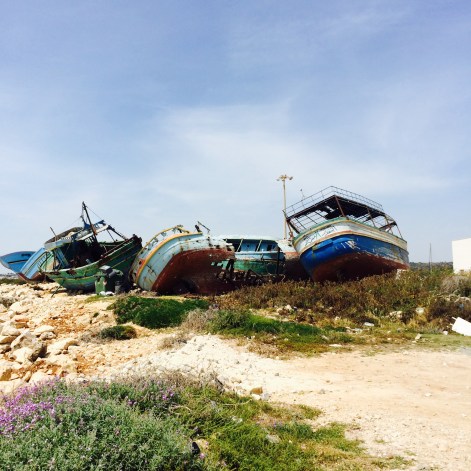
Further along the coast we stop at the Isola delle due Correnti, where the Ionian Sea meets the Mediterranean and then a little further on at Portopalo. Here, near the harbor, lies a graveyard of wooden fishing boats, some burnt hulks, others, stripped and paint-faded, awaiting incineration. On the ground, among the rocks and under the hulls, are the flotsam and jetsam of their passengers – a plastic bottle, a shoe, a torn and grubby headscarf. These are the boats that have survived the journey from North Africa with their cargo of refugees. The nearest Italian landfall to Libya is the island of Lampedusa, but for those boats that miss it, Portopalo is where they end up. At the immigration centre near the port some of the latest arrivals are playing football in the sun; you can see why they call it ‘the world game’.

IMG_3075

Refugee boats awaiting destruction at Portopalo

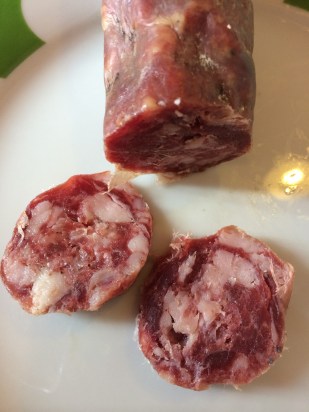
While Sydney continues to congratulate itself on its fine dining and gourmet food shops it still cannot produce a crunchy baguette, a tasty tomato, a punnet of ripe, unblemished strawberries or a decent salame. Try asking a butcher for a corn-fed cockerel or a capon and he will merely point to his row of uniform, trussed and glad-wrapped hens. If you are planning trippa alla Livornese and ask for tripe the odds are he will throw his hands up in horror. Honeybee has found an excellent salame di suino nero.

IMG_2968

Note the essential high fat to lean ratio

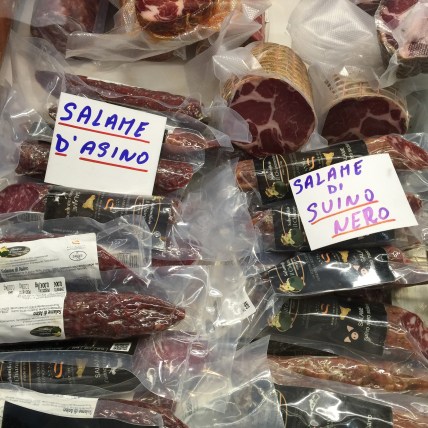
The salumista also sells a tasty salame d’asino or donkey meat sausage. Like its pork brother, it is suspended for a several months in a cool cellar to mature, hence the expression ‘hung like a donkey’.

IMG_3362

Sausage for donkey lovers

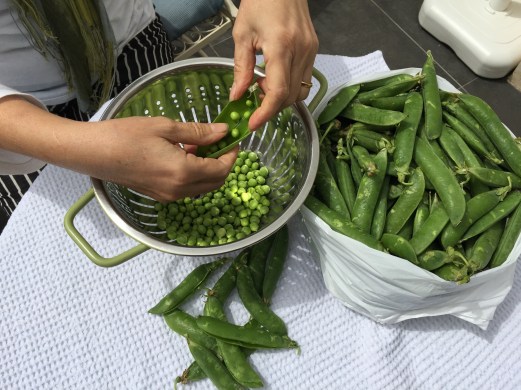
‘I know nothing more noble than the contemplation of the world’ said Flaubert and there is no activity more conducive to rumination than the shelling of 2 kilos of peas.

IMG_3346

Meditation time

Occasionally available in Sydney, ready shelled and at scandalous prices, fresh peas in Italy are a cheap and popular delicacy served with pasta or as a piatto unico and occasionally, in Sicily, popping up in the sticky centre of an arancino.

Mind you, I’m not all that partial to some Sicilian dishes. Pasta col macco (overcooked pasta in a soup of dried broad beans) and the little pastries filled with a mixture of ground meat and chocolate called ‘npanatiddi I can live without. Not that I’m opposed to the addition of chocolate to meat dishes, after all lepre in dolceforte (jugged hare) can be tasty, but the appeal of ‘npanatiddi has its roots in ancient efforts by the monks to conceal the consumption of meat during Lent, and old customs die hard on this island.

A morning stroll through the quartiere of Santa Teresa in Modica Alta. This is a charming area of quiet, narrow streets and tree-shaded piazzas. Nespoli, bougainvillea and rose hang over garden walls; old men the size and colour of walnuts sit talking and not talking outside cafes. It’s warm and peaceful and it beckons like the waters of Lethe. Many houses are for sale and I’m tempted but I’m not ready just yet and we start walking down to Modica Bassa.

IMG_3011

Modica Bassa

On the balcony of an apartment just below the Duomo they are filming an episode of the detective series ‘Inspector Montalbano’. The Inspector’s (actor Luca Zingarotti) appearance on the balcony is received with the same degree of enthusiasm as Giuseppe Garibaldi’s. There is a rattle of applause and cries of ‘Bravo Luca‘, while Honeybee melts into a damp spot on the pavement.

IMG_3803

Honeybee asking Montalbano if he wants her phone number

One thing that England and Modica have in common is the same patron Saint, St George, a Syrian-born soldier in the Roman army, executed on Emperor Diocletian’s orders for refusing to recant his Christian faith. England’s most visible association with the Saint is the sign ‘The George and Dragon’ attached to various pubs sprinkled across the country; it’s a very different story in Modica. We are here on St George’s Day, April 23rd, for Modicani the most important feast day of the year. Marching bands parade along Corso Umberto I, families clog the gelaterias and there is an antiques fair in the Piazza Corrado Rizzone displaying, inter alia, old car radios, 45rpm records, rusting keys, coins, second hand books and ceramic jelly moulds from Caltagirone. At 5 pm a crowd gathers outside the massive doors of the Baroque Duomo of San Giorgio in Modica Alta. With cannons booming and the bells of every church in Modica ringing out, the doors open and through the red and white smoke of Roman Candles, an equestrian Saint George is borne out into the sun by his red-coated disciples. Preceded by a band, San Giorgio is then paraded through the town until, near midnight, he is carried back to the Duomo and tucked away for another year.

IMG_3687

Saint George’s Day in Modica


TWO PARISIENNES

1.      Bonjour Tristesse

When I knew Mademoiselle Bonjour in the early 1970s she was at what the French discretely call ‘a certain age,’ meaning that period when it would be foolish to ask and dangerous to guess a woman’s years. But if she was no longer young, her hair carried only traces of grey and she was tall and slim and wore her clothes of classic chic with that air of nonchalance peculiar to ladies of bonne famille. She was definitely BCBG. I thought at first she was a widow as she almost always wore black, occasionally offset by a tasteful Hermes scarf but always relieved by her smile, even if it was a trifle sad. She seemed as if she had an interesting past, an acceptable present and no future.

Bonjour Tristesse, as I called her, always maintained an air of grace and patience. I imagined she had suffered some great misfortune, perhaps a lover who had died, for she had never married. Unlike some French ladies in similar circumstances who let it be known that they wished to be called Madame to hide the indignity of advanced spinsterhood and to escape any embarrassment on Saint Catherine’s Day, she accepted her title of Mademoiselle with equanimity.

Mademoiselle Bonjour was second in command of the typing pool in the Paris office of Ernst & Young, run by the formidable Madame Alprand, a horn-rimmed lady from Alsace. We would bring our work for typing to her, grinning at the improbability of the greeting preceding our request for her services – “Bonjour, Mademoiselle Bonjour”. Her soft brown eyes regarded us with infinite tolerance.

But what appealed most to our childish sense of humour was to hear her telephone the periodic order for fresh stationery supplies. The proprietor of the company providing the office materials had the unusual surname of Monsieur so that the initiation of the order began with the absurd “Bonjour Monsieur Monsieur, voici Mademoiselle Bonjour”.

These small pleasures came to an abrupt end. Mademoiselle, it seemed, was leaving to be married to an American that she had met during the liberation of Paris. We learned that his wife had died and he was returning to Europe to pick up the pieces of that long ago romance. I pictured the victorious armies descending the Champs Elysees, the American Captain, waving from his Jeep and later slipping into conversation with the young French woman that such times make easy. Or was it a chance encounter as both sheltered in some doorway to avoid the last desperate rounds of German sniper fire?

We never knew if the American took his new bride back to the US. Somehow I didn’t see her in some leafy, Wisconsin suburb, playing surrogate mother to a pair of overweight college boys, backing the Pontiac station wagon into the supermarket car park on a Friday afternoon. I hoped Brad or Dexter or whatever his name was, moved to Paris and that he and his new wife are enjoying a Lapin au Moutarde together at Le Petit Zinc, walking in the Jardins de Luxembourg on a Sunday morning and climbing the stairs to an apartment that looks over the city he helped liberate and where he rediscovered a love that had lain hibernating in some mid-western state for close on thirty years.

2. Une Infirmiere Extraordinaire

If you were very ill and very rich and you were living in Paris in the 1970s you went tout de suite straight to the Hartmann Clinic in Neuilly, the city’s most prestigious private hospital. If, in spite of the unparalleled care provided by the Hartmann, you still failed to make the cut, it is likely that the last face you saw in this world would be that of Monica Clothier, the Angel of Neuilly. It wasn’t just Monica’s professional competence and discretion that ensured she was the nurse de choix for the rich and famous but her role as a nurse of the old order, smartly starched, knowledgeable about her business, firm, exuding confidence, discreet and gentle, unfazed by power and authority.

You don’t have to be French to be a Parisian. Monica’s roots were in rural Australia, an unlikely qualification, but she was a life-long expatriate and her name, with its hint of Gallic ancestry, had a classy ring to it. Mon (names with more than a single syllable are anathema to Australians) suited Paris and Paris suited Mon, although it was in London that she established herself as a legend among the ailing aristocracy, for it was there that she nursed Lydia Lopokova, one of Diaghalev’s great Ballets Russes dancers and wife to John Maynard Keynes. And when Elizabeth Taylor was stricken with Maltese Fever on the set of ‘Cleopatra’ and the actress was shifted from the Dorchester to the London Clinic, Mon was there to make sure she survived to grapple on and off set with Mark Antony (Richard Burton). She turned down a request to nurse Maud Kerr Smiley, sister of Ernest Simpson (ex-husband of Wallis, Duchess of Windsor), on learning that her duties included potty training the resident pug; but these brushes with the famous in London had given Mon an education in and a taste for the better things in life as well as an ability to mix easily in high society.

Mon and her friends, Jude, Barb and Bill, a sheep farmer from the Riverina, were the first Australians I had come across. My idea of Australians had been formed watching the films of Chips Rafferty; Bill with his laid-back air and sardonic wit fitted my expectations exactly. Unlike most visitors who ooohed and aaaahed, Bill was unsmitten by the charms of Paris; an exquisite souffle was only grudgingly praised (‘not bad, but two farts and it’s all gone’) and he remained unimpressed by the chapel–like tombs in the cemetery of Montmatre (‘a bunch of dunnies’); a poetry recitation in the Lapin Agile failed to keep him awake. Imagine my disappointment on finding that my first four Australians were the exceptions not the rule.

Mon lived in a modest 6th floor apartment in the Rue de Saussure in the 17th, leaving her the wherewithal for the important things in life such as her Chanel shoes, Louis Phillippe blouses, Gucci classic handbags and a Courreges dress that the couturier seemed to have designed with Mon in mind. Her favourite shops were Petrossian (caviar and foie gras), Laduree (chocolate macaroons) and Fauchon for her hors d’oeuvres when entertaining at home. There, in Sausage Street, as she called it, she would relax with Point de Vue and listen to the BBC on her large black transistor radio, a gift from the Empress Catherine who had once recovered under Mon’s care from the trauma of marriage to Jean-Bedel Bokassa, reputed cannibal and self-proclaimed Emperor of the Central African  Empire.

Work came first in Mon’s life. Under her touch popular French comedian Coluche recovered from his ailments as did car manufacturer Monsieur Peugeot, film director Anatole Litvak and actor Gregory Peck. When the Duke of Windsor became terminally ill, it was Mon who was chosen to make his last months comfortable, moving into Le Bois, the Duke’s Paris residence (now leased by Mohamed al Fayed and destination of Princess Diana on the night of her death). Before he died the Duke allowed Mon to photograph him at his most informal and presented her with a mint set of never to be issued coins of the (British) realm bearing his likeness as well as a selection of his silk cravats with the monogrammed feathers of the Prince of Wales that he wore in the evenings. Years later Mon would stay again at Le Bois, this time to see off the Duchess.

Karl Lagerfeld chose Mon to look after his mother at the Chateau de Penhoet, his country home at Grand Champ in Brittany. She appears, discreet as usual, facing away from the artist, in one of Lagerfeld’s sketches for “A Fashion Journal” published in 1986.

Monica Lagerfeld

Mon, drawn by Lagerfeld in Penhoet’s kitchen – 15th August 1976

When Nelson Bunker Hunt, perhaps enfeebled after failing to corner the world silver market, suffered a heart attack, a private plane was equipped as an airborne clinic and with Mon as his ‘flying doctor’, he was flown back to Texas and turned his attention to horse racing. In 1975 she was at the bedside of Aristotle Onassis, nursing him until his death and providing his wife, Jackie, with the red rose she tossed onto the casket as it was lowered into the ground. Did he have Mon as well as Jackie in mind when he remarked that “If women didn’t exist, all the money in the world would have no meaning”?

monica

Jackie leaving the Hartmann Clinic with Mon and her bodyguard George Sinas           (The Telegraph March 17, 1975)

Mon was too self-sufficient and content with her life to ever contemplate marriage, choosing her lovers with the same deliberation as she did her Camembert. The last was an eccentric English Lord I introduced to her, who charmed her with gifts of monogrammed hand-towels stolen from the washrooms of the House of Lords.


Like many with the task of repairing the health and welfare of others, Mon disregarded her own, smoking with the elaborate flourishes of a 30s debutante, finishing her long days and the climb up the stairs with a glass of champagne. She died alone in her apartment in Sausage Street in April 2008. Her friend Nicole, Comtesse de Demandolx organized the memorial service. Her ashes are in the Pere Lachaise cemetery, surrounded by Chopin, Moliere, Edith Piaf and Oscar Wilde, leaving her, as always, in the very best of company.

Mon 2

Mon et moi, Paris, November 1980


READING MATTERS

A friend recently gave me a newly published novel that she had abandoned after 20 pages. I persevered because the subject (the story of the Biblical David) was of interest, but the writing was packed with what Elmore Leonard called ‘hooptedoodle’- over the top, cringeworthy descriptions (‘ripe figs, warm from the tree, spilling their sweet nectar through these splayed fingers’). Unsurprisingly, the story of David contained in the Books of Samuel and Kings in the King James Bible is a far better read. I was shocked to see that a previous novel of the author (Geraldine Brooks) had won a Pulitzer Prize, surely devaluing the honour, in the same way Nicole Kidman diminished the value of the Academy Awards in general by accepting an Oscar for wearing a false nose in The Hours.

According to the International Publishers Association, 184,000 new and revised titles, of which 60,000 were digital, were published in the UK in 2013, that’s more books per inhabitant than any other country in the world. ‘A sign of cultural vitality or publishing suicide’ asks literary agent Jonny Geller, knowing that the average person reads between one and five books per year. Although many of these publications will be Government pamphlets, art monographs, technical journals and so on, for those who read in English there’s still an awful lot of books to choose from, even without considering contributions from America and the other Anglophone countries making selection problematic, especially with the demise of libraries and the helpful advice of librarians. Advice is on hand from the occasional ‘lists’ published by respected critics such as 100 Key Books by Cyril Connolly, Ninety–nine Novels by Anthony Burgess or The New York Public Library’s Books of the (20th) Century, but if you restrict your reading to the works included in ‘Penguin Classics – A Complete Annotated Listing’, you cannot go wrong. It was this catalogue that introduced me to the first two books of these three of my recent reads.

Manon Lescault
Abbe Prevost 1731

Not a common name for a girl, Manon, I thought, but it seems this diminutive form of Marie has recently become more popular in France. The only other Manon I’ve come across is the pure but wild water nymph in Marcel Pagnol’s ‘Manon des Sources’, a character very different from the scheming Jezebel of the Abbe Prevost’s title.

Set in France and Louisiana in the early 18th Century and, like many a good book, banned on publication, it tells of the infatuation of the Chevalier des Grieux, a young nobleman, for Manon Lescault, a penniless tart. Des Grieux is studying for the priesthood when he spots Manon (en route, forcibly, to a convent) and, weak-kneed from a coup de foudre, is instanter resigned to his fate. ‘The sweetness of her glance – or rather, my evil star already in its ascendant and drawing me to her ruin – did not allow me to hesitate for a moment’. Although an aristocrat, Des Grieux, coming from impoverished rural gentry, is neither rich nor worldly and when he and Manon run off to Paris to live together the couple descends quickly into a life of criminality initiated by Manon and aided by her dissolute brother. A noble but naïve interloper in a world of theatres, gaming houses, taverns and stews, Des Grieux is ‘incapable of detaching himself from this giggling, empty-headed minx’[i] and asserting his nobler instincts. On the sole occasion he has the opportunity to display courage and a little skill with the epee, he is found trouser-less and tripping over his scabbard. ‘A man,’ he correctly points out, ‘is helpless in his shirt.’

Among the landed gentry, the Abbe Prevost suggests, there exists a noblesse oblige, not just for others, but also for their own fallen members, and when Des Grieux turns to his friend Tiberge for money he is not refused, even though he abuses this honorable friendship by using the funds to keep Manon in a style to which she had never been accustomed, buying her jewellery and sustaining her with haute cuisine. Manon des Sauces. Three times De Grieux is betrayed by Manon, recalling Samson’s weakness for the scheming Delilah, and in the end one is left open-mouthed in disbelief by the perseverance of his passion. There was, he later concludes after the final betrayal, ‘no malice in her sins; she was fickle and imprudent but straightforward and honest.’ Eventually Manon herself is betrayed by a peeved sugar daddy and arrested on a charge of prostitution. ‘Love, will you ever be reconciled with wisdom?’ muses the judge as he convicts Manon and sentences her to transportation to New Orleans.

Needless to say Des Grieux follows her to America and, after further adventures, flees with her into the wilderness of Louisiana where Manon dies of exhaustion and fever. Des Grieux’s family receives him back with open arms, thankful, like many parents, to see the back of an unsuitable match for their child.

This story of how infatuation can make us forgive repeated disloyalty is so powerful that it has spawned no less than three operas (by Puccini, Massanet and Auber). What a dreadful life she gave Des Grieux, one is left thinking, a massive coup de tart, but then it was a life, something he might never have had in some seminary in the Cevennes. He had no regrets. ‘Love, I must add, though it may often deceive us, does at least promise only satisfaction and pleasure, whereas religion expects us to be prepared for a life of gloom and mortification’. Justement.

The Lily of the Valley
Honore de Balzac 1835

In France, in the early days of the newly restored Bourbon monarchy, Felix de Vandenesse, a young nobleman, writes a letter to Natalie de Mannerville, in which, in an attempt to win her, he makes the mistake of revealing his past infatuation with two women, Madame de Mortsauf and Arabella, Lady Dudley. Felix, it seems, has experienced a hard childhood and adolescence at the hands of an indifferent father and a cold, miserly mother who gave all the affection she could muster to Felix’s elder brother. Sent away to school, first in his native Touraine and then in Paris, he is deprived of the pocket money that enables the students to supplement their meager diet. Although academically strong, he is thin, sickly and unpopular, craving love, so that when, finally, he gets his hands on a little cash, he plans to spend it on a prostitute rather than chocolate eclairs. But just as he is on his way to the Palais Royal to surrender his virginity, his mother arrives and takes him home.

With Napoleon confined to the island of Elba, the aristocracy are dusting off their wigs and making themselves more visible; when a ball is held in Tours in honour of the Duc D’Angouleme, Felix is allowed to attend. There, unhinged by the sight of a lady’s decolletage, Felix plants a kiss on her bare shoulder before retreating quickly from the ensuing furore and returning home, where he is once more banished, this time to his uncle’s chateau of Frapesle, set in the bucolic paradise of the Indre valley. By chance, within view on the opposite bank of the river, is Clochegourde, home of the lady who had received Felix’s unwanted attentions at the ball in Tours. It was the home of Madame de Mortsauf, the Lily of the Valley. Unhappily married to a cruel and irascible husband and mother to a son and daughter, both in poor health, Madame Mortsauf finds a soul mate in her (much younger) new neighbor who endures evenings of backgammon with her husband in order just to be near her and to experience the exquisite pleasure of pressing his warm lips to her cool fingers on arrival and departure. Earthly language cannot describe the purity of the love Felix feels for Henriette (his pet name for Madame de Mortsauf), even though, bound by her duty as wife and mother, she can only exhibit friendship in return. Amid much swooning and embroidery, coiled passion, supressed beneath Henriette’s laced bodice and Felix’s satin waistcoat, assumes the energy equivalent of a small atom bomb.

When Felix is ordered to Paris to serve the newly restored monarchy, he takes with him a letter from Henriette, a sentimental education that would serve a young man well today. Uprightness, honor, loyalty and good manners, which consist of appearing to forget oneself for others, she tells him, are the surest and quickest instruments of success. Maintain an absolute silence about yourself, display your wit but do not be an amusement for others. Assume an attitude which is neither indifferent nor enthusiastic; display a coolness, which may even border on impertinence. Be implacable in your final determinations and avoid the abuse of promises. To maintain his devotion, she advises him to avoid young women, ‘for the woman of fifty will do everything for you, the woman of twenty, nothing’. Finally she urges him to serve all women and love one, who we may safely assume is Henriette herself.

This advice, combined with his continuing devotion to Henriette, serves him well at Court where he prospers. Enter beautiful English aristocrat Arabella, Lady Dudley. With Lord Dudley safely on the family estates on the other side of the channel, Arabella pursues Felix, first for his Gallic éclat, and later on account of his early resistance, which only further stimulates her passion. But the Englishwoman, ‘so slim, so frail, this milk white woman, so languid, so gentle, with such a tender face….is an organization of iron’ and Felix, being a man and consequently imperfect, eventually succumbs. Growing tired of her lover’s continuing ‘turtle dove sighings’ Arabella sets out to destroy the place Henriette continues to occupy in his heart, until finally, under the stimulus of desire, she wrings from him blasphemies against the Angel of Clochegourde. ‘Insatiable as sandy soil,’ she ‘works him like modeling clay’.

News of Felix’s infidelity soon reaches Clochegourde where Henriette loses the will to live and lies dying abed, steeped in opium and recriminations. Having longed to give his life for her, Felix is killing her. When he eventually comes to her bedside she upbraids him with that ‘cruel playfulness with which women clothe their revenge’. Realizing the awful necessity there is for lovers never to meet again when love has flown, Felix defends himself, claiming Henriette has his heart and Arabella only his body, a reference to the incompatibility of heaven and earth, of religion and love. Before dying Henriette confides that she has ‘prepared’ her daughter for him, but Madeleine, despising him for what he has done to her mother, hates him with the ‘deliberation of a Corsican’.

Returning to Paris Felix begins to find fault in Arabella and the relationship gradually deteriorates. ‘What is one to say to a woman who weeps in the morning?’ he asks himself. What indeed. Once free Felix resolves never to pay attention to any woman again, until that is, he meets Natalie de Mannerville. It is her letter of rejection that closes out the story. Natalie, fully informed of the insuperable competition the past would present, gives it to him straight – ‘Let us do away with love between us’ she writes, ‘since you can never taste the happiness of it again, save with the dead.’ Ouch.

The Kindly Ones (Les Bienveillantes)
Jonathan Littel 2006 (English translation 2009)

I don’t suppose the Y generation have any call to hate or fear the Germans; they may well admire them for their stable government, precisely engineered cars and Moselle wines, enjoying the odd Rhine cruise or a finely prepared Apfelstrudel mit schlag. The feelings and impressions of Germany for many older generations were less kindly. In the case of my father, born in 1904, for ten out of his seventy-five years (13% of his life) his country was engaged in unwanted war with Germany. Some citizens of France would have seen their country overrun by Germans three times between 1870 and 1939 recalling the 4th Century invasions by the Huns under Attila. Hunnic legend is still celebrated by the German people in the Niebelunglied, set to music by Wagner and deeply admired by Adolf Hitler, Attila’s recent reincarnation. Winston Churchill seized on the same historical link, describing the Germans invading Russia in 1941 as “the dull, drilled, docile masses of the Hun soldiery, plodding on like a swarm of crawling locusts.” Unlike the plans of any previous administrations, the war aims of the Third Reich included the extermination of European Jewry. The segregation and vilification of German Jews, the attempt to dispose of Gypsies and sub-perfect humans had started even earlier with the object of creating the caste system eloquently forecast by Aldous Huxley in his “Brave New World”. The systematic massacre of Jews, carried out with typical Teutonic thoroughness, was well known to the Allies early in the war but no real efforts to save them were made other than the occasional official statement condemning German “bestiality.” The true extent of Hitler’s euphemistically termed “Final Solution” (more hideous than the vastly superior body counts achieved by Mao and Stalin) only became fully understood after the war, but, for me, no one book seemed to explain exactly the political motives for the holocaust and the extent of the people’s involvement.

Enter Jonathan Littel, an American writing in French whose roman fleuve tells the story of Maximilien Aue, a highly educated young man recruited by the SS and sent to the Ukraine to command an Einsatzgruppe, a mobile unit charged with the extermination of Jews, Communist partisans, Slavs and other undesirables. He survives the battle for Stalingrad and conducts audits of Belsen and other camps where he stands, helpless, between those asking for Jewish and other prisoners to be kept alive as slave labour, a valuable resource in war production, and those anxious to complete their annihilation. He escapes Berlin with the Russian army at the gates and survives to manage a factory in Northern France. Whilst indifferent to the mass carnage and individual acts of brutality he oversees, he is traumatized by his homosexuality and incestuous affair with his sister.

Littel destroys two myths. First, everyone knew. What went on in the camps was known to the local suppliers of goods and services, to the train drivers delivering the wagon loads of victims, to the families of soldiers involved in feeding, guarding and gassing the inmates. Second, it was not mandatory for either SS or Wehrmacht soldiery of whatever rank to assist in the actual extermination process. It seems that through practice many developed an actual addiction to murder. Littel’s book won the Prix Goncourt, the Grand Prix du Roman as well as The Literary Review’s 2009 “Bad Sex Award” for an embarrassing description of Max failing to achieve an erection.

I once took the train from Munich’s Hauptbahnhof to Dachau, a camp constructed in 1933 and finally closed at gun-point in 1945 by the soldiers of the 42nd Division of the American Army. Needless to say the people of Munich, only 15 kilometres away, were totally unaware of the camp’s purpose and business. Although the sinister spirit of the place endures, Dachau has now been manicured by set designers and is full of contemporary concrete shrines to every known religion, with MikesBike tours available to those not wishing to make the 45 minutes train ride. It’s another destination for those caught up in the current fascination with all things Nazi.

Was there proper retribution?  Soon after the Nuremberg Trials, after which only 10 so-called war criminals were executed, the US and Soviet governments lost interest in bringing the culprits to justice, leaving it to Simon Weisentahl and his typewriter to continue the work from an understaffed office in Vienna.


[i] From Germaine Greer’s foreword to Andrew Brown’s translation of Manon Lescault, Hesperus Press, 2004


THE BELKNAP EARRINGS

I sometimes wonder if everything on this earth, tangible or intangible, is in some way connected. But that just shows my ignorance. Of course they are. But when Honeybee fishes in her jewellery box, holds up a tortoise shell earring and says “Shall I wear the Belknap earrings tonight”? I might be excused for wondering what could possibly be the connection between a piece of cosmetic jewellery, a volcano in Oregon, an Assiniboine Indian reservation, a 20th century warship and a young French woman. In point of fact the connections, in my mind anyway, seem endless.

The young French woman was born in Oued Zem in Morocco as had her parents and her grandparents, but they were not Moroccans: they were Pieds Noirs, settlers of French ancestry, bound to the Maghreb but not of it. On the morning of 20th August 1955, soon after the girl’s thirteenth birthday, the family’s Moroccan housemaid, who, until then, had been consistently punctual, failed to appear. In fact, no Moroccan gardener, housemaid, cook or driver reported for work in the European quarter of Oued Zem that day. Just as their absence was being discussed among the French settlers over fences and in cafes, a horde of Berber tribesmen, incensed at the French Government’s deposition of their Sultan, Mohamed Ben Youssef, were swarming down from the foothills of the Atlas Mountains, armed to the teeth and intent on mayhem. Although the attack had been long premeditated, the Berbers’ blood was at boiling point when they reached Oued Zem and they tore into the settlers with alarming ferocity. Scores of men, women and children, including patients and staff of the hospital, were killed and mutilated before the French Air Force, elements of the Foreign Legion and the guns of the settlers ended the assault. Seventy Europeans lay dead but the French girl and her family had survived. Fearing further atrocities, the girl’s father sent his whole family to safety in France, while he continued working as an engineer at the nearby phosphate mine in Khouribga. The family’s point of repatriation was Grenoble, where the father had bought the splendidly named Cafe des Abattoirs and the apartment above it, and it was there, in 1961, when I was learning to ski and drink wine at the University, that I first met Monique. She was a fellow student’s girl but our friendship lived on long after their romance was exhausted.

In December of 1989 Monique was married and living in the South of France with her husband Claude, a moody Police Inspector stationed in Toulon and their two daughters. Valerie, the eldest at 17, was a petite, petulant airhead who had reached her cultural and intellectual climax listening to pop music in a pink bedroom full of comic strip romances. Carole, two years younger, was quieter, deeper and cleverer. They lived in the business end of the Azure Coast in a town whose economy, since the sixteenth century, had relied upon ship-building and which was therefore pleasantly free of tourists. At this time Western Europe  was busy handing over ship-building  to the far North and the far East and the little port suffered, but it recovered and is still tourist-free, still a pleasant place to sit and drink a pastis by the little port. Agreeable too to take the ferry out through the mussel beds, past the Charles de Gaulle and her battle fleet anchored in the roads and into the harbour of Toulon, lying under the imposing canopy of Mount Faron where, in 1790, a young artillery officer called Napoleon Bonaparte halted a British invasion. I’m not going to reveal the name of this oasis of urban normality in the unlikely event this blog goes viral and I can no longer find a place in the café by the port.

I was at work in Verona the day Monique rang to tell me that her eldest daughter had run away to Italy with an American sailor. I would have viewed this as a Godsend but her mother was distraught. Valerie, it seems, was in Gaeta, a port just north of Naples and Monique needed to see for herself that her daughter was safe. Some days later I met her off the train and we set off on the long drive to Calabria during which she explained the events leading to Valerie’s elopement.

That summer the USS Belknap, flagship of the 6th Fleet, had paid a courtesy call on the port of Toulon, staying for nearly two months. Home to France’s navy for centuries, Toulon was used to playing host to sailors and the ship’s crew would have enjoyed the sea-front restaurants and night life. There was also much to see outside of the port. There was the nudist paradise on the Ile du Levant, the ever fashionable St Tropez and Tahiti Beach and the impressive Mont St Valerian where Cezanne received much of his inspiration. Although Toulon itself had no restaurants worthy of even one Michelin star, Bandol’s La Reserve (speciality: gratin de langouste) and La Veille Auberge Saint Nicolas at Hyeres (speciality: Bourride) merited single stars while Les Santons at Grimaud (speciality: goujonettes de St Pierre au Champagne), only a short drive from Toulon, had two. In the late 80’s there were also some more modest establishments that had escaped the excesses of Nouvelle Cuisine and had not been seduced by the prospect of turning themselves into a Pizzeria or taking up a Kentucky Fried Chicken franchise, places where one could enjoy an assiette de crudites, pied de porc panee and a pichet of Cote de Ventoux. But I know for a fact that two sailors, Craig and his friend Don and most likely many of the Belknap’s crew, preferred to lunch and dine at McDonalds, for this is where Valerie had been working during the summer, there being no universities offering courses in dress designing for Barbie Dolls.

Monique explained to me that the USS Belknap and the rest of the 6th Fleet were permanently based in Gaeta, that the sailors were allowed to rent apartments on land and were not obliged, under normal circumstances, to sleep aboard. A helpful Officer on the Belknap had provided her with the address of the apartment which Valerie was sharing with three members of the Belknap’s crew and, as dusk settled, we arrived at the appointed place. After three sharp knocks and ten seconds of silence, the door was flung wide and we were confronted by a stocky man in vest and shorts, the biceps on his Popeye arms lavishly illustrated in designs that must have taken the tattooist the best part of a day to achieve. Craig, who I later discovered to be Valerie’s abductor, looked inquiringly at Monique and me, but before I could properly explain our mission, a piercing screech echoed down the corridor. I was familiar with this blood-curdling cry; it meant Valerie had seen us and sure enough, restrained by two other young men in vests, she demonstrated her lack of enthusiasm for our visit by directing a flood of high-pitched Gallic abuse at us. Deeply regretting my decision to come to Gaeta and motivated by a cowardly wish to avoid any sort of confrontation, particularly physical, I seized a brief moment of quiet to suggest that Monique and I would go away and come back in an hour. I proposed that on our return I would invite everyone to dinner and hopefully we could all discuss calmly whatever we had to talk about. Happily the Americans, understanding the potential gravity of the situation, quickly agreed to the proposal. Although petite Monique had the cojones to make things difficult for them with their officers on the Belknap. She was also the mother of a teenage daughter that one of them, at least, wished to marry.

And so it was that Monique and I strolled the streets of Gaeta. I believe that wherever you are and in whatever circumstances, there is always an ounce of interest and perhaps even enjoyment to be squeezed out. The delay in the next encounter with Valerie and her sailor friends probably brightened my mood, but even so I remember pleasure in that evening walk, getting a feel for a place that normally one would never have thought of visiting, looking out for a likely restaurant to take Valerie and her matelots. Mercifully, retail in the streets of Gaeta had not yet been confined to real estate, seven-elevens, dentistry, nail-refurbishment and Thai massage and among the hardware, fruit and vegetables, between a café and a salumeria, we came across an interesting looking jewellery shop. As is often the case with a fledgling enterprise where the proprietor manufactures his or her own product, there was a limited stock, but the craftsmanship was evident and I chose a pair of earrings. This was a serendipitous purchase for someone else’s pleasure, the very best kind of shopping. The earrings were tortoiseshell with a silver clasp and had an ancient, perhaps Etruscan look to them. They were also reasonably priced. Any fool with bottomless pockets can acquire exquisite objects.

When we returned to the apartment after an hour or so we found a sullen but calmer Valerie while her American escorts were now smartened up in jeans and T shirts. My suggestion that we eat at one of the restaurants I had recently earmarked (piatto del giorno, spaghetti marinara) was brushed aside in favour of the sailors’ local Pizzeria. There, while Monique and Valerie chattered away in French, Don, the most agreeable of the three sailors, told me about the voyage he had made with the Belknap just two weeks earlier. He told me how they had anchored in heavy seas off the coast of Malta in a rendezvous with the Soviet cruiser Slava, how President of the United States, George Bush, had come aboard and how he and other Belknap sailors had visited the Slava, exchanging Soviet caps and watches for Zippo lighters with the Russian sailors. Don, as it happens, had witnessed a historic moment. Gorge Bush’s meeting with Mikhail Gorbachev, taking place just weeks after the fall of the Berlin Wall confirmed the final lifting of the Iron Curtain that had divided Europe for 40 years and set in motion the discussions that would deal with the changes it was already triggering. By the end of the meal, Valerie, realising her mother wasn’t dragging her back home, and with five thousand francs in her pocket, was mollified. We said goodbye to Craig and his two shipmates. As I shook hands with Don, he said “Don’t worry, I’ll look after Valerie.” Craig and Valerie announced their engagement and with these assurances Monique and I went back to our hotel and, in the morning, left for Verona.

Valerie never married Craig. She married Don and, when his tour of duty on the Belknap ended, became a Navy wife living in Norfolk, Virginia. Later there was a daughter, Samantha, and then, tragically, Don died in a car accident. After lingering for a while in America Valerie returned to France, settled in Avignon, and found herself a new partner. Monique was pleased to have her daughter near her and she delighted in Samantha. But she had misgivings about Valerie’s new lover who she suspected was abusing her granddaughter. With her characteristic, head-on style Monique weighed in with the accusations, in spite of denials by all concerned, including the child herself. Her next two years were a nightmare. Valerie refused her access to her granddaughter; legal proceedings were instituted. Monique’s very sanity was called into question, aided by statements from her now ex, Claude, whose testimony as a policeman bore considerable weight with the judges. My own testimony formed part of the defence’s effort to prevent Monique spending the rest of her life drowsy with Bromide in some depressing institution. Precious savings were diverted into the pockets of rapacious lawyers. Time was wasted and health jeopardised, but, like many a crisis, it slowly evaporated. It had taken its toll; there was no conclusion, but it was over.

——

The earrings, the volcano, the Indian reservation and the USS Belknap are all named after Rear Admiral George Eugene Belknap (1832-1903).

The USS Belknap: a guided missile cruiser of 8,957 tons, launched in 1964 was the flagship of the US Sixth Fleet based in the Mediterranean from 1985 to 1994. She returned to her home port of Norfolk, Virginia in 1995 and was destroyed by F-14 bombers as a target ship in 1998. It took 29,000 pounds of bombs to sink her.

Valerie still lives in Avignon with her two children. She now has a new partner. She and Monique are friends again.

THE GODFATHER

It was 1982 with the war in the Falklands in full swing when Honeybee sailed into my life. At the time she was showing Argentinian colours but no sooner were her grappling hooks in place than she ran up and broke out the dreaded skull and cross-bones of her native Sicily. Within a short time of being boarded I had agreed to accompany her to the island to meet her parents. I felt uneasy as we set out – I was already married.

Honeybee’s parents, Giovanni and Liliana lived in Adrano, a small town in the Province of Catania supposedly named after the Emperor Hadrian, better known for his brave but useless attempt to keep the Scots and their dreaded bagpipes walled up in their own land. In a repetition of this folly, Hadrian’s mad architects had perched the town dangerously close to the crater of a bubbling volcano. This fact troubled me less than the knowledge that the town also lay within a “Triangolo della morte” so named when the number of mafia assassinations in an area exceeded the total of World War One casualties in the entire Ypres Salient.  In winter the family lived in a bleak, tiled, modern apartment with AD 138 plumbing.  The summer months they spent at their simple country house in the shadow of Etna and it was there that we stayed the first night.

In the morning I went looking for Honeybee’s father in the garden. As I idled among the olive trees I saw a man, lupara casually slung from his shoulder, approach Giovanni. After five or so minutes of earnest talking the visitor disappeared amongst the trees. Later, wondering whether my future father-in-law was “connected”, I asked him about the visitor. He’s the man from the insurance, said Giovanni, going on to explain that the premium insured his country house against robbery in the winter months when the family lived in town. Keen to demonstrate what a smart Inglese accountant his daughter had found, I pointed out that there wasn’t much to steal so why not cancel the insurance. What could possibly happen if you don’t pay the premium, I asked. He would burn the house down, replied Giovanni, not even bothering to look at me.

Later that day I watched Honeybee and her parents work in the garden, an acre or two of vines, pistacchio and olive trees, tomato plants and herbs. Everything grew well in the rich volcanic soil watered by Giovanni’s elaborate irrigation system, which consisted of a complex network of pipes and cement aqueducts radiating from a huge concrete container. Under Sicilian laws dating back to 10 BC, the water supply was in private hands and Giovanni periodically paid for the tank to be refilled. Contrary to all known laws of sound economics the cost of the supply was based on the amount of time the owner kept his valve open rather than the quantity of water delivered. At those times when drought reduced the flow to a miserable trickle Giovanni was paying at the same rate as for Arabian crude.

It was the time for harvesting Giovanni’s crop of ripe tomatoes and producing the annual stock of passata, a staple of the Southern Italian diet. The whole family helped in this day-long process of pulping and bottling the fruit and boiling the filled bottles in oil drums. As evening approached and the job was complete Giovanni prepared to dispose of the gallons of juice that had been produced from the pulping process. Still eager to impress, I ignored his instructions to dispose of the liquid and set about, straining, bottling and corking the juice.  Giovanni and Liliana had already retired when I set out my twenty or so newly corked bottles of tomato juice on the kitchen table.

I was awake early the next morning and looking forward to pouring out a glass of tomato juice for each member of the family to taste with their small cups of bitter coffee when Cristina came into my bedroom. “I think”, she said “that you should stay in bed for a while. There’s been an accident and Mum wants to clear up before you see it”. With no further elaboration, Cristina went off to help. I lay in bed for ten minutes until, overcome with curiosity, I tiptoed down the corridor and peeped into the kitchen. It was a charnel house: Adrano Incarnadine! It was a scene from The Texas Chain Saw Massacre. The ceiling and walls, the furniture and appliances were covered in a red tide of tomato juice. Still standing on the table were the empty silos of the juice bottles, their fermentation-powered corks and contents fired into the four corners of the kitchen. I crept quietly back to bed.

Sunday morning. Time for the dreaded  passeggiata – the weekly ritual stroll through the town after church to collect the cannolis for Sunday lunch, to display a new Borsellino, to exchange gossip and, in our case, for Honeybee’s parents to show off their eldest daughter’s newly acquired fidanzato. The family’s most precious commodity was at stake. I refer of course to their honour not their daughter. The penalty for letting it slip that I was actually already married would be disastrous. I saw my body being spewed in a soup of liquid cement into the foundations of the new football stadium in Catania. I wondered what my mother would make of the mysterious parcel containing a wet mackerel she would find on her doorstep.

Honeybee took her father’s arm and set off across the roasting Piazza. Liliana and I, her hand resting on my arm, followed. Every few minutes we would stop for the family’s friends and relatives to inspect me. Men in oversized caps and polished grey winkle-pickers would size me up. Ladies in black quietly discussed me in Sicilian dialect, glancing at me doubtfully as if seeking confirmation of some outrageous claim my future mother-in-law may have made as to my prospects. As a mature Inglese living on the mainland I was instantly accorded the distinguished title of Dottore. The title of Dottore (or Dottoressa for a lady) is given to anyone in Italy with a university degree. The term can also be used merely out of respect or even as flattery or sarcasm leaving me unsure as to how they were employing the title. “Just call me Doc” I said to one neighbour clutching a parcel of pastries but my attempt at humour was met with stoney-faced incomprehension. Titles being so important in Italy, a person is often addressed solely by the badge of his or her profession. “Buongiorno Ingegnere” – Good morning Engineer, you may hear. The late Gianni Agnelli, President of FIAT and Juventus Football Club, was known simply as “L’Avvocato” – The Lawyer. I savoured the prospects of returning in a few years to be hailed as Commendatore, in Sicily, a title commanding more respect than a Dukedom or a capo di tutti capi.

The next day I was taken to visit Giovanni’s fruit grower friend.  In honour of the Dottore Inglese we were ushered into the salon where dust-sheets were whipped off to reveal a hideous suite of gilt and velvet baroque. Perched on the unforgiving horsehair I savoured bitter coffee and the unbearable sweetness of cannoli. I remembered instantly how Eli Wallach had died in The Godfather Part III. Swooning from the onset of diabetes I was introduced to the youngest member of the family. His mother spoke to me in Sicilian dialect. I looked around for translation. “She asks, said Honeybee, if you will consent to be the child’s Godfather”. I nodded gravely and extended my right hand for the boy’s lips. I was a made man.


Jekyll & Rawhide

Like many children in London’s immediate post-war years I sought refuge in a fantasy world. Not uncommonly for the age, my own alter ego was a cowboy. More uncommonly, it has remained with me to this day. Even now, more than half a century later, I can still recall that evening in 1949 when Gene Autrey’s Wild West Show came to the Olympia in London and I secretly assumed my second identity as the fastest gun in the West. In a lull between an Indian attack on a stagecoach and some target shooting by a lady in buckskins, Mr Autrey made an announcement. A gun-belt and six-shooter would be given to the boy on whom a revolving spotlight came to rest. I still cannot think of many things that I have ever wanted more than that gun-belt as the searchlight circled the venue, but in what proved to be a grim pattern for my future, the spotlight failed to rest on me.

Learning to smoke

Learning to smoke

From that night, wearing a pair of rubber Wellington boots with spurs, plastic chaps, check shirt, cowboy hat, holster and cap pistol, I would ride the lonely ranges and ghost towns of London’s bomb-sites. As time went by my costume and arsenal improved. My father’s Sam Browne was surgically altered to produce a more substantial gun rig and bartering on the bomb sites produced a collection of .303 shell cases for added authenticity to the cartridge belt. A putty knife from my father’s tool-box doubled as my Bowie knife and my guns became more realistic as the toy armaments industry improved its products. Today, except in America, you would be hard pressed to find the quality of toy replica Peacemakers and Navy Colts that I, and my gunslinger friends, carried in the late 1940s.


The Lemon Drop Kid at 10

The Lemon Drop Kid at 10

I was not alone as I rode the gritty canyons of South London. Whole posses of kids, each jealously guarding his chosen identity, would kill, be killed and be instantly reborn in the never-ending battle against Indians, cattle barons, corrupt railroad magnates and anyone in a black hat, On Saturday mornings, armed to the teeth, we would gallop to the local cinema for a feast of Western movies. There, occasionally dodging shots from the pistol packing kids in the rows behind, I got to know Johnny Mack Brown, Buster Crabbe, Lash Larue, Roy Rogers, William Boyd, Buck Jones and Tom Mix of the white horse and the silver spinning guns.

No Christmas stocking was complete without my Buffalo Bill Annual, no week went by without the latest Hopalong Cassidy comic. No Western movie went unseen. And there were a lot to see. In 1949 there were 97 western films to digest and in 1950 the number rose to 130, a peak year after which there was a steady decline as the western moved to the smaller screen, where, in 1955 there were no less than 23 series dedicated to the West. No small wonder my eduction suffered. I still re-watch all those old westerns but half the pleasure is now trying to remember the more intense enjoyment experienced when I first saw them.

I was pleased to find, on my first day at Prep School, that an enlightened Head Master had named the various groups or “houses” into which the students were divided after certain Indian tribes. I was less pleased to find I was an Objibwa as I knew this tribe from the Western Great Lakes Region to be farmers and gatherers and allies of the French. My request for a transfer to the more dashing and romantic Deerfeet was rejected. As an Indian I was puny from post-war under-nourishment and known as “Sand in the Face”

But it was the cowboys I loved most of all. The long pull on the whiskey jug for breakfast; the hat kept on in the bath tub and the amazing capacity of the cowboy’s saddlebags, which could hold a frying pan, tin plate and cup, coffee, chewing baccy, jerky, whiskey, ammunition, a bag of coin, as well as new hat, frock coat and silk waistcoat for visiting Kitty at the Long Branch.

Inevitably I fell in love. I knew Calamity Jane was really Wild Bill’s girl but nevertheless I wrote to Doris Day, her current screen persona, and received a signed photo of Doris from her Burbank studio. That was really the extent of our affair. Many years later, while driving through Beverley Hills, I passed her house, but it was all too late.

I was untroubled by the often historical inaccuracy of the films. The fact that Indians were palefaces with make-up did not concern me. This situation was changed overnight by the legendary Sam Goldwyn who was reported as saying to his Casting Director “You need Indians?…You can get them right from the reservoir”.

It was not until many years later that I was to see the real West and the reality the myth had become. From the town centre of Taos in New Mexico I took a mini bus to my hotel on the outskirts and found myself sitting next to a native American. “Where to, Charlie?” said the driver.  “Take me to the reservation” said Charlie from under his blanket, and after a short drive we arrived in the middle of a Pueblo. The dwellings or hogans, as they are called, were the same windowless adobe huts with entry via the roof I had seen in my Buffalo Bill Annuals, the only change being the odd television aerial sprouting from a roof. Wondering how they kept the rain out, I reached inside my jacket to feel the comforting presence of my pearl-handled Derringer, snug in its shoulder holster. I need not have worried. My former enemies, who had left some of my best mates scalped, castrated and staked out in the desert to die, now seemed bored and lifeless.

At 50 as Rooster Cogburn with Diamond Lil De Rham, owner of the Silver Slipper. Lil was lightning fast on the draw and is famous for having read the entire works of Shakespeare while riding shotgun for the Overland Stage

At 50 as Rooster Cogburn with Diamond Lil De Rham, owner of the Silver Slipper. Lil was lightning fast on the draw and is famous for having read the entire works of Shakespeare while riding shotgun for the Overland Stage

None of my three wives shared my passion for cowboys although my second wife did show some interest in Lash Larue and would, on occasion, agree to do the housework wearing only a pair of black leather chaps. The heroes of today’s post-Pokemon children are Space Explorers, swallowing a pill for dinner and popping into a chaste Perspex coffin for a night’s sleep. 

I know it will not be long before a faster gun comes to town and I shall be forced to decide whether to hand in my badge and hang up my guns and make a decent woman out of Kitty at the Long Branch, or marry that new schoolma’m from back East. But I think I’ll just drift South and end my days mowing down scores of endlessly expendable, pyjama-clad Mexicans until the inevitable conclusion. Watched by Rosita, my unfaithful but beautiful Mexican spitfire, I will die in a hail of bullets in some adobe cantina. But, as a suddenly repentant Rosita cradles my bloody head in her lap, begging me to tell her where the gold is hidden, I will think of the worse fate that awaits my alter ego, shuffling along with his walking frame in some retirement village. I know he will be thinking, as he sits watching Dancing with the Stars, of the philosophical words of the greatest cowboy of them all “It’s better to die on your feet than live on your knees”.     


FLOWERS OF ANGUISH

The most common portrait of Charles Baudelaire is a photograph, which shows him in his middle age, sporting a large, floppy cravat, balding, glowering seriously at the camera because photography was a serious affair in the 1860s and the Age of the Selfie was still far away. But the sitter’s gravity may also have been due to the accumulated burden of poverty, stress, opium dependency and syphilis – that post-coital debt paid by so many lovers – that would prevent him reaching old age. If syphilis remained the untreatable disease it was in the 19th century, every prostitute would now be wearing a government sticker with the message ‘Sex Kills’. When Baudelaire finally succumbed to the illness at the age of 46 he left us the gift of Les Fleurs du Mal, a volume of poems, which, in contrast to the popular themes of the day – nature and its eternal purity – addressed the city and its associated decadence. Using these poems, German philosopher Walter Benjamin, produced a scholarly study of a particular genus of early urban man, now popularly known as ‘Le Flaneur’.

The term has recently been adopted by the fashion house Hermes to describe their latest marketing campaign, launched in London’s Spitalfields, along with brochures containing a full explanation of all the sights. This, of course, is anathema to the real flaneur, who thrives on the unexpected, the fleeting, the serendipitous. He is not to be found on a guided tour or following an umbrella held aloft. Don’t expect the flaneur to be viewing the main event, perhaps a Wren Church; he will be admiring a dandelion behind a tombstone. The flaneur sets out with no particular objective or destination. He is not going to shop or to work, merely to stroll, to idle and to observe. To observe, the observer must remain incognito. “To be away from home yet feel at home anywhere; to see the world, to be at the very centre of the world, and yet be unseen of the world.” For Baudelaire, with the crowd his domain, walking the streets was more exciting than any play or novel. Gaslit Paris was the mecca of flaneurs and even neon Paris remains so. The Grands Boulevards are the arteries, the streets the veins and the arcades the capillaries of the beating heart of that ‘seething city, city full of dreams’. There are few cities in the New World and the Southern Hemisphere suitable for flanerie. I have sometimes seen the word ‘Boulevardier’ substituted for flaneur, but Baudelaire himself was unimpressed by the way Baron Hausmann had remodeled much of his city.

Idleness, disengagement, a fixation on the transient, these are not favoured attitudes today in a world that applauds ambition, commitment and the setting of moral and material targets, that has a horror of doing nothing, of ‘measuring one’s life in coffee spoons’. Nor is surfing the net a pastime of the flaneur; how can it be when you need to key in an objective at the start? Nor can Facebook or Twitter provide you with social contact; you have to exit your front door for that. The flaneur is curious, for curiosity is compelling, ‘the starting point of genius’. But he is not a seeker, for seeking requires an objective, as Herman Hesse fully understood.

‘When someone is seeking, said Siddhartha, it happens quite easily that he only sees the thing that he is seeking; that he is unable to find anything, unable to absorb anything, because he has a goal, because he is obsessed with his goal. Seeking means to have a goal; but finding means to be free, to be receptive, to have no goal. You, O Worthy One, are perhaps indeed a seeker, for in striving towards your goal, you do not see many things that are under your nose“.

Because Baudelaire wrote about the dandy, dandyism has been associated with flanerie. And there is no doubt that the writer admired a dandy.

“Dandyism borders on the spiritual and stoical … the last spark of heroism and decadence…a sunset, like the declining daystar, it is glorious, without heat and full of melancholy. But alas, the rising tide of democracy, which invades and levels everything, is daily overwhelming these last representatives of human pride.” Baudelaire’s dandy is the heir of Byron and Beau Brummell rather than Alcibiades and other followers of exaggerated fashion, for he believed that perfection in dress lay in ‘absolute simplicity’. “If people turn to look at you on the street, you are not well dressed’. It was the cut of fine but unostentatious fabric modeled on his uniform as an officer in the 10th Light Dragoons that created the pleasing silhouette that distinguished Brummell as a dandy.

Imagine the dandy, wandering the streets of Paris, He is blasé, or pretends to be, a man of the world ‘who understands the world and the mysterious and legitimate reasons behind all its customs’. He identifies in thought with all he encounters. A beautiful woman smiles at him and he is filled with longing and a sense of what might have been. ‘O toi que j’eusse aimee, O toi qui le savais’! (‘You, whom I might have loved, O you who knew it!’). He sleeps with a cruelly indifferent Jewess, imagining a single tear that might have quenched ‘the icy fuel of her blazing eyes’. Both high life and low life fuel his curiosity and provide material for his poems as they did for the weekly columns of Taki and Jeffrey Bernard in the Spectator, presumably the journal of the flaneur. We are invited into the decadent and erotic milieu of idle monks, drunken rag-pickers, gamblers and prostitutes – free women in Baudelaire’s opinion rather than respectable wives bound to their husbands. The Flowers of Anguish (or Evil or Pain, for mal may translate as any of these) are the host of demons in your brain, which, if liberated by boldness or misfortune, would make you, the hypocritical reader, brother or sister to the decadent cast of characters in the poems and even to Baudelaire himself.

Poems of Baudelaire, A Translation of Les Fleurs du Mal. Roy Campbell; The Harvill Press, 1952

The Painter of Modern Life, Charles Baudelaire
Selected Writings on art and Literature
Penguin Books 2010

A TRIP TO ITALY

I BARBUTI (THE BEARDED ONES)

I’m spinning through the Lombardy countryside on the way to Milan surrounded by the green of European spring. Spring green; the acid green of fresh stalks and new leaves; the green that, for those born in lands of seasons, fulfills some deep need. Lombardy, so called because it is the land of the Longobardi, or long-beards, descendants of the Winnili people of Southern Scandinavia who moved gradually South until by the end of the 6th century they were masters of all Italy north of the Po. Barbados is also a land of the bearded but not of the long-bearded. In the Middle Ages the Lombards struck pay dirt by revolutionizing the existing loan industry, which was in the hands of non-Christians, the loaning of money for interest being condemned by the Papacy and prohibited by Canon Law. By inventing pawning, where interest is included in the repurchase price, the Lombards circumvented the law, escaped Papal censure, and reaped the rewards. ‘Lombard Street to a china orange’ was once a common expression for heavily weighted odds. Later, banking competition would increase when the restrictive Canon Law was repealed. But by then the entrepreneurial Lombards were planting rice, inventing the risotto and manufacturing shoes. In Poland and Russia a pawnshop is apparently still called a ‘Lombard’.

Off to EXPO 2015 an event that has its origins in the 1851 Great Exhibition in London, moving from city to city every five years. There’s the same special, friendly ambiance that you find at the World Cup and the Olympics. The theme in Milan is ‘Feeding the Planet’ and food is something the Italians know about. 145 countries are exhibiting, including Nepal and the Sudan; but not Australia, which has blown its dough on a new pavilion at the Venice Biennale. Peccato, because Sudan and Nepal are here to be fed while I thought feeding the world is what Australia did or would like to do. Never mind, I’ll drown my disappointment in the Italian wine pavilion and sit around the albero de la vita while it conducts Roberto Cacciapaglia’s Oceano.
 

Evening at Milan EXPO

Evening at Milan EXPO

Into my favourite Milanese restaurant, La Bagutta, for lunch. What pleasure to be greeted as ‘Signore e Signora’ and not ‘You guys’. The restaurant has been here in via Bagutta since 1924, when it moved from Florence. It still serves classic Tuscan cuisine in the charming garden and the network of salons decorated with caricatures of the winners of the Premio Bagutta, an annual literary prize.

IMG_2379

Paolo takes us out to Vigevano and to lunch in the Piazza Ducale, possibly the most beautiful piazza in Italy. But Honeybee is not here for the piazza or lunch but the shoes. In the 1950s the factories and workshops clustered around Vigevano were producing 30 million pairs of shoes a year. Volumes are down but Vigevano still remains the capital of Italian shoe production and Honeybee makes for the ‘outlet’ of one of the major manufacturers, exiting with the knowledge that her collection now exceeds those of Paris Hilton and Imelda Marcos combined.


Piazza Ducale, Vigevano

Piazza Ducale, Vigevano

We’re moving on to Sicily tomorrow and I’ve decided to grow a beard; a chap can’t just lie around the pool doing nothing for two weeks! It’s been on my bucket list for a bit. Honeybee is surprisingly supportive; ‘It will hide a multitude of chins‘, she tells me. I’m not contemplating a Hell’s Angels beard or a full set of dundrearies (1) or Piccadilly Wipers, just a neat, clipped affair to give me that professorial air; a Hemmingway or a Sean Connery would do nicely. But what if I can’t? I’ve failed at so many things; I even failed milk at school. Having to abandon the project after a few weeks would be really humiliating. O the ignominy! The indignity!

SICILIAN VESPAS

We’ve rented a house near the hill-town of Chiaramonte Gulfi in Ragusa Province. It is buried somewhere in a grid of unmade roads flanked by fields of olive, citrus and fichi d’india studded with poppies and surrounded by dry stone walls. Google maps is useless and it takes longer to find than Toto Riina.
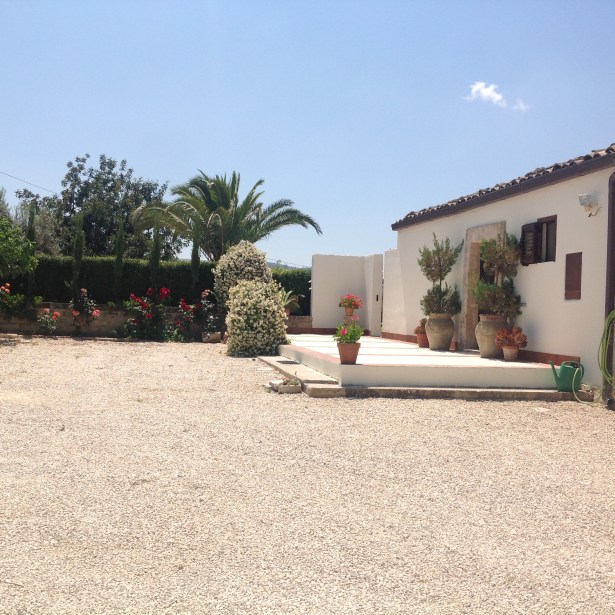
Albero Limone

Albero Limone

Albero Limone, when we find it, is charming; an old stone farmhouse which Ian and his wife Jenny have restored and extended with taste and restraint, set in a lovely garden with pool. The elegance of the pool surroundings has not been compromised by a safety fence, mandatory in Australia. I suppose there is a possibility that my mother-in-law may fall in the pool and drown but I’m willing to take that risk in return for a nice, uncluttered poolside.
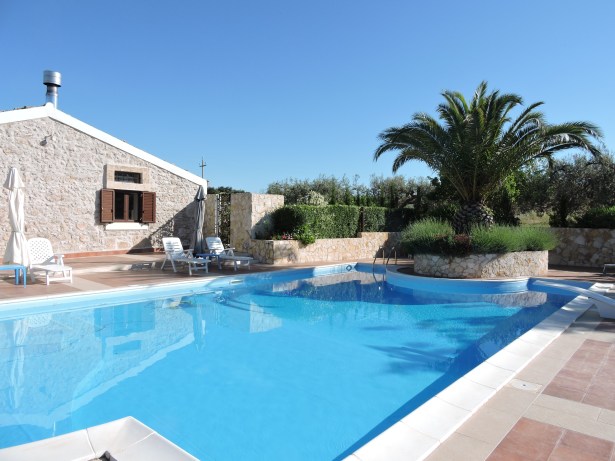
Albero Limone

Albero Limone

There are great clumps of lavender in the garden and the honeybees (apini) are busy. It seems so long since I’ve had the pleasure of hearing the comforting drone of bees. I don’t think I’ve seen a bumblebee (bombini) since I was a child. Sylvia Plath, whose father was an authority on bees, wrote ‘The Bee-keepers Daughter” shortly before she took her life:

In burrows narrow as a finger, solitary bees
Keep house among the grasses. Kneeling down
I set my eyes to a hole-mouth and meet an eye
Round, green, disconsolate as a tear.
Father, bridegroom, in this Easter egg
Under the coronal of sugar roses
The queen bee marries the winter of your year.

Emily Dickinson also wrote of the bee:

Partake as doth the bee,
Abstemiously
The Rose is an Estate
In Sicily

A plump and furry bumblebee docking carefully into the yellow trumpet of a hollyhock. Wouldn’t that be a fine thought to take with you when the Boatman comes to row you across the river?

I’m in a coma; have been for some time. There’s something about the Sicilian countryside, the thin, waving arms of the olive trees, the sun on the pale stones, a hawk cruising in circles in the blue sky and the bottle of wine at lunch under the pistacchio tree that induce fatigue. I came loaded for work with pen, paper and paints, but I’ve been drifting in and out of this coma, hardly able to separate dreams from reality. The hum of Honeybee’s hairdryer brings me, momentarily, back to life. A cloud the size of Africa is about to blot out the sun so I’m going inside for a glass of chilled Frapatto, the colour of a tart’s nail polish.

Plenty of time to reflect on serious issues while lying around the pool. Jesse shows me Woody Allen’s interesting reincarnation plans:

In my next life I want like to live my life backwards. You start out dead and get that out of the way. Then you wake up in an old people’s home feeling better every day. You get kicked out for being too healthy, go collect your pension, and then when you start work, you get a gold watch and a party on your first day. You work for 40 years until you’re young enough to enjoy your retirement. You party, drink alcohol, and are generally promiscuous, then you are ready for high school. You then go to primary school, you become a kid, you play. You have no responsibilities, you become a baby until you are born. And then you spend the last 9 months floating in luxurious spa-like conditions with central heating and room service on tap, larger quarters every day and then voila! You finish off as an orgasm.

Chiaramonte Gulfi is a typical Sicilian hill-town with 8,000 inhabitants and 11 churches. We cross the roofless pizza oven of the central square and dive into the cool and dusty interior of the Chiesa Madre, where Madonna and Child, under a blood red canopy and surrounded by gilt sunrays and angel faces, overlook an altar designed for a Busby Berkeley musical. I love it! This is idolatry at its highest level. Baroque art, the Catholic Church’s counterblast to the Reformation. Not fifty metres from the church is Da Majore, a former macelleria, now a restaurant specializing in a pig-inspired cuisine, which allows for a wide variety of dishes, for the pig is the most versatile of animals. Lamb and chicken will never inhabit a successful sausage. The food is perfect with a pleasing absence of rocket and cherry tomatoes, but the cantina, where we go to choose our wine, leaves Jesse and I weak at the knees. From a cornucopia of amazing wines at absurdly low prices we select a 2007 Prunotto Barbera (18 Euros) and a 2008 Masi Amarone (45 Euros).
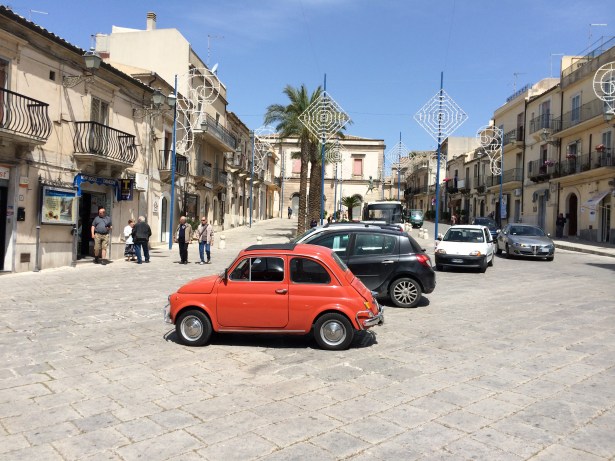
Chiaramonte Gulfi - daytime

Chiaramonte Gulfi – daytime

Chiaramonte Gulfi - at night

Chiaramonte Gulfi – at night

The two jewels of Ragusa province are Modica, an UNESCO world heritage site, and its smaller neighbour, Scicli. Scicli is overlooked by hills of tunneled limestone once home to its ancient, troglodytic people which may explain the height impairment of the present population. Modica, largely rebuilt after the earthquake of 1692, is home to a very particular type of chocolate. The story goes that the Spanish introduced the cocoa bean sometime during their occupation of Sicily in the 16th century along with a recipe for chocolate obtained from the Aztecs. Modica chocolate is made at low temperatures without the addition of butter and other fats. As the sugar does not melt completely, the crystals remain. Personally, I’m too accustomed to Cadbury’s to even pretend to enjoy it. The thing about Modica and Scicli is that they are both vibrant communities rather than Baroque museums and art colonies like Ragusa and Caltagirone.

There are fields of olive all around us, the trees randomly, and therefore attractively, disposed with no thought to the economies of mechanical harvesting provided by planting straight lines. Each tree, as old as the temple columns in Siracusa, has its own character. There is beauty in the contrast between ancient trunk and main limbs and the thin pliant, fruit-bearing branches, which rise at the end like an Australian sentence.
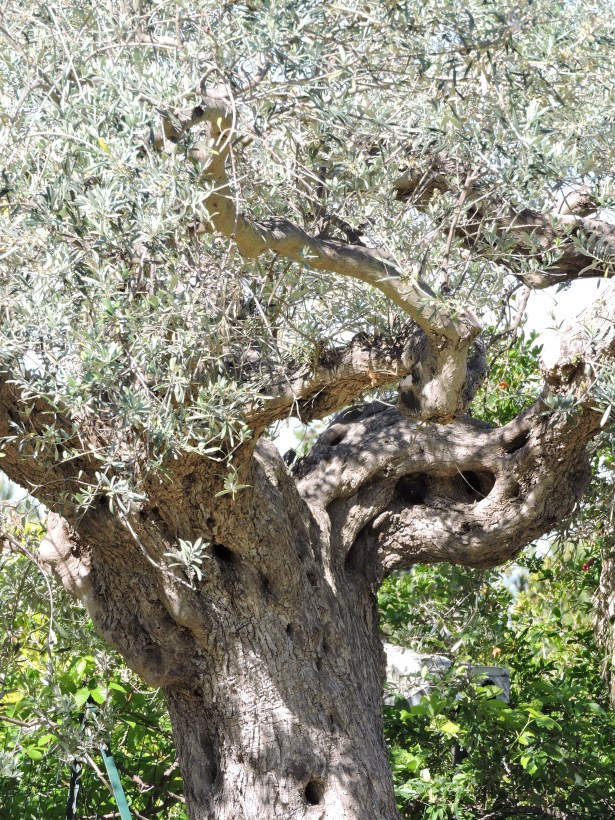
DSCN0591

A Sicilian friend tells me that the current rush of tourists into Sicily, and particularly into the province of Ragusa, is entirely due to a bald Italian policeman. Commissario Montalbano is the principal character in a televised crime drama that has attracted audiences worldwide since the first series appeared in 1999. The stories unfold in Vigata, a fictitious town, a pastiche of various locations from a variety of towns in the province. By chance we are in the Mezzaparola restaurant in Donnalucata, and after a misto arrosto di pesce and a bottle of Grillo we motor on to nearby Punta Secca where Honeybee can pose by the Inspector’s apartment overlooking the beach.

Ispettore Montalbano's apartment at Punta Secca

Ispettore Montalbano’s apartment at Punta Secca

UNDER THE VOLCANO

I’m taking my mother-in-law back to her home in Adrano, a small town on the slopes of Etna. The road from Catania to Adrano is Hellish, the hard shoulder strewn with litter, the weeds as high as an elephant’s eye. It is a road of shrines with frequent bunches of flowers, sometimes in a vase or even with a small marble tablet, marking the spots where a son or husband failed to make the sorpasso. What were the circumstances in the 18th and 19th centuries that allowed the citizens of Adrano to build elegant houses and fine churches when now there are insufficient funds to collect the rubbish and efface the graffiti from the park walls? The town resembles Ramadi, the Iraqi town torn apart in American Sniper; was it filmed here? Many of the houses on the outskirts remind me of Osama Bin Laden’s depressing compound in Abbottabad. My mother in law’s apartment is typical; armchairs the size of elephants, pictures of Saints and Popes, china figurines and photos of grim looking ancestors.

On the other hand this is real Italy, a town without hotels, tourists or Michelin starred restaurants, a town where people are courteous and look out for each other, a town without traffic lights or visible pedestrian crossings where the roads are a shared space between people and vehicles. The Café Europa serves the best granita di mandorle and brioches in all of Italy and if you become depressed by the immediate surroundings you can always look up and see the big, white diamond of the volcano against the blue sky.

I’m in one of the most important places in town, the Tabaccheria. For those who remember the days when smoking was an elegant pastime, when one could enjoy the aroma of smouldering nicotiana tabacum in peace, relax watching a curling column of rising smoke from a Passing Cloud, feel the solid comfort of a silver Dupont in your hand or inhale the burst of sulphur from a freshly struck match; for all of you I attach these images of Murattis, Chesterfields and Camels, glorious names from a freer past. Now that the display of cigarette brands is prohibited in Australia, pictures like this will soon be harder to find than dirty postcards in a Seminary.

Vietato ai minori di 18 anni

Vietato ai minori di 18 anni

Not much for the young to do in this town except work on a scratchy, listen to the partita on the radio, drink 15 espressos a day, lean on your Vespa on the street corner, shave your head or get a new tattoo. No wonder love, inexpensive and absorbing, is treated seriously. Here, on the walls of the park, written in spay-paint by an Italian Cyrano, is this pitiful tale of the unparalleled agony of love rebuffed, of a suit declined:

Vaffanculo, Tere’
Non credete nell’amore
Tutto questo per te
Ricordi … vorrei dimenticarti ma non riesco…Ecco!!!!
Ci sei riuscita. Addio e’ FINITA
Ti ho dato il mio cuore
Me lo hai ridotto cosi, verde come il veleno…Distrutto
Sei una falsa, ipocrita, bugiarda e stronza!

Go xxxx yourself Teresa. You don’t believe in love.
All this for you
Memories…I would like to forget you but I cannot
You have succeeded. Goodbye IT IS OVER
I gave you my heart
You have reduced me to this – green, like poison……Destroyed
You are false, a hypocrite, a liar and a bitch!

IMG_2504

I would like to meet the young author, buy him a drink, counsel him, tell him how, even after 50 years, irritating scar tissue will continue to remind him of the pain he felt when he wrote those words.

In spite of its cold winters, the culture of Sicily is focused on keeping cool, hence the polished granite floors, the metre thick walls of Albero Limone, the permanently shuttered windows and the cult of the gelato. And so, on our last night, Matteo drives us 19 kilometres to Bronte for pistacchio ice cream. I go to sleep under a particularly harrowing crucifixion in painted terracotta.

And so we leave Sicily, careful to obey the parking regulations for pedestrians……
IMG_2200


A WEDDING IN SARDINIA

We are staying at Sa’ Manda, an agritourism resort where tomorrow Simone and Eleanora will be having their wedding dinner. Soon after we arrive Andrea and Marta pick us up and we go to dinner in the nearby seaside town of Alghero, so called on account of the amount of algae in the water. Here is another ancient and attractive town that has lost all self-respect, a whore ravished daily by coachloads of modern day Visigoths. In the narrow streets of the centro storico the Algherese have retreated into their kitchens and opened their street front sitting rooms to diners and the seekers of souvenirs. On the seafront, music from the lower ranks of the Eurovision Song Contest serenades the clientele of the vast pizzerias. After a long search we settle into Mirko’s small parlour, which he has refurbished as a Trattoria and have a perfectly respectable Fregola con gamberi.

The English do nice weddings; Ladies in big hats, men in morning suits, flower-stuffed village churches in the Cotswolds; but the Italians also do it well, perhaps in a less choreographed, more intimate way. It is Andrea’s elder brother, Simone, who is getting married and the next morning we witness him on his knees as the family anoint him with rose petals and bless him before we go to the Chiesa di Santa Caterina in Sassari’s centro storico. There’s no communal hymn singing but Simone’s zia Adriana fills the vast knave with a voice so clear and pure that I’m reduced to tears and on the verge of conversion to the Catholic faith. There’s applause as Simone and Eleonora emerge into the sunlight to be showered with rice and confetti (still legal in Italy) before we all go to dinner at Sa’ Mandra.

IMG_2537

I cannot begin to tell you how grateful I am to be part of this large and generous Sardinian family and very honored tonight to be sitting at the table with the senior uncles. Porcetto allo spiedo stillato con gocce di lardo and a glass of Santa Maria La Palma Cannonau. Heaven. Like every other special occasion in Italy the wedding dinner coincides with an important partita, this time the European Cup Final. Guests consult their i phones between mouthfuls of capretto con finochietto selvatico and waiters are sent off to bring back the latest score. The match is between Juventus, a Torinese team, and Barcelona, but it is not a match between Italy and Spain, it is a contest between Turin and the rest of Italy and when the final whistle blows with Barcelona the winners, our waiter strips open his shirt to reveal an Intermilan jersey, demonstrating to the assembled diners his pleasure at his rival city’s loss.

After dinner the dancing begins. Uncles, aunts, friends, mothers and brothers all on the floor clapping, hopping and twisting, forming snaking conga lines to Chubby checker and Pat Boone but mostly to the romantic Italian music of the 70s.

LA MAREMMA

Campiglia Marittima, another un-spoilt hill-town, where Ann has kindly lent us her house, an ancient building which she has restored in her inimitable style, respecting its simple period style while discretely incorporating all the necessary mod-cons. The town is quiet with only the occasional tourist, mostly of the serious, bearded variety working on small watercolours. In the central piazza two cafes compete for our breakfast and aperitif business while, underneath Ann’s house, Rosy provides the sort of home cooking that makes cooking at home unnecessary.

La casa di Ann

La casa di Ann

Near the town of Venturina, a 10 minute drive from Campiglia, is the spa of Il Calidario with its natural warm springs. We spend the morning in and out of the outdoor thermal pool and the afternoon we are bathed, roasted, steamed and massaged in the indoor tepidarium designed to resemble the Etruscan baths that once stood here.
 

Il Calidario, Venturina

Il Calidario, Venturina

Along the thin, umbrella’d littoral of the Alta Maremma are a series of stazioni balneari and Alex has directed us to her favourite (shortly to become mine). At Bagno Skiuma, which I doubt I could ever find again, we rent umbrella and deck chairs on the largely deserted beach and toast and soak until lunchtime when we sit down to spaghetti alle vongole and sorbetto al limone in the restaurant. A bottle of Antinori Scalabrone and I collapse in a coma on the beach for the rest of the afternoon, but the lunch was so outstanding we return the next day for a bis.

We move to Vada where Alex, in festive mood having put to bed another Business Plan, takes us to dinner at La Barcaccina on the sea front where the water is as flat and calm as my mother’s gravy, which is not, fortunately, on the menu. An outstanding meal of crudo di mare and a superb orata al forno accompanied by Champagne, a chilled Pinot Nero from Alto Adige and a vintage grappa, which seems to have aged better than me. Alex, you should write a personal guide to the food and wines of La Maremma; no one could be better qualified.

Bagno Skiuma

Bagno Skiuma

Alex takes us to Castiglioncello, which is remarkable for a number of reasons but all with roots in the beauty of this rocky promontory pointing out into the Tyrrhenian Sea with its sandy beaches and forests of pini marittimi. In the mid 19th century the Macchiaioli, a school of Tuscan painters who painted in macchie (patches of light and shade) and alla prima like the Impressionists, found inspiration in Castiglioncello. Later Luigi Pirandello, the Bulgari family and Lucchino Visconti all built villas here. But it was in the 1950’s, the Dolce Vita years, that Castiglioncello became a summer escape for Vittorio Gasman, Marcello Mastroianni, Alberto Sordi and other stars of Italian cinema. During the economic decline and the tangentopoli scandal of the 1980s the resort fell on hard times but is now, happily, experiencing a revival.

At Dai Dai (literally c’mon c’mon), a wine bar famous for its bite sized choc-ices, I spot a framed painting of Moana Pozzi. The subject is angel-winged and seated, with breasts bared and a bunch of red grapes covering her business parts. Blonde, beautiful and smart, at 20 she was the lover of Prime Minister, Bettino Craxi, who helped her get a job in a children’s show on television. That same year (1981) she performed in her first hardcore porno movie Valentina, Ragazza in Calore. In the ensuing scandal she lost her job in television but became the first Diva of Italian Porn and launched the Golden Age of the Blue Movie. Apart from her film fans, she won respect from other Italians as an informed and eloquent pundit on talk shows and for her (unsuccessful) bid to become mayor of Rome. She died in France at the age of 33 in mysterious circumstances. At the top of the painting the words Beata Santa appear; they point to the gradual Beatification of this remarkable Mary Magdelene, who with the approval of the Italian people, continued to sin until the very end.

VERONA

Verona, still beautiful, but much changed since we lived here in the 1980s. Since then it has become the fourth most visited city in Italy, but whereas the tourists are spread thinly over the much wider areas of Rome, Florence and Venice, here they are clustered in the small centro storico. I raise my arm to point out a church tower and 20 or 30 Japanese tourists follow me into the Piazza Dante. The number of tourists taking pictures in the Piazza Erbe makes it inevitable that my image will shortly be appearing on 10,000 screens from Copenhagen to Kobe. Glacial, white Scandinavian legs gleam on the pink marble pavements. In the Via Mazzini, many of the old independent shop owners have sold out to international chains. The windows of Guelphi e Barbotini, once the most elegant of bookshops, are now filled with unremarkable ladies underwear. The ferramenta, which once sold artists’ pigments and raw alcohol for your alembic or home made limoncello, now sells handbags.

We are staying in an apartment in I Filippini, overlooking the river. The apartment is very pleasant with floor to ceiling mirrors everywhere, presumably to give the sensation of non-existent space. Nothing is more horrible than waking up next to myself. In the corridor I see four of me turn into the tiny bathroom as if in one of David Copperfield’s illusionist tricks. Honeybee goes to look at our old house around the corner in the aptly named Vicolo Satiro (Satyr’s Alley), but I sense the onset of depression just thinking about it.

Lunch with Honeybee and Andrea at the beautiful Osteria Ponte Pietra. We eat on the terrace overlooking the fast-flowing Adige and overlooked by envious tourists on the bridge. We start with cappesante and tartare of crustacians followed by coda di rospo. As I raise my glass of Lugana I can see a crocodile of tourists sweating up the steps of the Roman Theatre on the far bank, which somehow seems to improve the taste of the wine.

With Andrea at Osteria Ponte Pietra
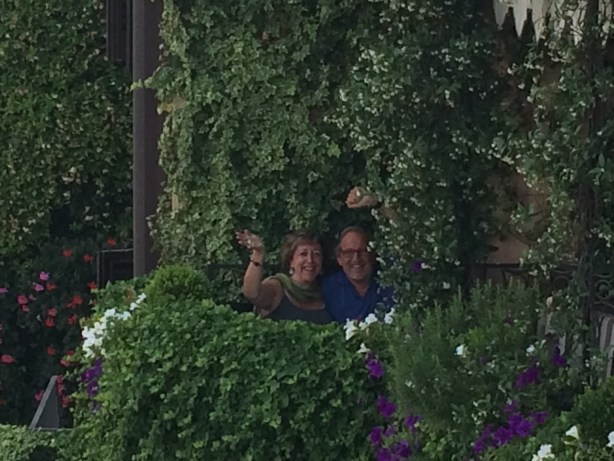
With Andrea at Osteria Ponte Pietra

View from Ponte Pietra

View from Ponte Pietra

Our last night in Italy. We are with Paolo in the leafy suburbs of Gallarate, a few kilometres from Malpensa airport, when we fall upon hidden treasure, La Tana del Lupo. Weeks after our return home I still look at the bill in disbelief. A glass of Prosecco, antipasti of grilled anchovy and scamorza cheese fried in breadcrumbs, two superb risotto dishes and a plate of Dublin Bay Prawns flambeed in Cognac. A selection of cheeses and fresh figs, a bottle of excellent Pinot Noir from the Alto Adige, Limoncello, friandises and coffee. 3 covers, 65 Euros! I’m having it framed.


(1) After the side-whiskers worn by Lord Dundreary in the play Our American Cousin, the play Abraham Lincoln was attending when he was assassinated by John Wilkes Booth.

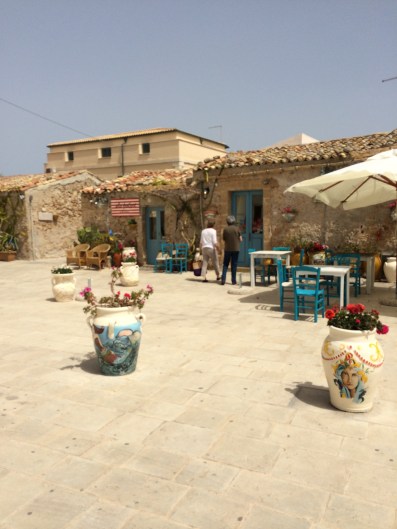
MONSIEUR BLONDEAU

As the hotel employee said to George Best when he found him in his suite, lying on a bed of banknotes in the arms of a naked Miss World, ‘Where did it all go wrong?’ Perhaps for some, a qualitative deterioration in life began when they first started serving salad with fish and chips. But probably the seeds of our self-destruction were already planted in our ancestors before they even hauled themselves out of the primeval bog and on to dry land. It was the same when their descendants ventured from the green comfort of the Great Rift Valley and trailed north, oblivious of impending climate change. And it was the same when their colonising descendants returned to the Heart of Darkness and to a zoonotic disease that would spread to all four corners of the earth. Shamans will say of our occasional, and ultimately final, tragic destiny ‘it is written’; Higgs and Boson will say it is in our DNA and will be looking for it with microscopes.

For Monsieur Blondeau things started to go spectacularly wrong close to his fortieth birthday in the 1970s. It was at a time when labour-intensive investment was shifting from the old to the new world and, as in many a calamity, it was the wider issue that triggered the personal. It was a time when the satanic mills and coalmines of Europe were being dismantled and abandoned, a time when great and ancient shipyards on the Mediterranean shore, on the Clyde and in Belfast were closing, skeletal cranes marking their graves along the seashores and banks of estuaries. It was a time when riveters of ships’ plates and deep seam miners began to join the list of skilled workers lost to progress, along with the fletchers and coopers, the thatchers and cordwainers. Remnants of the Industrial Revolution, like Ironbridge, and more modern structures like Battersea Power Station, were turned into museums. The only Western European countries attempting to modernise their heavy industries were Russia and its Polish satellite; the rest of Western Europe turned to tourism, printing T-shirts and gambling, or dealing in futures and options as the financial community prefer to call it.

Among the first countries to invest in the steel industry abandoned by Britain, France and Germany were Brazil and Venezuela. Part of that huge investment was spent on the rolling-beam and rotary hearth furnaces supplied by the French engineering company where I was employed, and I found myself travelling back and forth to South America in the process of organising our commercial presence in those countries. The contracts prescribed the establishment of branch offices, limited production and the training and use of local labour. These were long-term contracts requiring the expatriation of scores of French engineers and their families for two or three years. Monsieur Blondeau, a tall, dark draughtsman of few words was one of the first to volunteer. His wife also worked in the company as a secretary and it was agreed that she would accompany him and provide administrative help in the plant and accounting office we were setting up in an industrial estate close to the town of Campinas, some 80 kilometres from Sao Paulo.

As I went back and forth to Brazil I learned more about the Blondeau family. The husband and wife were leaving two daughters, one of whom was married, and a son behind. The son was serving a prison sentence for drug-related offences and the unmarried daughter was in a nursing home suffering from a nervous breakdown. The day before I was to leave on one of my trips to Brazil I was asked to take Monsieur Blondeau’s unmarried daughter with me. It was arranged that a doctor would release the girl into my care at Orly Airport and her parents would be at the airport in Sao Paulo to collect her. And so it was that Blondeau’s daughter, sobbing incessantly throughout the whole trip and soaking the sleeve of my suit jacket, flew into an altogether new and more hideous nightmare.

The day before I was due to return to Paris, I found the Blondeau family reunited, happy and smiling by the pool at the country club. Their reunion was tragically brief. One month later Monsieur Blondeau was driving his wife home from a restaurant along one of Brazil’s many pitted and unlit highways when he ran full pelt into the back of an unlit, stationary truck. Wooden planks, protruding beyond the tail-board, sliced through the car’s windscreen, decapitating Madame Blondeau. Her husband was unhurt. Within days he was back in the office with his usual placid smile as if nothing had happened.

Shortly after the death of Madame Blondeau I was sent to Brazil on a more permanent basis. Complications caused by an inflation rate of 10% per month, the resignation of the local General Manager and delays in the Brazilian Government’s payment schedule had forced French management to reinforce its team in Brazil.
Three of us set out, P-J to be General Manager, EM to beef up the engineering side and myself as CFO to risk sending the whole operation into bankruptcy. We had only been in Brazil for a short time when we learned that the recently bereaved Monsieur Blondeau was living with one of the Brazilian secretaries we had employed locally. A sensuous black girl from Bahia, she was half Blondeau’s age, attractive, ambitious and self-confident to the point of insolence. Within months she had fallen out with Blondeau’s daughter and driven her out of the home.

The Mayor of the quiet and prosperous town of Campinas, where Blondeau, his daughter and girlfriend lived, had decreed that no bars, brothels or gambling were to be allowed within the city’s precincts. All of these forms of entertainment were contained in a special enclosed area outside of town near the international airport. This red-light city, ringed by a barbed-wire fence with a permanent police presence at the sole point of entry, was known as the “Zona” and it was here that Monsieur Blondeau’s rejected daughter went to live and to earn her living as a prostitute. There was no way out of the Zona. Her neighbours were all brothel madams, drug-dealers, pimps and fellow whores. Soon pregnant and later the mother of a baby boy, she left the Zona only long enough to deposit her son into the care of her father and his Bahian mistress. Strangely, the added distress of his daughter’s circumstances did nothing to remove Monsieur Blondeau’s permanent grin of contented complacency.

Like all the expatriates, Monsieur Blondeau was entitled to an annual trip back to France for himself and partner. And so it was that I approved the purchase of two return tickets from Sao Paulo to Paris via Rome. On the day of Blondeau’s departure, even as his plane lifted into the evening sky over the Zona, I took a call from someone wishing to talk to the departing Frenchman. The caller identified herself as Blondeau’s elder, married daughter. Incoherent in her misery, I was unable to understand her problem and could only tell her that her father would be in Rome in 12 hours time and in Paris 2 days later. Blondeau arrived in Paris to the news that his daughter had been killed in a domestic fight on the evening I had taken her call. Some weeks later he reported back for work. There was no outside sign that the latest tragic event in his life had upset his normal cheerful composure.

With his wife and eldest daughter dead, his son in prison, his younger daughter a prostitute and his mistress the sulky ward of his daughter’s illegitimate child, there seemed nowhere to go but up. But fate and the company President had other ideas. And so it was, on the President’s next visit to Brazil, that Monsieur Blondeau was fired. Electing to remain in Brazil, he bought a nail-making machine with his redundancy package, grew a big black beard and settled down in a shanty suburb of Campinas with his grandson and his black mistress.

The ancient Greeks believed that on the third night after a child’s birth the Moirai (the Three Sisters of Destiny) would decide the course of the child’s life. Clotho would spin the thread of life, Lachesis would tailor it and Atropos would decide when the thread would be cut and life ended. Perhaps Monsieur Blondeau’s composure in the face of tragedy lay in accepting the destiny the Sisters had designed for him. Or perhaps Tyche, daughter of Aphrodite and Hermes and Goddess of Luck, played a part, because I’m not sure, even now, whether Monsieur Blondeau was the luckiest or the unluckiest man I ever knew. Perhaps to endure those disasters and to end up self-employed in the dreamy tropics with a young Bahian mistress was more than he could ever dream of.


George Best: Gloriously talented Manchester United and Northern Ireland footballer who self destructed in 2005 at the age of 59. ‘I spent a lot of money on booze, birds and fast cars; the rest I just squandered.’